
I recently walked back into a big-box commercial gym after three years in my garage. The smell of industrial cleaner and the sound of fifteen different Bluetooth speakers was a sensory assault. I stood there staring at rows of different workout machines at the gym, trying to remember why anyone needs a machine specifically for their hip adductors while the only two power racks had a twenty-minute wait. It is easy to feel lost in that sea of purple and yellow steel, but most of those stations are just taking up space.
- Stability equals muscle: Machines allow you to push to absolute failure without worrying about dropping a barbell on your neck.
- Focus on 'Heavy Hitters' like hack squats and converging presses for maximum tension.
- Avoid 'filler' machines that isolate tiny muscles you are already hitting with big movements.
- You can replicate 90% of a commercial gym floor at home with just one or two versatile pieces.
The Sea of Steel: Why the Commercial Floor Is So Confusing
The commercial gym floor is a maze designed by people who love floor-plan efficiency more than biomechanics. You see fifty variations of the same bicep curl, but only one decent squat rack. This layout traps beginners into doing 'junk volume'—performing four different movements that all hit the same muscle just because the machines are sitting next to each other. It feels productive because you are sweating, but you are often just spinning your wheels.
Most big-box gyms prioritize isolation units because they are 'safe' for the general public. They want you sitting down, locked into a fixed path where you cannot hurt yourself or the equipment. The problem is that many of these machines ignore how your joints actually want to move. If you are not careful, you end up with a workout that is high on effort but low on actual mechanical tension. You do not need twenty different stations; you need the five that actually work.
Gym Equipment and What They Do: The Heavy Hitters
To really understand gym equipment and what they do, you have to look at the tension curve. Unlike free weights, where the load often disappears at the top or bottom of a movement, high-quality machines use cams and cables to keep your muscles under fire throughout the entire range of motion. This is the secret to hypertrophy.
Lower Body: Hack Squats and Leg Presses
The Hack Squat is the undisputed king of the machine floor. It locks your back into a fixed, angled position, which removes the 'lower back limit' often found in barbell squats. This allows you to drive your quads to absolute failure safely. A 45-degree leg press is a close second, provided you do not ego-press 1,000 lbs with a two-inch range of motion. These machines provide the stability your nervous system needs to recruit the maximum amount of muscle fiber.
Upper Body: Converging Chest Presses and Cable Rows
Look for 'converging' machines. Instead of pushing a straight bar in a flat line, the handles move slightly inward as you extend. This mimics the natural path of your pectorals. Similarly, cable rows are essential because they allow you to adjust the handle height to hit different parts of your lats—something a fixed barbell row simply cannot do. The constant tension of the cable means your back is working from the second you pull until the second you reset.
The 'Skip It' List: Shiny Stations That Waste Your Time
The rotary torso machine is a back tweak waiting to happen. It forces your spine to rotate under load in a way that feels unnatural and rarely translates to real-world strength. Then there is the inner/outer thigh machine—unless you are a competitive bodybuilder looking for that last 1% of detail, your time is better spent on lunges or squats. If a machine feels like it is forcing your joints into a weird, pinchy angle, trust your body over the shiny paint job. Most of these 'filler' machines are just there to make the gym look more 'complete' to new members during a tour.
Replicating Gym Equipment What They Do Best at Home
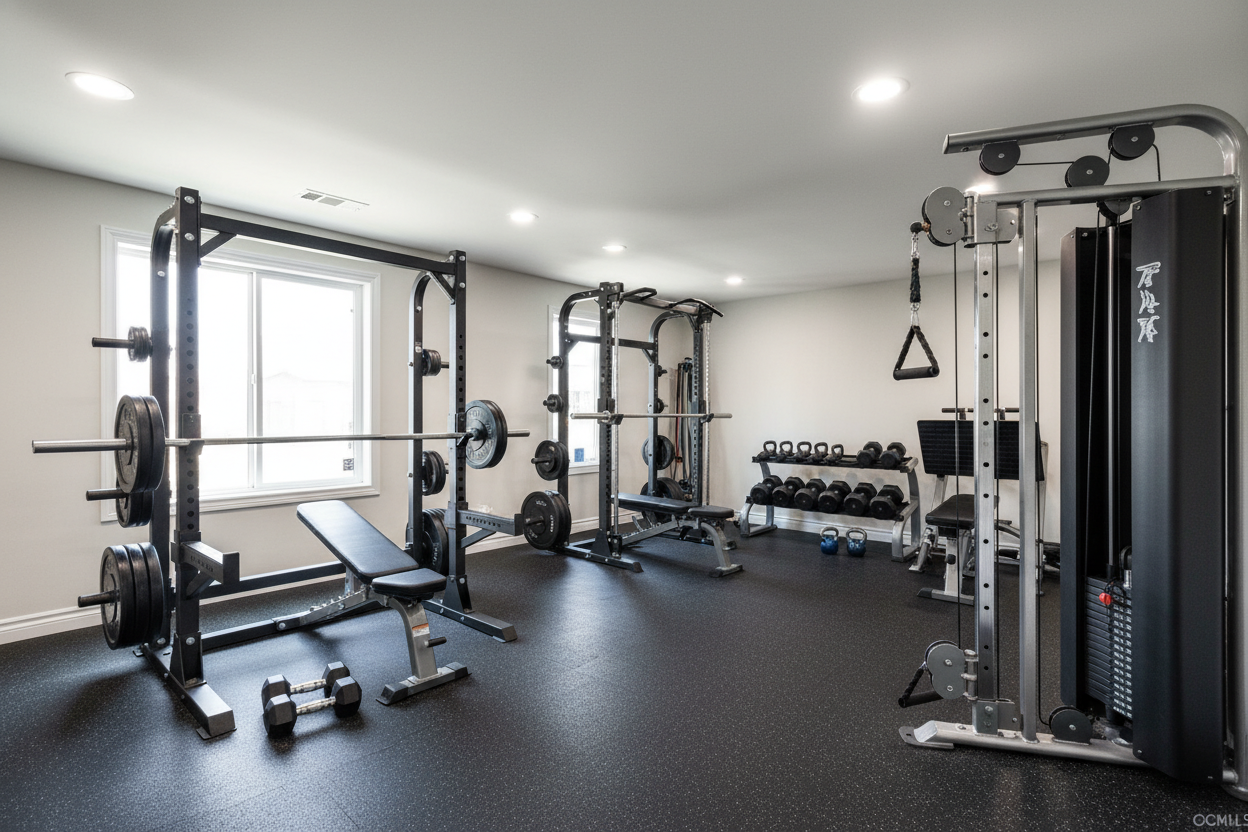
If you are tired of the crowds and the 'out of order' signs, you can get these same benefits in a garage. You do not need 5,000 square feet. A Smith machine home gym station is basically five commercial machines in one. It gives you that fixed-path stability for heavy squats, overhead presses, and rows without needing a spotter. It is the ultimate space-saver for someone who wants the safety of a machine with the versatility of a rack.
For leg day, you do not need a massive commercial leg press. A high-quality bench with a leg extension curl station allows you to hammer your quads and hamstrings with the same isolation focus you would get at a big-box gym. I have found that having these few key pieces at home actually leads to better gains because I am not waiting thirty minutes for a teenager to finish texting on the leg extension.
Stop Machine-Hopping and Start Programming
Pick two big compound movements and one isolation machine per session. That is it. Stop wandering from station to station like a lost tourist. When you realize the best at home gym equipment is often just a more efficient version of these commercial staples, the transition to training on your own terms becomes a no-brainer. Focus on the machines that allow you to move the most weight through the longest range of motion, and leave the 'coat racks' for everyone else.
Personal Experience: The 'Optimization' Trap
I once spent six months doing an 'all-machine' hypertrophy block because I thought I was being smarter than everyone else. My numbers on the machines went through the roof. I felt huge. But when I finally stepped back under a 315-lb barbell, I felt like a newborn giraffe. My stabilizer muscles had completely clocked out. The lesson? Use machines to finish a muscle off, but do not let them become your entire personality. They are tools, not a replacement for foundational strength.
FAQ
Are machines better than free weights for beginners?
They are safer for learning movement patterns and building initial muscle, but you should still learn to move your own body weight and handle a barbell eventually. Machines are a great starting point to build confidence.
How do I know if a machine fits me?
Your joints (knees, elbows, shoulders) should align with the pivot points on the machine. If you feel a 'pinch' or 'pull' in your joints rather than tension in the muscle, the machine is not adjusted correctly for your height.
Can I build a pro-level physique using only machines?
Yes. Many top-level bodybuilders use machines for 80% of their training to minimize injury risk. However, for general health and 'functional' strength, mixing in some free weights is usually better.
Share:
Stop Buying Cement-Filled Junk: The Truth About Cheap Weight Sets
Why I Finally Upgraded My Home Gym With a Dumbbell 30 kg