
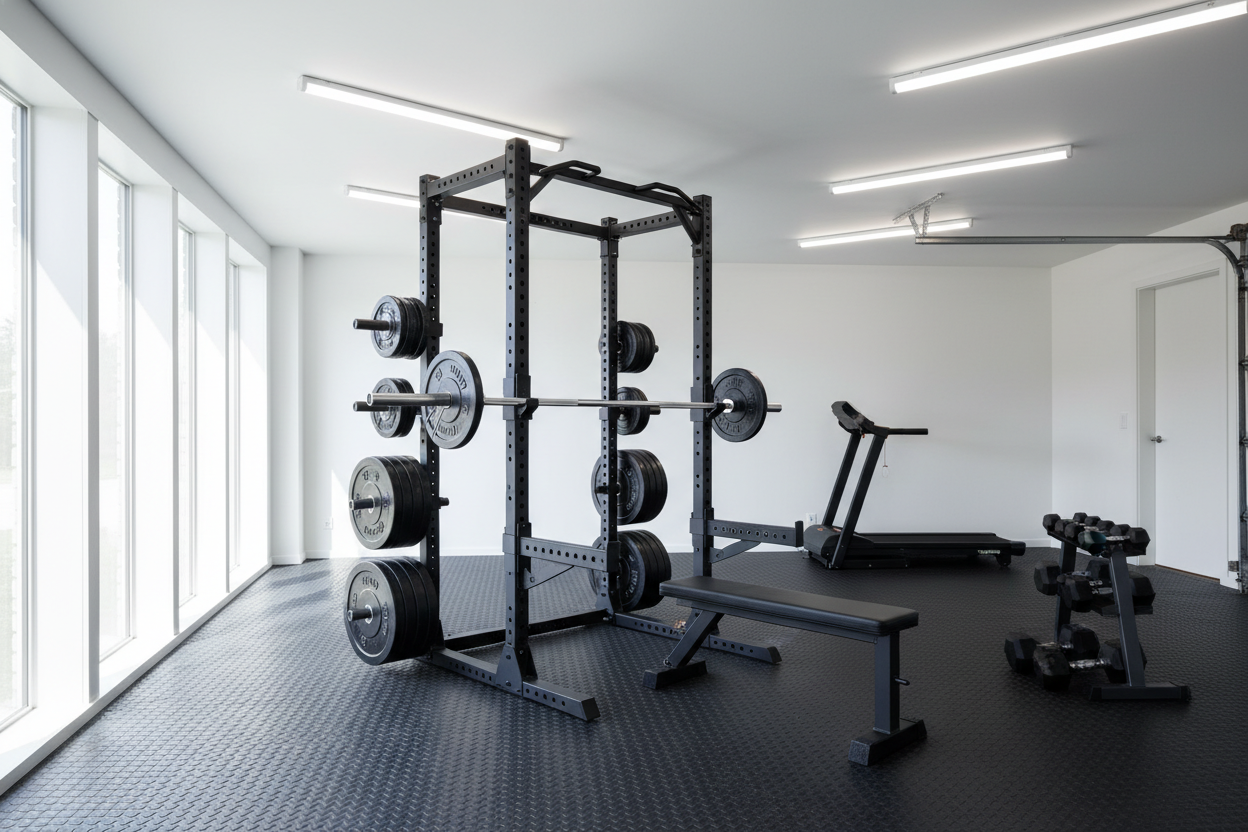
I remember staring at a $2,500 functional trainer online, measuring my garage floor for the tenth time. I was convinced I needed those pulleys and selectorized stacks to get a 'complete' workout. Then I looked at the free weight barbell leaning against my workbench and realized I was about to pay a premium to make my workouts less effective and my floor space non-existent.
Quick Takeaways
- A barbell takes up 1/10th the space of a multi-gym tower.
- Free weights force you to stabilize the load, building more functional core strength.
- You can't outgrow a quality bar; you just add more plates.
- Maintenance is almost zero—no cables to snap or pulleys to grease.
The Multi-Gym Trap Most Garage Lifters Fall Into
We’ve all been there. You get a wild hair to start training at home, and your first instinct is to recreate the local powerhouse gym in a 10x10 spare room. You start looking at those massive multi-station towers that promise 50 exercises in one. Here is the reality: those machines are usually built with thin-walled 14-gauge steel that wobbles the second you put more than 135 pounds on the carriage.
I’ve tested towers where the cable pull felt like it was dragging through sand because the plastic pulleys were so cheap. You end up with a limited range of motion that doesn't fit your body's natural mechanics. After three months, once the novelty wears off, that $1,500 monstrosity becomes the world's most expensive coat rack. You can't deadlift on it, you can't safely squat to depth, and you're stuck in a fixed path that usually irritates your shoulders more than it builds them.
Why a Free Weight Barbell Is the Real All-In-One System
If you want to get strong without turning your garage into a cluttered mess, you need to master the 'Big Four': the squat, bench press, deadlift, and overhead press. A single high-quality Olympic Barbell is the only tool that allows you to train every single one of these movements with infinite scalability. You aren't limited by a 200-lb weight stack; you're only limited by how many plates you can slide onto the sleeves.
The versatility of barbell free weights is unmatched. With one bar, you can do rows for your back, curls for your arms, and lunges for your legs. I’ve spent years training in 400-square-foot spaces where every inch mattered. A bar and a stack of plates can be tucked against a wall when you’re done. You get a total body stimulus that a machine simply can't replicate because the bar doesn't have a 'track'—you are the machine.
The Stabilizer Muscle Reality Check
When you use a machine, the equipment handles the balance for you. When you use barbell and free weights, your nervous system has to fire every tiny stabilizer muscle in your trunk and joints just to keep the steel from crashing down. This is where real-world strength is built. If you can't balance the weight, you can't move the weight.
I used to think machines were 'safer,' but locking your joints into a rigid, predetermined path is a recipe for overuse injuries. In my guide on Smith Machine Versus Free Weights: Why Barbell Purists Are Half Right, I break down why that guided track can actually put more stress on your connective tissue than a free-moving bar. Fighting gravity in three dimensions forces your core to stay tight, protecting your spine and building a frame that actually holds up outside the gym.
The Only Accessories You Actually Need to Complete the Setup
You don't need a 12-piece attachment kit. To make a barbell setup work, you need two things: a squat stand and a bench. A heavy-duty squat stand with a 1,000-lb capacity takes up a fraction of the footprint of a full power cage. It gives you the safety of J-cups for your squats and a stable base for your presses.
Pair that with a rock-solid Adjustable Weight Bench Owb01, and you’ve just unlocked incline presses, seated rows, and Bulgarian split squats. I’ve seen guys spend $5,000 on 'smart' home gyms that have half the utility of a $300 bench and a $200 set of stands. Look for a bench with minimal gap between the seat and backrest—there's nothing worse than your butt falling into a hole while you're trying to set a PR on the bench press.
Stop Overcomplicating Your Floor Plan
The biggest mistake I ever made was buying gear based on what I 'might' do. I bought a leg extension attachment I used twice. I bought a lat pulldown bar that sat in a box for a year. Every piece of extra junk is just another distraction from the heavy lifting that actually changes your physique. Stop scrolling for gimmicky attachments. Get a bar, get some plates, and get to work. When your gym is simple, your focus is sharp. Less gear means more intensity, and intensity is what gets results.
FAQ
Is a barbell harder to learn than machines?
Yes, there is a learning curve. You have to learn form and bracing. But that 'difficulty' is exactly why it works better. You're teaching your body how to move as a single unit rather than isolating parts like a car engine.
How much space do I really need?
A standard Olympic bar is 7 feet long. You need about 8 to 9 feet of width to comfortably load plates without hitting a wall. If you have that, you have a gym.
Will a barbell damage my garage floor?
If you're deadlifting, yes, eventually. Grab a couple of 4x6 rubber stall mats from a farm supply store. They're cheap, nearly indestructible, and will save your concrete from the impact of heavy iron.
Share:
Why Most Fitness Bundles Are Trash (And the Best At Home Workout Set)
Can a Cardio Brand Build a Good Proform Weight Bench With Weights?