
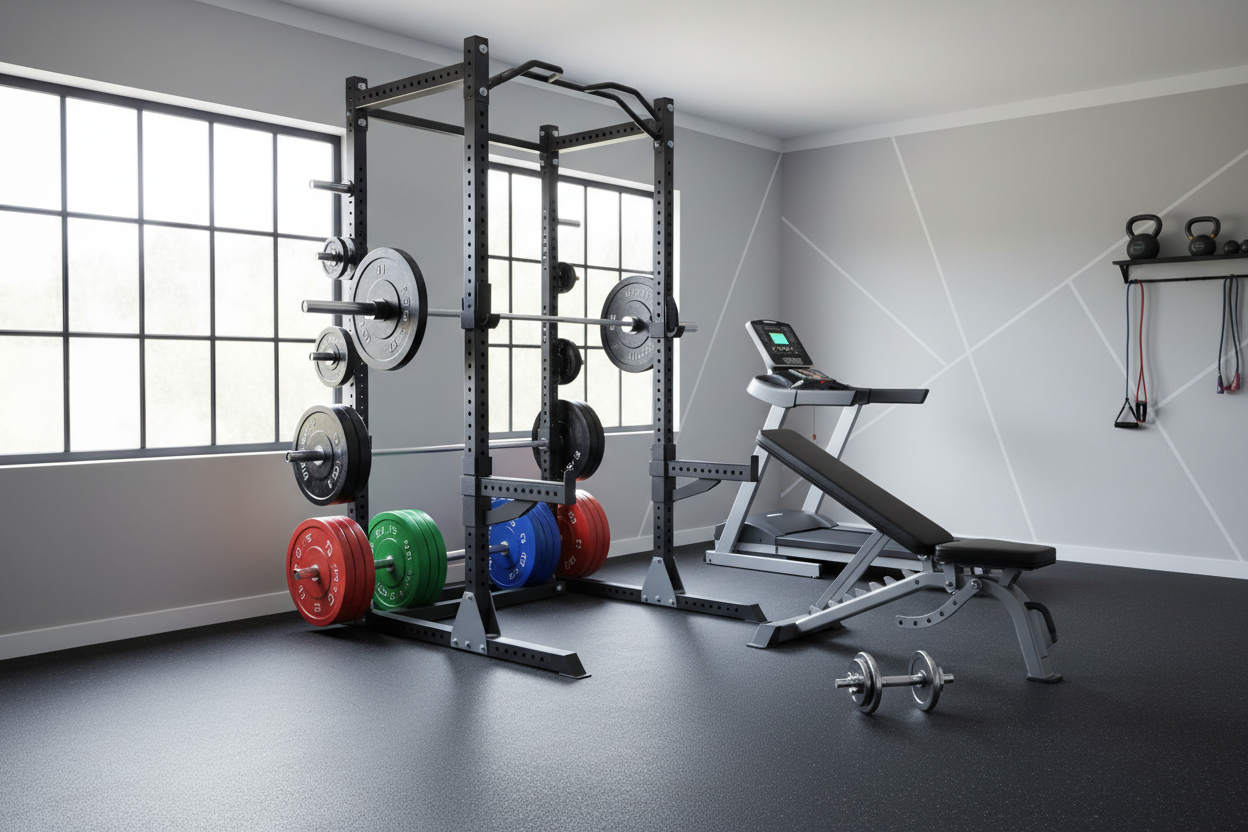
I have spent more time in my garage than in my living room over the last decade. I have also spent thousands of dollars on steel that eventually ended up as scrap metal because I fell for the 'Top Rated' trap. Most people start their search for good at home exercise equipment by sorting by price and star rating, but that is exactly how you end up with a squat rack that sways in a light breeze.
- Ignore reviews written within 24 hours of unboxing; they tell you nothing about durability.
- Look for 11-gauge or 12-gauge steel for anything supporting your body weight.
- Prioritize hardware size—5/8-inch or 1-inch bolts are the industry standard for safety.
- Budget for your 'big three' (rack, bar, bench) and save on the rest.
The 5-Star Review Trap (And Why It Costs You Money)
The problem with online ratings is the 'honeymoon phase.' A beginner buys a $150 flat bench, puts it together in twenty minutes, and gives it five stars because it looks shiny. They haven't actually tried to hit a PR on it. They haven't seen the vinyl crack after three months of sweat exposure or felt the frame start to twist under a 200-pound load.
I survived using cheap gear for my first year of training, but the anxiety of wondering if my equipment would fail was a massive distraction. Good workout equipment for home should be boring. It should sit there, heavy and silent, doing its job without you having to worry about a weld snapping mid-set. Real quality gear often has 4-star reviews because the people buying it are experienced lifters who actually know when a knurling pattern is slightly off or a powder coat is prone to chipping.
What Actually Makes Good At Home Exercise Equipment?
Stop looking at the glossy marketing photos and start reading the spec sheet. If a company doesn't list the steel gauge, run away. In the world of strength gear, a lower gauge number means thicker steel. You want 11-gauge steel for your heavy-duty home gym pieces. It is the difference between a rack that feels like a tank and one that feels like a birdcage.
Check the upholstery too. Cheap benches use open-cell foam that compresses to the board the moment you sit down. High-quality gear uses dense, closed-cell foam that supports your spine. You also want to look at the footprint. A 2x2-inch frame might save space, but a 3x3-inch frame with 1-inch holes gives you the versatility to add high-end attachments later as your training evolves.
The Static Weight Capacity Lie
Manufacturers love to brag about '1,000-lb weight capacities.' Here is the secret: that is usually a static rating. It means the bench can hold 1,000 lbs if you place it there gently with a forklift and never move it. It does not mean the bench is stable when you are wriggling into position with a pair of 100-lb dumbbells. A bench with a high static rating but a narrow base is still a safety hazard.
When to Save vs. When to Go Heavy-Duty
You do not need to buy commercial-grade everything to have the best equipment for at home workout success. You need to spend money where the stakes are high. Your squat rack and your barbell are non-negotiable. If a cheap barbell bends, it is trash. If a cheap rack collapses, you are in the hospital.
However, you can absolutely save money on cardio and accessories. A foldable upright exercise bike is a perfect example of where you can go budget-friendly. It does not need to support a 500-lb squat; it just needs to provide resistance and keep the pedals turning. Use the money you save on cardio to buy a better barbell.
Stop Treating Your Setup Like Homework Equipment
If your gym feels like a collection of flimsy 'homework equipment,' you are going to find excuses to skip your sessions. There is a psychological component to training. When you step onto a solid rubber floor and grab a bar with sharp, clean knurling, you feel like an athlete. When you use gear that rattles, you feel like you are playing with toys.
My advice? Buy once, cry once. If you don't overthink your setup and focus on three or four high-quality pieces rather than ten pieces of junk, you will have a gym that lasts a lifetime. I once bought a bargain-bin adjustable bench that collapsed while I was doing incline presses. I didn't get hurt, but I learned my lesson: my safety is worth more than the $80 I saved on a 'top-rated' mystery brand.
Frequently Asked Questions
Is 14-gauge steel okay for a home gym?
It is fine for light accessories or plate storage, but I would never recommend it for a primary squat rack if you plan on lifting more than 200 lbs. Stick to 11 or 12-gauge for the big stuff.
Why are some barbells so much more expensive than others?
It comes down to the steel's tensile strength and the quality of the bushings or bearings. A cheap bar will permanently bend under a heavy load; a high-quality bar will whip and return to perfectly straight.
How much space do I actually need for a home gym?
You can do a lot in an 8x8 ft space. The key is choosing multi-functional gear like an adjustable bench and a power rack with a small footprint. Always measure your ceiling height before buying a rack.
Share:
Tracking Workouts Forced Me to Learn Gym Equipments and Their Names
I Squeezed a Real At Home Weight Training Set Into a 10x10 Room