
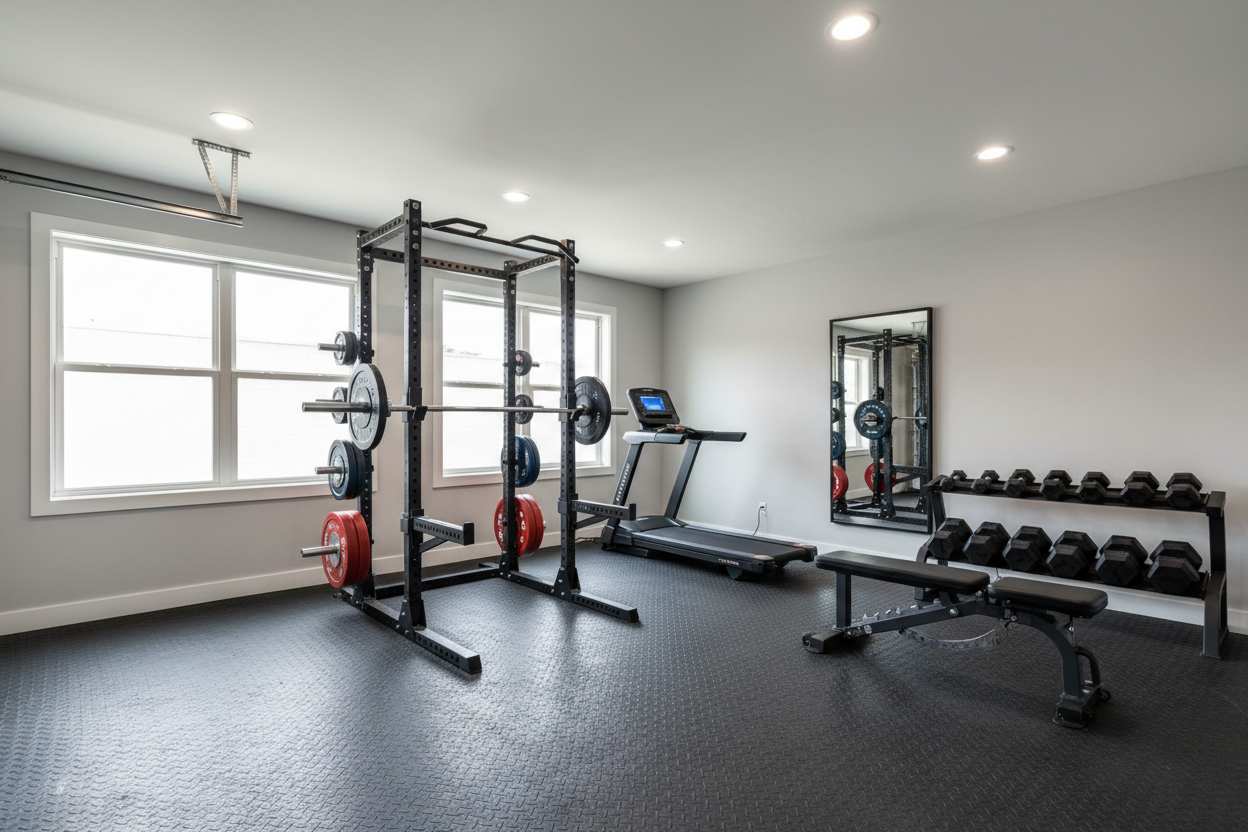
I remember the first 'heavy-duty' bench I bought from a local sporting goods shop. On the box, it claimed a 500-lb capacity. In reality, the moment I unboxed it, I realized the frame was made of steel so thin I could probably dent it with a firm kick. When I finally got under 225 lbs for a working set, the whole thing groaned and shifted an inch to the left. That was the day I stopped trusting retail aisles and started hunting down legitimate weightlifting stores that actually furnish commercial facilities.
Quick Takeaways
- Commercial steel is usually 11-gauge; consumer gear is often 14-gauge or worse.
- If a piece of equipment folds for storage, it is inherently less stable than a fixed frame.
- Industrial suppliers focus on weight capacity and bolt-down safety over flashy paint jobs.
- Real gym strength equipment should feel like a tank, not a piece of furniture.
Why Consumer Big-Box Stores Are Selling You Toys
Most big-box retailers aren't selling you gear to get strong; they are selling you the 'idea' of fitness. They stock shelves with items that look good in a catalog but fail the second you put them through a real training block. You’ll see plenty of plastic end-caps, thin powder coating that flakes off after three workouts, and bolts that look like they belong on a bicycle rather than a squat rack. These shops prioritize shipping weight—because lighter boxes are cheaper to move—which is the exact opposite of what you want when you're looking for stability.
These retailers often push flashy, multi-functional machines that promise to do twenty different exercises. In reality, they do none of them well. I’ve seen 'all-in-one' systems with cables that fray within six months because the pulleys are cheap nylon instead of heavy-duty aluminum or steel. Instead of falling for the marketing trap of a machine that does everything, you should focus on the lifting weight equipment you actually need to build a foundation. If it has a built-in cup holder but the uprights are made of 2x2 inch thin-walled tubing, it’s a toy, not a tool.
The illusion of choice at these shops is the biggest hurdle. You think you’re choosing between three great racks, but they are all coming from the same factory with different stickers. They are built for the casual user who might lift once a month, not the person who is hitting heavy triples on a Tuesday morning. When you buy from a generalist, you’re paying for their overhead and marketing, not the quality of the steel.
The Secret World of Commercial Weight Lifting Suppliers
There is a massive difference between a shop that sells yoga mats and one that acts as one of the primary weight lifting suppliers for local high schools and warehouse gyms. These commercial outfitters don't care about 'lifestyle' branding. They care about liability and longevity. If a rack they sell breaks while a 300-lb lineman is using it, they have a massive problem. That’s why their entry-level gear is almost always superior to the 'top-tier' products found in consumer retail.
When you walk into a warehouse that supplies commercial gyms, the vibe is different. You aren't seeing 50-lb dumbbells made of encased sand; you’re seeing solid steel or high-density urethane. Buying from these suppliers is the ultimate cheat code for a home lifter. Even their 'budget' lines usually feature 3x3 inch 11-gauge steel and 1-inch hardware. This is the kind of gym strength equipment that stays in your family for thirty years. It doesn't rattle, it doesn't bend, and it certainly doesn't require a 'maximum user weight' warning that you’re dangerously close to hitting.
The best part? Because these suppliers move volume to commercial clients, their prices are often surprisingly competitive. You might pay a bit more for shipping because the gear actually weighs something, but you won't be replacing it in two years. I’ve found that industrial suppliers are also much more transparent about their specs. They’ll tell you the exact tensile strength of their barbells and the shore hardness of their bumper plates. They aren't hiding behind buzzwords because their customers—gym owners—know exactly what to look for.
If It Folds Up Easily, You Probably Shouldn't Lift Heavy On It
I get the appeal of space-saving gear. Most of us are working in a cramped garage or a spare bedroom. But there is a hard truth in the lifting world: hinges are weak points. Every time a manufacturer adds a folding mechanism or a 'space-saver' hinge to a piece of equipment, they are compromising the structural integrity of the unit. If you’re planning on benching or squatting anything significant, you need a permanent, rigid footprint.
A lot of mainstream weightlifting stores push these folding benches and racks because they are easy to sell to people living in apartments. But the best at home weight lifting equipment doesn't fold away for a reason. Real stability comes from a solid, welded frame or heavy-duty bolts that stay put. When you’re under a heavy bar, the last thing you want to wonder is if a locking pin is seated correctly or if a hinge is about to shear under the load.
If you absolutely must save space, look for commercial-grade wall-mounted folding racks that use heavy-duty stringers. These are a far cry from the flimsy, free-standing folding racks sold at big-box stores. However, for a bench, I always recommend a fixed or high-end adjustable model with a wide tripod base. Safety should always outrank convenience. If you can't fit a real rack in your space, you're better off with a solid pair of squat stands than a shaky folding cage that feels like it’s made of soda cans.
The 'Wobble Test': How to Spot a Cheap Bench Immediately
If you want to know the quality of a store's equipment in five seconds, perform the wobble test. Walk up to any flat or adjustable bench on the floor, grab the top of the back pad, and give it a violent shake. If the feet leave the ground or you hear a chorus of metallic rattles, walk away. A high-quality adjustable weight bench should feel like it’s bolted to the earth even when it isn't. It should have zero lateral play in the hinge and a pad that doesn't compress down to the wood the second you sit on it.
Check the steel gauge. Most commercial-grade gear uses 11-gauge steel, which is about 3mm thick. Cheap retail gear uses 14-gauge (2mm) or even thinner. It might not sound like a big difference, but 11-gauge is significantly stiffer and heavier. You should also look at the weld quality. Are they clean 'stacks of dimes,' or do they look like a bird with a stomach ache flew over the joint? Poor welds are a hallmark of mass-produced junk from suppliers that don't specialize in strength.
When you browse a dedicated weight bench collection from a real supplier, look for the weight of the actual unit. A bench that weighs 40 lbs is a toy. A bench that weighs 80 to 100 lbs is a tool. The extra mass comes from the thicker steel and denser foam padding required to support heavy loads without deformation. Don't be fooled by high-gloss paint; look at the thickness of the steel plates at the adjustment points. If they look thin enough to bend with a pair of pliers, they probably will.
How to Shop Like a Gym Owner (Even for a Garage)
To get the best gear, you have to change your mindset. Stop looking for 'home gym' equipment and start looking for 'light commercial' or 'full commercial' specs. When you contact weightlifting stores, ask for the spec sheet. If they can't tell you the steel gauge, the bolt grade, or the static weight capacity of the safety bars, they aren't a serious supplier. A real pro will know exactly what their gear is rated for because they’ve had to insure it in a commercial environment.
Ignore the branding and the 'as seen on TV' nonsense. Focus on the hardware. Are the bolts 1/2-inch or 1-inch? Is the pull-up bar textured or slick? Does the rack use standard 5/8-inch or 1-inch holes that allow you to use attachments from other high-end brands? Buying into a 'closed' ecosystem of cheap gear is a mistake I see beginners make all the time. If you buy a rack with weird hole spacing, you’re stuck with that brand’s mediocre attachments forever.
Finally, don't be afraid to buy 'ugly' gear. Some of the best gym strength equipment I own came with a basic matte black finish and no fancy logos. It doesn't look like much, but it’s built to be beaten on for decades. Commercial suppliers often spend their budget on the quality of the steel and the precision of the laser cuts rather than a fancy chrome finish that’s going to rust in your garage anyway. Shop for the steel, not the sticker.
My Biggest Gear Mistake
Years ago, I bought a 'pro' power tower from a big-box store because it was on sale for $150. I thought I was being smart. The first time I tried to do weighted dips on it, the entire frame bowed inward, and the base lifted off the floor. I ended up having to weight the base down with sandbags just to make it usable, and even then, the handles eventually bent. I wasted $150 on a piece of junk that I eventually left on the curb. If I had just spent $300 on a commercial-grade stand from a real supplier, I’d still be using it today. Buy once, cry once.
Frequently Asked Questions
What is the best steel gauge for a home gym?
For any load-bearing equipment like a squat rack or bench, 11-gauge steel is the gold standard. Some companies use 12-gauge for 'home' lines which is acceptable, but avoid 14-gauge or higher for anything you plan on lifting heavy weight on.
How can I tell if a barbell is high quality?
Look for the tensile strength rating, measured in PSI. A decent bar should be at least 190,000 PSI. Also, check the sleeve construction; bushings are great for powerlifting, while bearings are better for Olympic lifting. Avoid '1-inch' bars; stick to Olympic 2-inch sleeves.
Is commercial gym equipment worth the extra cost?
Absolutely. Not only is it safer and more stable, but it also holds its resale value. If you ever decide to sell your gear, a commercial-grade rack will sell for 70-80% of its value on the used market, whereas big-box gear is almost worthless once it leaves the store.
Share:
The Best Places to Buy Gym Equipment When You're Tired of Wobbly Junk
The Brutal Truth About Buying Aussie Gym Equipment for Your Garage