
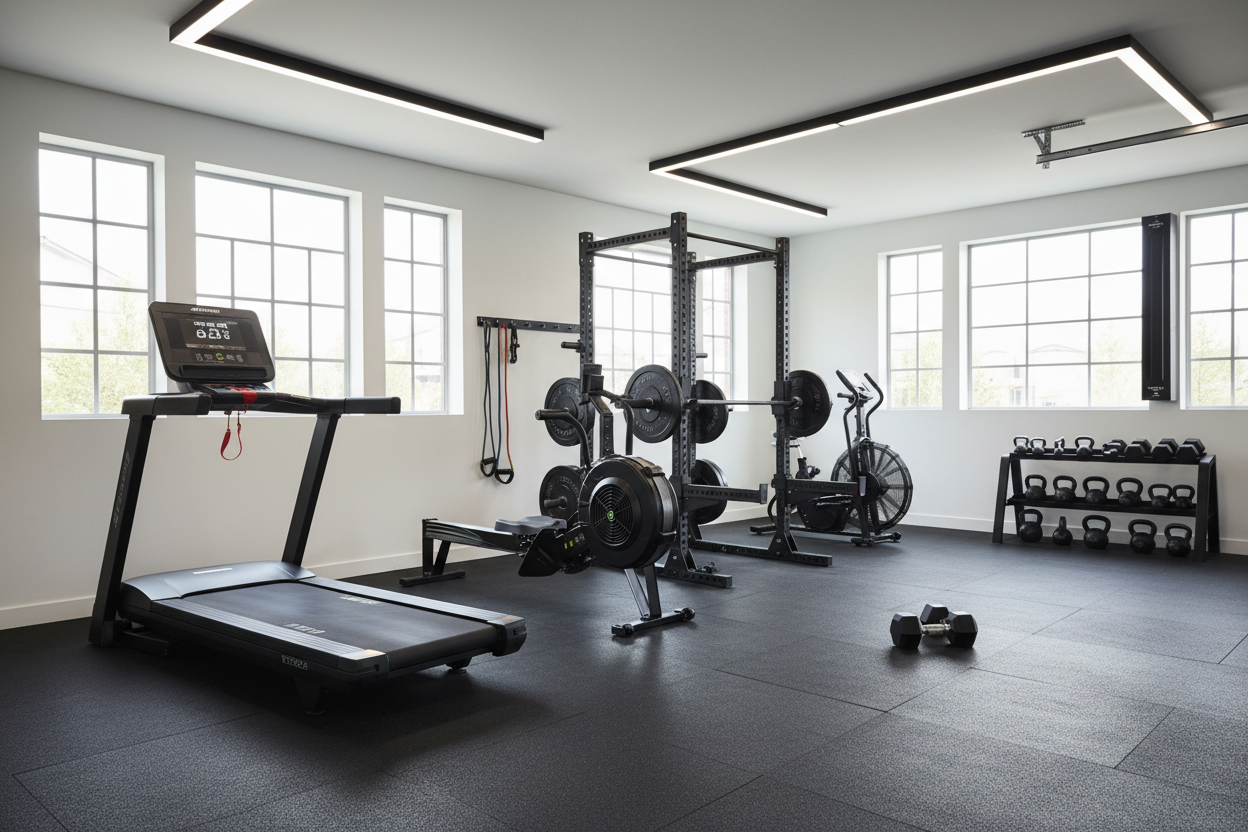
I remember standing by the water fountain, eyes darting between the clock and the row of treadmills, waiting for a single running machine at gym to open up. It was 5:15 PM on a Tuesday—peak hour. The air smelled like stale pre-workout and desperation. Every belt was occupied by someone staring blankly at a screen, and there were three people already hovering like vultures. I wasted twenty minutes that night just waiting to start my workout. It was the moment I realized that my membership was actually a subscription to a waiting room.
Quick Takeaways
- Waiting for a treadmill at gym kills your heart rate and your motivation.
- Metabolic resistance training builds a better engine than steady-state jogging.
- You can fit a world-class conditioning setup in a 6x8 foot corner of your garage.
- Investing in heavy iron is more cost-effective than a decade of commercial dues.
The Soul-Crushing Reality of Cardio Rush Hour
Walking into a packed commercial facility during the post-work rush is a special kind of hell. You’ve had a long day, your energy is flagging, and all you want to do is get your miles in and go home. Instead, you’re forced to play a tactical game of 'who looks like they’re finishing their cool-down?' Searching for a gym with treadmill availability shouldn't be your primary workout goal. When your training schedule is dictated by the occupancy of a motorized belt, you aren't in control of your fitness—the crowd is.
I’ve seen people spend thirty minutes on an elliptical they hate just because the running machine at gym they actually wanted was taken. That’s an hour of your life gone with zero intensity. Most commercial gyms have a 30-minute limit on cardio equipment during busy hours anyway. So, you wait twenty minutes to use a machine for thirty minutes. The math doesn't work. You’re spending more time standing still or walking at a snail's pace than you are actually pushing your threshold. It’s a time-suck that drains your mental discipline before you even break a sweat.
Why That Treadmill at Gym Might Be Stalling Your Progress
Let’s be honest: for a lot of us, the treadmill at gym is a comfort zone. It’s easy to hop on, press 'Quick Start,' and zone out for forty minutes. But that mindless slogging is often an excuse to avoid the uncomfortable, heavy work that actually transforms your body composition. If you’re trying to lose fat or build a gas tank that won't quit, steady-state cardio on a motorized belt is the least efficient way to do it. The machine is doing half the work by pulling the floor out from under you.
When you prioritize the cardio floor, you’re usually neglecting the rack. I’ve fallen into this trap myself. I’d tell myself I was 'getting my cardio in' while my deadlift stalled and my overhead press went backwards. Real metabolic change happens when you force your muscles to work under load while your heart rate is screaming. If your goal is to look like an athlete and move like one, you need to stop treating the treadmill as the centerpiece of your routine. It’s a tool, not the blueprint.
Ditching the Belt: How Heavy Iron Builds Better Engines
If you want a heart that pumps like a race car, you need to stop jogging and start moving heavy weight fast. This is called metabolic resistance training. Think about it: a set of 15-repetition goblet squats followed immediately by kettlebell swings will get your heart rate higher than a 6 mph jog ever will. And the best part? Your metabolism stays elevated for hours afterward as your body works to repair that muscle tissue. You don't get that 'afterburn' from a casual stroll on a belt.
By building your own home gym, you shift the focus from 'burning calories' to 'building capacity.' You can chain together compound movements—cleans, presses, and lunges—into circuits that leave you gasping for air in fifteen minutes. This isn't just about strength; it's about conditioning. I’ve found that my 'cardio' improved significantly more once I stopped running on a motorized floor and started doing EMOM (Every Minute on the Minute) sessions with a barbell. My resting heart rate dropped, and my work capacity exploded.
The Real Math: Swapping Memberships for a Garage Setup
People complain about the cost of equipment, but let’s look at the numbers. A decent commercial membership costs $50 to $100 a month. Over five years, that’s $3,000 to $6,000. For half of that, you can buy a rack, a bar, and enough plates to bury yourself. You don’t need a massive footprint or a $4,000 motorized treadmill to get fit. In fact, the best home gym under $1000 doesn't have a treadmill because that money is better spent on high-quality steel that lasts a lifetime.
A treadmill is a complex machine with a motor, a belt, and electronics that eventually fail. A squat rack and a pile of iron plates are essentially immortal. When you move your training to the garage, you aren't just saving money; you're gaining time. No commute, no waiting for the running machine at gym, and no dealing with someone else's sweat on the console. You can get a world-class conditioning session done in the time it would have taken you just to drive to the commercial facility and find a parking spot.
Consolidating Your Footprint with the Right Rig
The biggest myth in home fitness is that you need a huge room. You don't. If you’re smart with your equipment choice, you can replace an entire commercial cardio and weight floor in about 25 square feet. The key is versatility. Instead of a single-purpose machine, you want a centerpiece that allows for infinite movement patterns. This is where a high-quality functional trainer or a loaded power rack becomes the MVP of your garage.
Investing in an All In One Smith Machine With Cable Crossover is a total game-changer for small spaces. It allows you to transition from heavy strength work to high-intensity cable circuits without moving an inch. You can do face pulls, cable sprints, and explosive presses in rapid succession. This kind of 'mechanical circuit' keeps your heart rate in the training zone while building actual muscle. It’s the ultimate way to get your cardio in without ever touching a treadmill belt. You get the resistance of a weight room and the conditioning of a track, all inside one footprint.
My Personal Experience: The $200 Mistake
Years ago, I tried to compromise. I bought a cheap, entry-level treadmill for my garage because I thought I 'needed' it. It was a nightmare. The deck was too short for my stride, the motor smelled like burning hair if I went over 7 mph, and it took up half the floor space. I eventually sold it for fifty bucks on Craigslist and bought a set of bumper plates instead. I started doing high-rep thrusters and burpees. My conditioning reached levels I never touched on that shaky treadmill. The lesson? Don't buy equipment that limits you; buy equipment that challenges you.
Frequently Asked Questions
Can I get good cardio without a running machine?
Absolutely. High-intensity interval training (HIIT) using weights, or even simple bodyweight circuits, can provide a more intense cardiovascular stimulus than steady-state running. The key is to keep your rest periods short and your effort high.
How much space do I actually need for a home gym?
You can get a full-body workout in a space as small as 6x8 feet. A compact power rack or a multi-function cable machine can fit in the corner of a standard garage or spare bedroom while leaving plenty of room for movement.
Is a Smith machine good for conditioning?
Yes, especially for circuits. Because the bar is on a fixed path, you can safely push to failure and transition between exercises quickly, which is perfect for keeping your heart rate elevated during a metabolic workout.
Share:
Forget the Hype: Must Have Equipment for Home Gym Setups
The Sketchy Truth About Building a DIY Smith Machine