
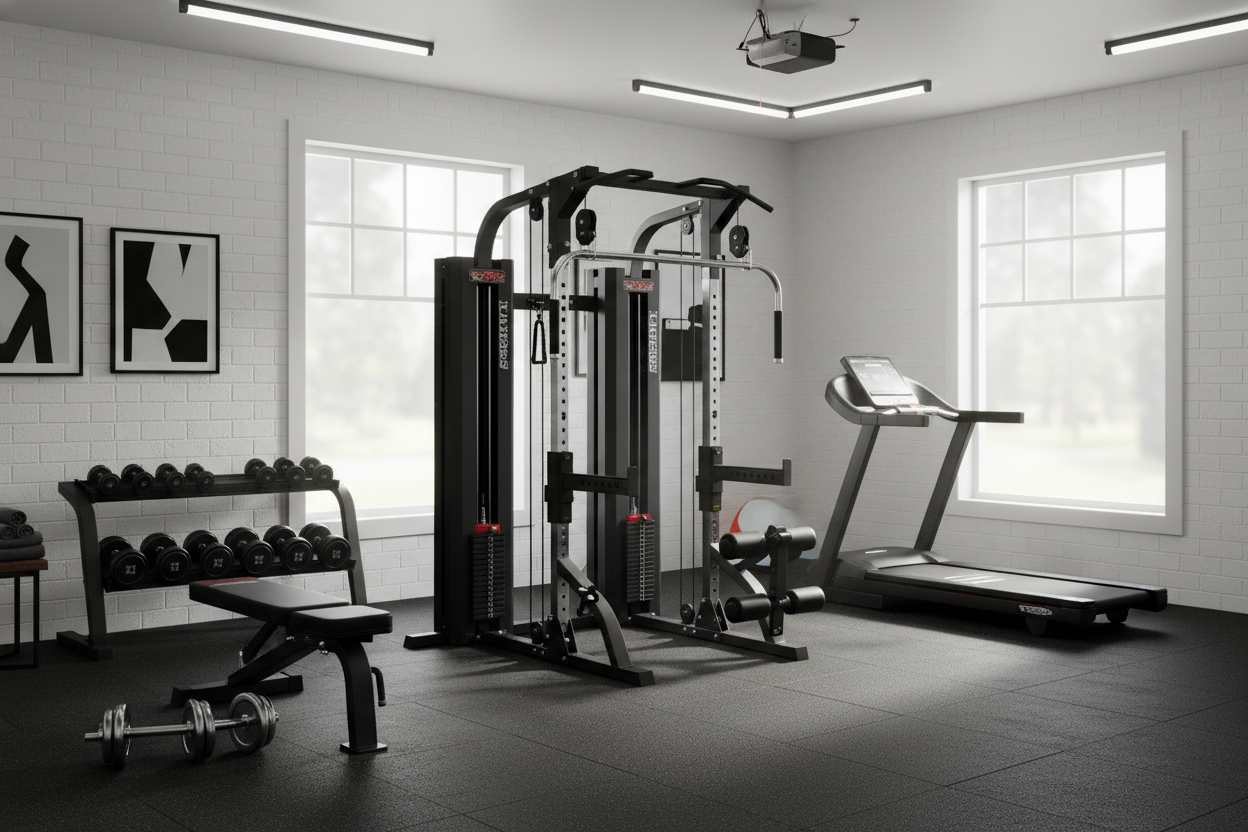
I spent years defending my pile of rusty iron like it was a sacred relic. I thought a full body workout machine at home was just for people who wanted a light sweat while watching the news. My garage looked like a scrap yard: three different brands of plates, a rack that shook if I breathed on it too hard, and dumbbells scattered like landmines.
- Space Efficiency: Reclaims 40-60 square feet of floor space.
- Safety: Integrated spotters mean you can actually hit failure without dying.
- Tension: Constant cable resistance beats momentum-based lifting for growth.
- Versatility: One footprint handles squats, rows, and flyes.
The 'Frankenstein Setup' is Killing Your Gains
Buying random gear over five years is a trap. You start with a cheap bench, add some Facebook Marketplace plates, and eventually, you have a room full of stuff that doesn't play well together. My old squat stand was too narrow for my wide-grip bench, and my pull-up bar hit the ceiling. It was a mess.
I realized I wasn't spending time training; I was spending time moving heavy things out of the way just to reach other heavy things. Building a cohesive Home Gym isn't about how many individual items you own. It is about how effectively you can move from one exercise to the next. A dedicated home gym full body workout machine solves the 'Frankenstein' problem by putting the pulley, the rack, and the bench in one engineered ecosystem.
Why I Finally Made the Switch to an All-in-One
The breaking point was a Tuesday night leg session. I tripped over a 25-lb plate while trying to plate-load a leg extension attachment that never felt right anyway. I was done. I needed a home full body workout machine that didn't feel like a compromise. I spent weeks researching, terrified I would end up with a high-end coat rack.
I specifically looked for reviews on How to Pick an At Home Workout Machine You Won't Hate in 6 Months. I needed to know that the linear bearings wouldn't seize up after three months of heavy use. Switching to a single unit meant I could finally park my car in the garage again while still having a setup that handled 315-lb squats without groaning.
Cable Tension vs. Iron: The Biomechanics Shift
Purists will tell you that cables are 'cheating.' Those people usually have small delts. The reality is that a full body home gym provides a strength curve that free weights can't touch. When you do a dumbbell fly, there is zero tension at the top. With a dual-pulley system, your chest is fighting for its life through the entire range of motion.
I also stopped worrying about my floor. Dropping 100-lb dumbbells in a residential garage is a great way to crack your foundation. Using a guided system allows for high-intensity training without the chaos. This is Why the Best Full Body Home Workout Machine Is Actually a Smith Rig—it combines the stability of a machine with the heavy-loading potential of a barbell. You get the hypertrophy benefits of a commercial gym in a 6x8 foot corner.
The 3 Non-Negotiable Specs for a True Centerpiece
If you are going to buy a full body home gym machine, do not buy the thin, bolted-together junk from big-box retailers. If the steel is thinner than 14-gauge, it will wobble during pull-ups. I look for 11-gauge steel in the uprights and a weight capacity of at least 600 lbs on the rack portion. Anything less feels like a toy.
You also need a 2:1 pulley ratio for versatility. This gives you enough cable travel for lunges and crossovers without the weight stack hitting the top. A high-end Smith Machine Home Gym Station should feel smooth, not crunchy. If the bar doesn't glide on commercial-grade bushings, you'll hate using it within a week. I prioritize the feel of the movement over fancy digital screens every time.
Stop Guessing: The Unit That Actually Delivers
If you're ready to stop playing Tetris with your equipment, you need a unit that replaces the clutter. The Full Body Multi Training Station Smith Machine Dm01 is the specific rig I point people toward. It combines a power rack, a Smith machine, and a functional trainer into one footprint. It is the at home full body workout machine for people who actually lift heavy.
It replaces about ten different pieces of commercial equipment. You can go from heavy back squats to high-to-low cable flyes in about thirty seconds. No more hunting for collars or moving benches across the room. It’s built like a tank and handles the abuse of daily 5:00 AM sessions without needing constant maintenance.
Personal Experience: My Biggest Mistake
I once bought a cheap 'all-in-one' power tower because it was $150 on sale. The first time I tried to do weighted dips, the whole thing tipped forward and nearly went through my drywall. I learned the hard way that weight equals stability. If the machine doesn't weigh at least 300-400 lbs itself, it isn't going to stay put when you're working hard. Don't cheap out on the frame; you can't upgrade the steel later.
FAQ
Do these machines take up more space than a rack?
Actually, no. Because they integrate the storage and the pulleys, they usually have a smaller total footprint than a power rack plus a separate cable crossover and accessory tree.
Can I still do 'real' squats on a machine?
Yes. Most high-end units include J-cups on the outside of the frame, so you can still use a traditional barbell whenever you want the challenge of free-weight stabilization.
Are they hard to assemble?
It takes a few hours. Grab a socket wrench set and a buddy. It's a one-time tax for years of better workouts.
Share:
I Tested the Cheapest Fitness Equipment Online (Here's What Broke)
If I Had to Start Over: The Best Workout Machine at Home