
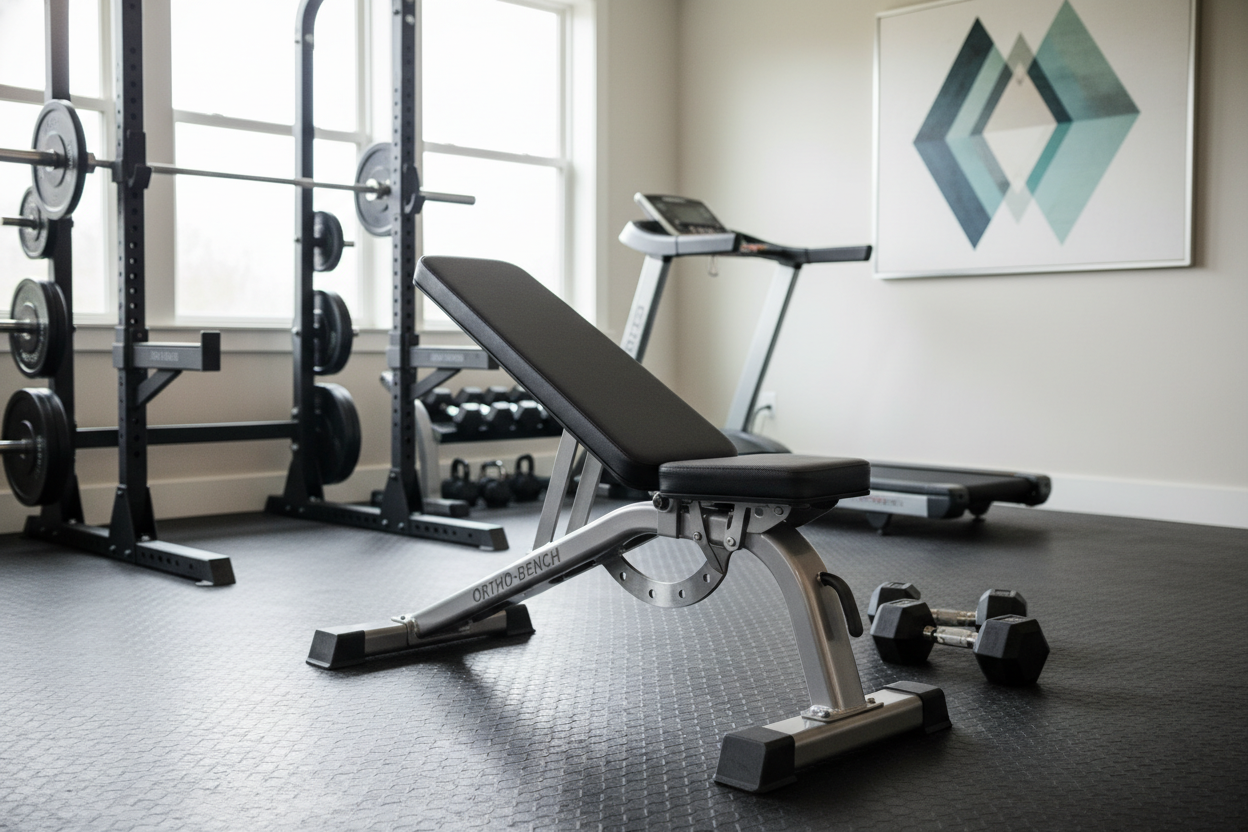
I’ve spent the better part of a decade building out garage gyms, and I’ve wasted more money on sub-par gear than I’d like to admit. Most of that waste came from buying budget gear that looked great in a filtered Instagram ad but felt like a wet noodle under a 225-lb bar. The biggest offender? The benches gym equipment companies market to home lifters that are built for aesthetics rather than actual human biomechanics.
Quick Takeaways
- Standard 10-inch pads are too narrow for shoulder blade stability.
- Look for a 12-to-14-inch width to protect your rotator cuffs.
- A 17.5-inch height is the sweet spot for proper leg drive.
- Slick vinyl is a safety hazard; you need a 'grippy' texture to stay pinned.
The 10-Inch Pad Problem (And Why It Hurts)
Budget brands love the 10-inch pad. Why? Because it’s cheaper to manufacture, easier to ship, and most beginners don’t know any better. But here is the reality: a 10-inch wide pad is a disaster for your shoulders. When you lie down to press, your scapulae (shoulder blades) need a solid platform to retract and depress against.
On a narrow pad, your shoulder blades literally hang off the edges. Without that physical support, you have no foundation to push from. It is like trying to fire a cannon from a canoe. The lack of surface area forces your smaller stabilizer muscles to do the work that the bench should be doing, which is a fast track to a strain.
What Happens to Your Shoulders Under Load
Biomechanics 101: if your shoulder blades aren't pinned to a stable surface, they move. Under a heavy load, your shoulders will naturally want to roll forward—a movement called protraction. This closes the subacromial space in your shoulder joint and starts grinding away at your rotator cuff tendons. It’s a slow-motion injury that builds up over hundreds of reps.
If you're wondering why your bench press has plateaued or why your joints ache for days after chest day, Your Gym Math Is Wrong The Real Matrix Bench Press Bar Weight might be one piece of the puzzle, but an unstable base is usually the bigger culprit. You cannot generate maximum force when your foundation is wobbling. You need a platform that matches your anatomy, not a company's shipping budget.
Finding a Real Fitness Equipment Bench
When you are ready to stop gambling with your joint health, you need to look at specs that match International Powerlifting Federation (IPF) standards. You want a pad width between 12 and 14 inches. This gives your upper back a massive, stable shelf that allows you to lock your shoulders into a safe, powerful position.
The foam density is just as critical. If you can feel the plywood base through the foam when you’re lying on it, the bench is trash. High-density foam should feel firm, almost stiff, and shouldn't bottom out even when you're handling heavy triples. When it’s time to upgrade, browsing for a proper Weight Bench with these specs will change your training overnight. Your shoulders will finally feel 'set' rather than floating in space.
Does the Height Matter As Much As Width?
Height is the most underrated spec in the home gym world. A bench that is 20 inches tall is a nightmare for anyone under 6 feet tall. If your feet can't reach the floor with full heel contact, you lose your leg drive. No leg drive means a weaker press and a less stable spine.
The gold standard is 17 to 18 inches from the floor to the top of the pad. This height allows you to drive your heels down, create a solid arch, and stay locked into the upholstery. Even an Adjustable Weight Bench Owb01 should maintain these proportions. I've seen many adjustable models that sit way too high because of the hinge mechanism, but the good ones manage to keep that competition height even when the angle changes.
Stop Settling for Bad Upholstery
Cheap vinyl is slick. When you start your leg drive, you shouldn't slide toward the head of the bench. I’ve seen guys use shelf liner or even spray adhesive on cheap benches just to stay put. Don't be that guy. A quality fitness equipment bench uses textured, 'grippy' vinyl that holds you in place like Velcro. This allows you to maintain your 'shelf' throughout the entire set, ensuring your shoulders stay in the safe zone while you move the weight.
My Experience
I once bought a $100 bench from a big-box store thinking I was being savvy. Three months in, the pad compressed so much I could feel the bolt heads in my mid-back during heavy sets. My right shoulder started clicking every time I reached for a door handle. I finally swapped it for a 12-inch competition-style bench and the pain vanished in two weeks. I learned the hard way: your joints are worth more than the $50 you save on a narrow pad.
FAQ
Is a wider pad harder to press on?
No, it is actually easier. A wider pad provides a more stable base of support, which allows you to recruit more muscle and move more weight safely.
Can I just add a wider board to my current bench?
You can try, but you'll likely mess up the height and compromise the structural integrity. It's usually better to just buy a bench designed for the load.
What's the best foam density?
Look for 'reconstituted' or high-density foam. It should feel firm to the touch and not 'squish' easily when you press your thumb into it.
Share:
Does Planet Fitness Have Squat Racks? (I Checked Every Machine)
Which Types of Bench in Gym Setups Do You Actually Need?