
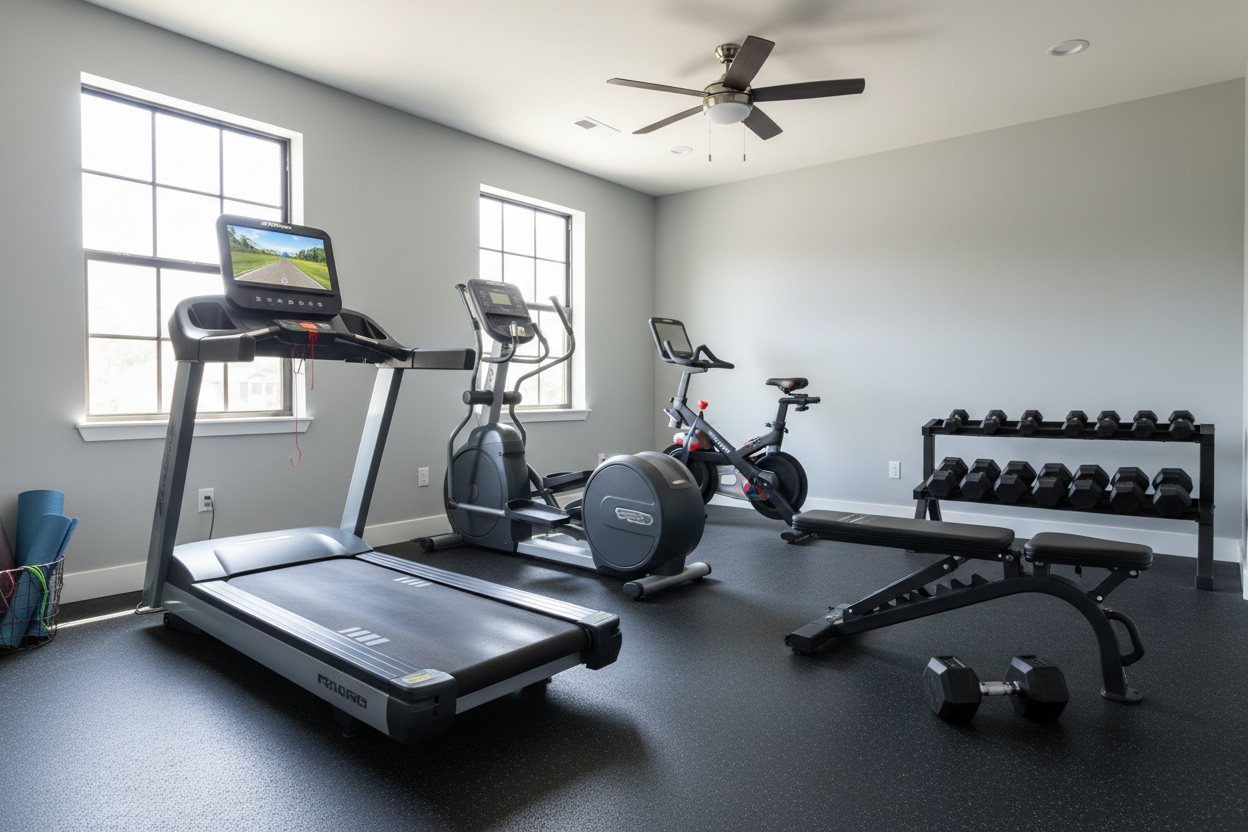
You step onto that Life Fitness or Matrix beast at the local club and it feels like running on a cloud made of industrial-grade rubber. Then you go home, hop on your $600 big-box special, and it feels like running on a wet piece of plywood vibrating over an earthquake. The running machines in gym settings are built for 16 hours of daily abuse; your home unit is built to survive a three-week New Year's resolution.
The gap between commercial and residential cardio isn't just a matter of price—it is a matter of physics. If you are trying to replicate that rock-solid gym feel in your spare bedroom, you are likely fighting a losing battle unless you are prepared to renovate your electrical panel and reinforce your flooring.
- Commercial units use AC motors that stay cool during long sessions.
- Residential treadmills often require 15-amp circuits, while pro gear needs 20-amp dedicated lines.
- Weight matters: a 450-lb machine stays planted; a 150-lb machine walks across the room.
- Curved manual treadmills are the secret hack for durability in unconditioned garages.
The $10,000 Difference Under the Hood
The heart of those massive gym machines is an AC (Alternating Current) motor. Most home treadmills use DC motors. While DC is quieter at low speeds, it generates significant heat. In a gym, a machine might run for ten hours straight. An AC motor handles that without breaking a sweat, whereas a consumer-grade DC motor would literally melt its own internals.
Then there is the deck. Commercial machines use 1-inch thick, reversible phenolic decks. These are heavy, stiff, and soaked in lubricant to reduce friction. When you run on one, the frame doesn't flex. Most home units use a 1/2-inch or 3/4-inch MDF board that bows with every strike. That 'bouncy' feeling people like in home units? That is usually just the frame and deck screaming for help under your body weight.
Why You Can't Just Plug One Into Your Garage
I have seen plenty of people score a 'deal' on a used commercial treadmill from a gym liquidation. They get it home and realize it has a weird plug with one horizontal prong. That is a NEMA 5-20 plug, and it requires a dedicated 20-amp circuit. If you plug that into a standard 15-amp household outlet with an adapter, you are asking for a tripped breaker or, worse, a fire.
Beyond the power, there is the sheer logistics of the footprint. These things weigh as much as a motorcycle. I once helped a friend move a Life Fitness 95T into his basement, and we nearly took out a load-bearing wall. I realized then that I put commercial gym machines in my garage and made huge mistakes by not measuring the overhead clearance. Most commercial decks sit 10-12 inches off the ground. If you have 8-foot ceilings and you are 6 feet tall, you will scalp yourself the moment you try to use the incline.
Chasing the Belt Feel Without Breaking the Bank
You don't need to spend $10k to get a decent run, but you do need to look at the right specs. Stop looking at the 'Peak Horsepower'—that is a vanity metric. Look for 'Continuous Horsepower' (CHP). Anything under 3.0 CHP is going to struggle if you weigh over 200 lbs or plan on doing sprint intervals.
Check the roller size too. Commercial machines have 3-inch or 3.5-inch rollers. Bigger rollers mean more surface area contact with the belt, which leads to less tension, less heat, and a longer life for the motor. If a treadmill has 1.9-inch rollers, keep walking. It will feel 'choppy' the moment you hit your stride.
Non-Motorized Alternatives That Actually Survive
If you want that tank-like durability without the electrical headache, look at curved manual treadmills like the AssaultRunner. These have no motor to burn out and no electronics that will fry when the humidity hits 90% in your garage. They are the gold standard when building a functional home gym that is meant to last a decade.
The learning curve is real—you are the motor. But the lack of a speed limit and the heavy-duty slat belt feel much closer to a commercial experience than any $900 motorized unit ever will. Plus, they don't require a dedicated circuit, just a flat spot on the floor and a lot of grit.
Stop Obsessing Over the Belt (Do This Instead)
Here is the truth: you don't need a motorized belt to get fit. If you are frustrated by the flimsy feel of home running machines, stop trying to run on them. Pivot your conditioning to something that doesn't rely on cheap electronics. A heavy sandbag, a set of kettlebells, or a high-intensity circuit on a Smith machine home gym station can get your heart rate higher than a 7-mph jog ever could.
I spent years trying to find the 'perfect' home treadmill only to realize that a mix of heavy carries and hill sprints outside was more effective and cost me zero dollars in maintenance. If you must buy a machine, buy for the frame and the warranty, not the fancy touchscreen that will be obsolete in two years.
My Personal Lesson in Cheap Plastic
I once bought a mid-tier treadmill from a department store because the sales guy swore it was 'club quality.' Within three months, the plastic side rails had cracked from my foot strikes. Within six months, the motor started smelling like an electrical fire every time I ran longer than 30 minutes. I eventually sold it for parts and realized that for the same price, I could have bought a lifetime supply of Olympic plates and a decent pair of running shoes for the pavement.
FAQ
Can I use a commercial treadmill on a regular outlet?
Usually no. Most require a 20-amp dedicated circuit. Using an adapter on a 15-amp circuit can damage the motor and is a legitimate fire hazard.
Why do home treadmills feel so much shakier?
It is the weight. A commercial treadmill weighs 400+ lbs of steel. Home units use thinner gauge steel and more plastic to keep shipping costs down, leading to vibration and 'walking.'
Is a manual treadmill harder than a motorized one?
Yes. You can expect your heart rate to be about 20-30% higher at the same 'speed' because you are responsible for the friction and movement of the belt.
Share:
I Built the Marcy Smith Machine SM-4008. Was It Worth the Headache?
Is All-in-One Exercise Equipment for Home Just a Gimmick?