
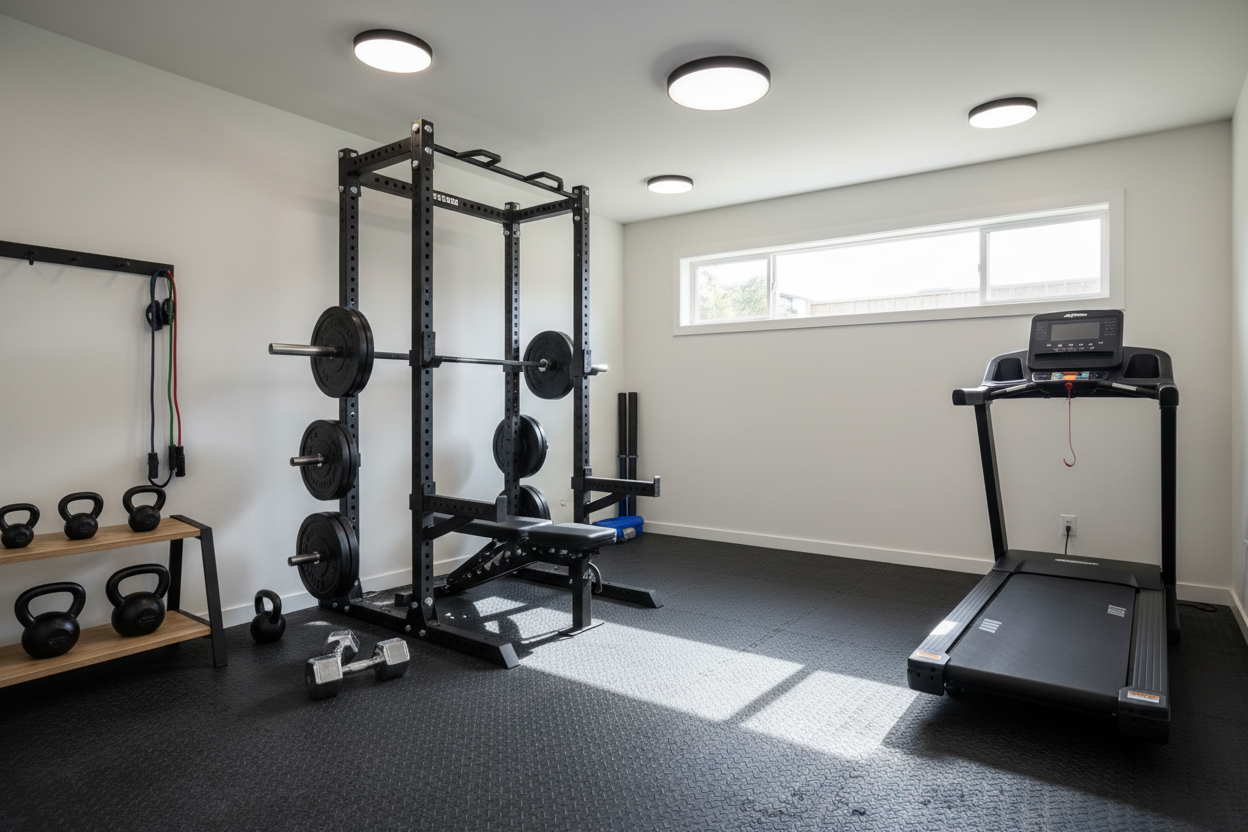
I remember trying to run a classic 'Chest and Tris' Monday in my first garage setup. It was a disaster. Between the kids waking up early and the sheer amount of time spent swapping iron plates on a single barbell, I was forty minutes in and hadn't even touched a tricep extension. The truth is, the best at home total body workout isn't about isolation; it’s about economy of movement and realizing your garage isn't a Gold's Gym.
Quick Takeaways
- Frequency beats volume when life gets in the way of your training.
- Compound movements hit more muscle groups in half the time of isolation exercises.
- Cable systems allow for faster transitions, keeping your heart rate up.
- A 3-day full-body routine is more sustainable for home lifters than a 6-day split.
The Trap of the 6-Day Bro Split in Your Spare Room
We’ve all seen the professional bodybuilding programs. They want you in the gym six days a week, dedicating an entire hour just to your delts or your calves. That works if your commute is a thirty-second walk and you have a staff to plate your bars, but for the rest of us, it’s a logistical nightmare. When you train at home, life happens. A meeting runs late, the dishwasher leaks, or you’re just plain tired. If you’re on a 6-day split and you miss 'Leg Day,' you’re now a full week behind on your squat progress. It creates a mental cycle of 'catching up' that usually ends in burnout.
Furthermore, the setup time for isolation work is a silent killer. If you only have 45 minutes to train, spending 10 of those minutes moving benches and hunting for the other 25-lb dumbbell is a waste. High-volume splits require a massive array of equipment that most 10x10 spare rooms simply can't accommodate. You end up with half-finished workouts and a physique that looks like you only ever do bench press because that’s the only station that was ready to go.
What the Best At Home Total Body Workout Actually Looks Like
The paradigm shift happens when you stop thinking about 'working muscles' and start thinking about 'training movement patterns.' A best full-body home workout focuses on the big four: a squat, a hinge, a push, and a pull. By hitting these every session, you’re triggering protein synthesis across your entire body three or four times a week rather than just once. It’s the difference between a slow drip and a flood.
To make this work in a residential setting, you have to stop buying single machines that only serve one purpose. You don't need a dedicated leg extension or a preacher curl bench taking up precious floor space. When you focus on heavy compound movements, your core, grip, and secondary stabilizers get hammered naturally. I’ve found that a heavy set of weighted pull-ups does more for my biceps than three sets of concentration curls ever did, and it takes a fraction of the time.
Why Cables Are the Secret Weapon for Quick Transitions
If you’re chasing the best full-body workout at home, speed is your ally. This is where the debate between iron and cables gets interesting. While I’ll always love the feel of a 45-lb plate, stripping a barbell to go from heavy deadlifts to overhead presses is a momentum killer. Adjustable cable stacks allow you to change the resistance and the height of the pull in about three seconds. This keeps your heart rate in that sweet spot where you're building cardiovascular health alongside raw strength.
I’ve tested dozens of setups, and I’ve noticed that workout machines use cables not bands for a very specific reason: constant tension. When you’re using bands, the resistance is lightest at the bottom where you’re often strongest. Cables give you a smooth, 1:1 or 2:1 ratio that challenges the muscle through the entire range of motion. Plus, if you’re training in a tight spot, cables are dead silent compared to the clanging of iron plates, which your family will appreciate during those 5:00 AM sessions.
The 4-Movement Blueprint You Can Do on One Machine
You don't need a 2,000-square-foot commercial facility. You need one solid anchor point. My go-to routine for a best full-body workout at home revolves around a heavy squat variant, a horizontal press (like a chest press), a vertical pull (lat pulldowns or pull-ups), and a hinge (Romanian deadlifts). You can execute all of these without ever stepping off your rubber flooring if you have the right gear.
I personally prefer a multifunctional training station because it consolidates the footprint. For the squat and hinge portions, I’ve found that a Smith machine home gym station is a massive safety advantage when training solo. If you’re pushing for a PR on an RDL and your grip fails, or you hit a sticking point on a heavy squat, you can just rack the bar with a flick of the wrist. No spotter, no problem. You can move from a set of heavy presses to a set of face pulls just by moving a carabiner. That efficiency is what allows you to finish a total-body annihilation in under an hour.
Consistency Beats Complexity When Training Solo
At the end of the day, the best program is the one you actually do. We love to geek out over RPE, periodization, and micro-loading, but none of that matters if your workout is so complex that you dread starting it. A simplified home gym setup removes the friction. When you know you only have four movements to master, the mental barrier to entry drops significantly.
I’ve spent years swapping gear and trying to find the 'perfect' split. What I’ve learned is that my best gains came when I stopped trying to be a scientist and started being a worker. Heavy weights, full-body frequency, and equipment that doesn't get in its own way—that's the formula for a body that actually looks like it lifts.
My Personal Experience: The 'More is Better' Mistake
Early on, I bought a cheap power tower and a set of plastic-coated adjustable dumbbells that only went up to 25 lbs. I thought I could make up for the lack of weight with a 6-day high-rep split. I was wrong. The tower shook like a leaf every time I did a pull-up, and I spent more time shaking the dumbbells to make sure the plates wouldn't fall off than I did lifting them. I eventually sold it all for a loss and invested in a single, high-quality cable station. My advice? Don't buy the 'budget' version of five different things. Buy one piece of gear that can handle 300+ lbs safely. Your joints and your progress will thank you.
FAQ
How many times a week should I do a full-body workout?
Three days a week is the sweet spot for most. It gives you 48 hours of recovery between sessions, which is crucial when you're hitting every muscle group with heavy compound movements.
Can I build as much muscle as a bodybuilder split?
Yes. Hypertrophy is driven by total weekly volume and intensity. If you hit your chest three times a week for 4 sets, you’re getting the same 12 sets as the guy who does them all on Monday, but your quality of reps is likely higher because you aren't fatigued by set ten.
Do I need a spotter for heavy home workouts?
If you're training alone, I highly recommend a Smith machine or a rack with high-quality spotter arms. Safety is the one thing you can't compromise on when there's no one else in the house.
Share:
I Tested 5 Types of Weight Plates (And Kept Just One)
The Red Flags I Look for When Browsing Weight Machines for Sale