
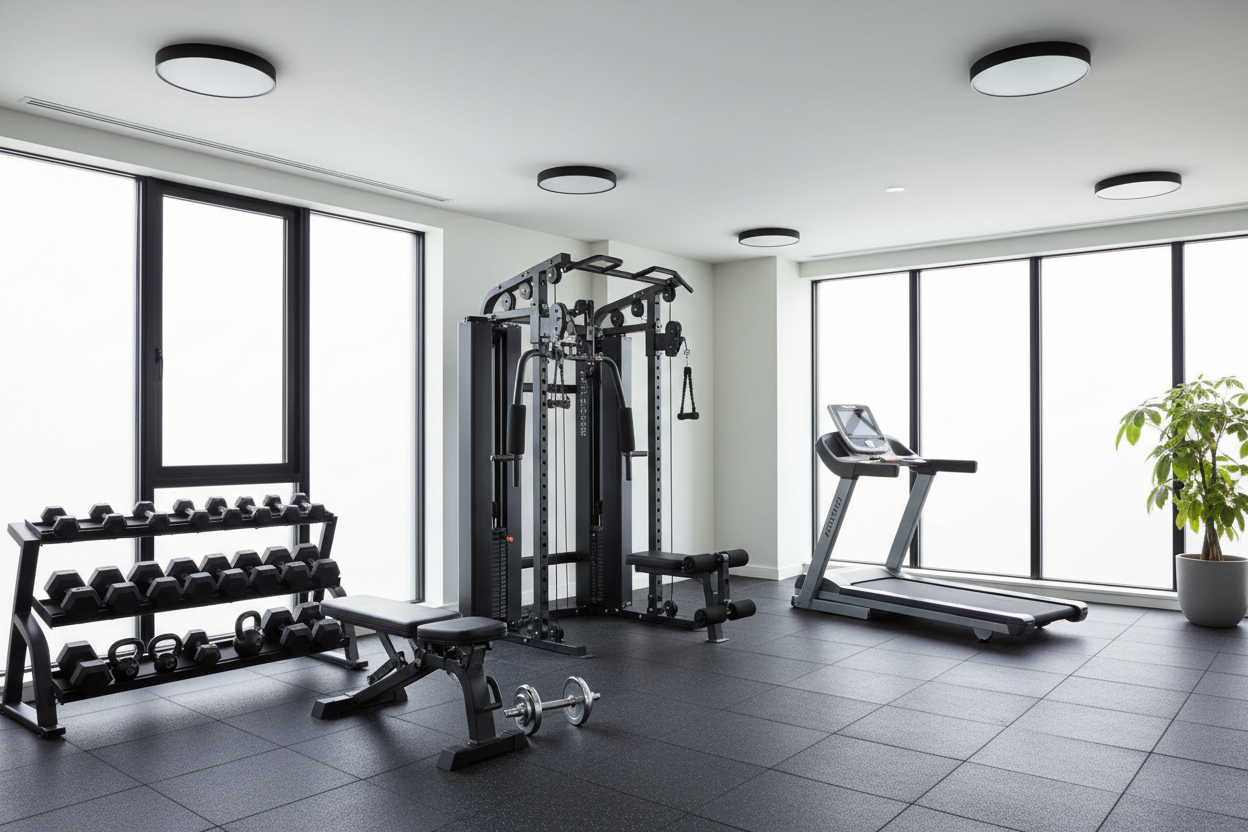
I remember the day my cheap high-street multi-gym finally died. I was halfway through a set of lat pulldowns when the 'aircraft-grade' cable snapped, sending the handle into my forehead and the weight stack crashing into the floorboards. It was a wake-up call. I’d spent £400 on a pile of wobbly steel and plastic-coated cement plates that belonged in a skip, not a serious training space. If you are hunting for the best home multi gym uk, you have to stop looking at the shiny catalogs and start looking at the steel gauge.
- Steel Gauge Matters: Look for 11-gauge or 14-gauge steel; anything thinner will vibrate like a tuning fork when you drop the weights.
- Pulley Precision: Sealed bearings are non-negotiable if you want a smooth stroke that doesn't feel like dragging a sledgehammer through gravel.
- Footprint vs. Function: Measure your floor space twice, then add 50cm of 'elbow room' on every side.
- Plate Loading: Plate-loaded machines usually offer a higher ceiling for progression than fixed weight stacks.
The High Street Multi-Gym Trap (And Why They Always Wobble)
Walk into any major UK retailer and you’ll see them: the £300 'all-in-one' wonders. They promise 50 exercises in a space the size of a phone booth. Here is the reality: those machines are designed for people who plan to use them twice as a New Year's resolution and then let them gather dust. When you start building a proper home gym, you realize that thin-walled steel is the enemy of gains. If the frame twists when you’re doing a chest press, your stabilizer muscles are working to keep the machine still rather than pushing the weight.
Most of these budget rigs use plastic-coated concrete weights. They’re bulky, they crack, and they usually max out at about 60kg. For anyone who has spent more than six months in a commercial gym, that’s a warm-up. You’ll outgrow the stack in weeks, leaving you with a very expensive clothes drying rack. I’ve seen frames literally bow under the tension of a heavy row because the manufacturer used 2mm steel instead of 3mm. Don't be the person who buys twice because they tried to save £200 on the first go.
Cable Ratios: The Secret Math Behind a Smooth Lift
This is where most UK buyers get caught out. You’ll see a machine advertised with a '100kg weight stack,' but when you pull the handle, it feels like 50kg. That is the cable ratio at work. A 2:1 ratio means for every 2kg on the stack, you feel 1kg of resistance. This isn't necessarily a bad thing—2:1 ratios provide more cable travel, which is great for functional movements and crossovers where you need the handle to move a long distance without the plates hitting the top of the rack.
However, if you want the best multi gym for home uk setups to feel like the heavy-duty gear at your local iron paradise, you need to know what you're pulling. A 1:1 ratio is 'true' weight. If the stack says 80kg, you are moving 80kg. In my experience, the best rigs use a combination or allow for heavy plate loading to bypass the limitations of a light stack. I once tested a machine that felt incredibly smooth until I realized the friction in the cheap nylon pulleys was adding about 5kg of 'fake' resistance on the way down. It’s jerky, it’s annoying, and it ruins your eccentric phase. Always look for aluminum pulleys with sealed bearings; they stay buttery smooth for years, even in a damp British garage.
Why a Smith Machine Hybrid Beats a Standard Weight Stack
If you have the space, a hybrid system is the gold standard. A standard multi-gym locks you into fixed planes of motion that might not suit your limb length. A solid Smith machine home gym station changes the game by giving you a guided barbell path. This allows you to safely push to failure on squats or bench presses without needing a spotter, which is the biggest hurdle for solo home lifters.
The beauty of a hybrid is the plate loading. Instead of being stuck with a 70kg stack that you can't upgrade, you can just slide another 20kg iron plate onto the sleeves. It allows for genuine progressive overload. I’ve found that the transition from a fixed-stack machine to a plate-loaded Smith system usually results in a quick strength jump because the movement patterns are more natural. Plus, these hybrids usually include a dual-pulley system and a pull-up bar, effectively giving you three machines in one footprint. It’s more of an investment upfront, but it’s a rig you won’t outgrow in two years.
Putting the DM01 Through a Proper Heavy Leg Day
I recently got my hands on the Full Body Multi Training Station Smith Machine DM01 to see if it could handle the abuse of a 180kg squat session. Most multi-stations claim they can handle heavy weight, but they start to groan and 'walk' across the floor once you get past three plates. The DM01 is a different beast. The frame is heavy—really heavy—which is exactly what you want. I spent three hours bolting this thing together, and while my back was sore, the structural integrity was immediately obvious.
During heavy rows, there was zero frame twist. The linear bearings on the Smith bar felt commercial-grade; there was no sticking point, even when I intentionally applied uneven pressure. The downside? It’s a monster to assemble. You’ll need a proper socket set and a Saturday afternoon. But once it’s up, the versatility is insane. I went from heavy squats to cable flyes to pull-ups without stepping more than two feet. For a UK lifter looking to maximize a single-car garage, this is the kind of setup that actually replaces a gym membership. It’s not just a 'multi-gym'—it’s a power rack, a Smith machine, and a functional trainer welded into one unit.
Does Your British Garage Actually Have the Headroom?
Before you drop a grand on a rig, we need to talk about the 'Great British Garage.' Most of our garages were built for classic Minis, not modern functional trainers. I’ve made the mistake of ordering a rack that was 215cm tall, only to realize my ceiling joists were at 212cm. If you are a taller lifter, finding the best home gym for tall person needs can be a genuine struggle because you need a high pull-up bar but have a low ceiling.
Always measure the highest point of the machine's travel. Some Smith machines have 'horns' or pulley housings that extend higher than the frame itself when the weight is raised. Also, consider the floor. If you're putting a 300kg machine plus 200kg of weights on a standard concrete slab, you need 20mm rubber matting. Not the cheap foam puzzle mats from the supermarket—those will compress to nothing in a week. Get high-density rubber. It protects your foundation and, more importantly, keeps the noise down so your neighbors don't complain when you're hitting PRs at 6 AM.
FAQ
Do I need to bolt my multi-gym to the floor?
If the machine has a wide base and weighs over 150kg, you usually don't have to. However, if you're doing heavy cable work or dynamic pull-ups, bolting it down adds a layer of 'rock-solid' feel that you can't beat. If you can't bolt down, look for a rig with a long floor stabilizer.
Are plate-loaded gyms better than weight stacks?
Weight stacks are faster to change (just move the pin), but plate-loaded machines are usually more durable and offer a higher weight ceiling. If you already own Olympic plates, a plate-loaded machine is a much better value for your money.
How much maintenance do these machines need?
Not much, but don't ignore them. Wipe down the guide rods with a silicone-based lubricant every few months. Never use WD-40—it attracts dust and will turn your smooth glide into a gritty mess within weeks. Check the cable tension regularly; if they start to sag, tighten them up to keep the movement crisp.
Share:
I Refused to Buy a Machine to Build Muscle (Until Leg Day Broke Me)
I Toured the Coolest Home Gyms (And Stole Their Best Ideas)