
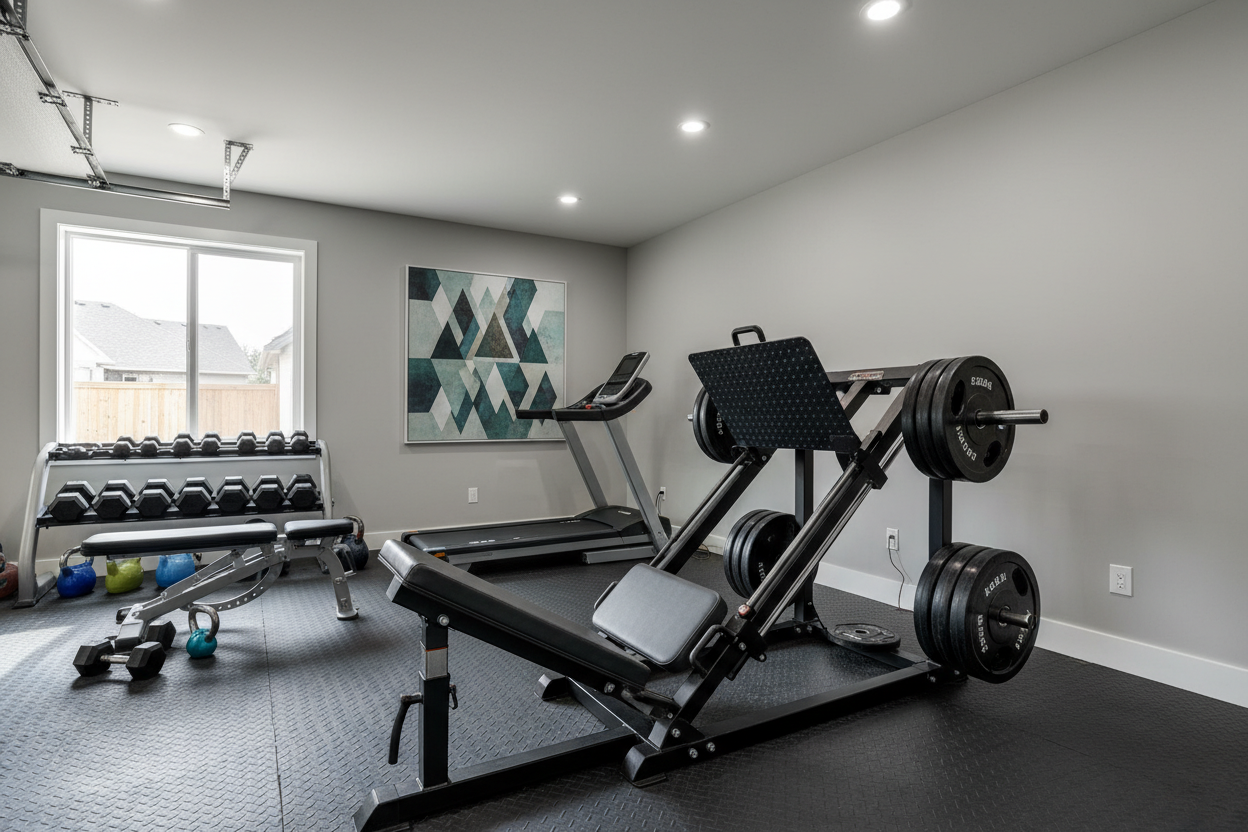
You ever walk into a high-end commercial facility, hop on the sled, and feel like you're pushing a cloud made of solid iron? Then you go home, hop on your budget weight machine leg press, and it feels like you're dragging a bucket of gravel across a sheet of sandpaper. It is a soul-crushing realization that usually happens right after you spend three hours assembling a 200-pound box of Chinese steel.
- Linear bearings are the gold standard—accept nothing less.
- A small footplate is the fastest way to ruin your knee health.
- Budget machines flex under heavy loads, causing 'binding' on the rods.
- Space is your biggest enemy; measure twice, buy once.
The Commercial Gym Illusion
The reason that leg push machine gym setup at your local powerhouse feels so smooth isn't just maintenance; it is mass. Commercial units are built with massive 2-inch solid steel guide rods and industrial-grade linear bearings. They don't flex because they weigh 800 lbs before you even put a plate on the horns. In a garage gym, we are often looking for something we can actually move, and that is where the trouble starts.
Budget manufacturers cut corners on the 'guts' of the machine. Instead of precision bearings, they use nylon rollers or, even worse, plastic bushings. These components have a high coefficient of friction. When you load up four plates a side, those plastic wheels compress. Suddenly, you aren't just fighting gravity; you're fighting the machine's own desire to grind itself into dust. It’s a stuttering, jerky movement that kills your mind-muscle connection.
The Anatomy of a Non-Garbage Sled
If you want a feet press machine that doesn't make you regret your existence, you need to look at the bearing system. Linear ball bearings are non-negotiable for a smooth ride. They allow the sled to glide with minimal resistance, meaning the tension stays on your quads, not on the friction of the rods. If a listing doesn't explicitly mention 'linear bearings,' it probably uses cheap wheels.
Next, look at the footplate. A tiny 18-inch plate is a trap. You need enough real estate to move your feet high for glute emphasis or low for quad recruitment. A wide plate also allows for a sumo stance, which is great for adductor work. If your feet are cramped, your range of motion will suffer, and your knees will take the brunt of the load.
Combo Machines: Space-Saver or Double Compromise?
Most garage gym owners don't have the luxury of a 1,000-square-foot facility. This is where the leg press/hack squat combo comes in. In the past, these were usually 'jack of all trades, master of none' situations where the transition took ten minutes and the ergonomics felt off for both movements. However, modern engineering has changed the game.
A compact 30-degree combo rig is often the smartest play for a single-car garage. These units use a clever geometry to give you a massive range of motion without the 8-foot footprint of a traditional 45-degree sled. You get the quad-pumping benefits of a hack squat and the heavy loading of a press in one footprint. Just ensure the flip-down footplate is heavy-duty steel, not thin diamond plate that bows when you press.
The Fake Math Behind Budget Leg Machines
Physics is a jerk. On a 45-degree leg press, you aren't actually lifting 100% of the weight on the horns because of the angle. But on a cheap machine, the 'feel' is even more distorted. Friction from poor-quality rollers can add or subtract a perceived 50 lbs from the lift. It makes tracking progress impossible because the machine feels different every day depending on the temperature of the grease.
Understanding the actual weight you are lifting is crucial for progressive overload. If the sled has high internal friction, you might think you're getting stronger, but you're actually just wearing down the plastic components. A high-quality machine will have a consistent, predictable 'weight curve' that lets you actually measure your gains.
Will This Massive Rig Destroy Your Floor?
A decent leg press is heavy. Add 600 lbs of plates, and you're looking at half a ton concentrated on four small feet. If you are worrying about cracking your garage floor, you are being smart. Standard 4-inch residential concrete isn't always poured perfectly.
To protect your foundation, don't just throw this on bare concrete. You need 3/4-inch horse stall mats at a minimum. These mats help distribute the 'point load' of the machine's feet across a larger surface area. If you're planning on loading it to the max, consider a double layer of plywood under the mats to create a proper lifting platform.
Seated vs. 45-Degree: What Fits Your Space Better?
A leg bench press machine, which is usually a seated horizontal unit with a weight stack, is a godsend for basement gyms with 7-foot ceilings. They have a smaller footprint and are much easier to 'jump into' for a quick set. However, they usually top out at 250-300 lbs, which most serious lifters will outgrow in a year.
The 45-degree sled is the king of lower body hypertrophy, but it requires a 'runway.' You need space to load the plates on the sides and space for the sled to travel. If you have a deep garage, the 45-degree is the way to go. If you're in a cramped spare bedroom, the seated version or a compact combo is your only realistic path to big wheels.
My Personal Lesson in Cheap Steel
I once bought a 'prosumer' leg press from a big-box sporting goods store. It looked great in the photos. But the first time I loaded it with five plates per side, the guide rods actually bowed inward. The sled got stuck at the bottom of the rep. I had to shimmy out from under it like a trapped subterranean mole. I sold it on Craigslist the next day for a $200 loss. Buy once, cry once—get the linear bearings.
FAQ
Does a leg press replace the squat?
No. Squats are a full-body stability movement. The leg press is a tool for absolute quad and glute isolation without your lower back being the limiting factor. Use both.
How much ceiling height do I need for a 45-degree press?
Most standard sleds need about 5 to 6 feet of vertical clearance at the top of the stroke, but you also need room to stand over it to load plates. 7 feet is the comfortable minimum.
Are plate-loaded machines better than weight stacks?
For a home gym, plate-loaded is usually better. It's cheaper, easier to move, and you can use the plates you already own for your barbell work. Weight stacks are convenient but add $500-$1,000 to the price tag.
Share:
I Fried 3 Motors Before Finding the Best Treadmill for Home
Stop Running: Are Weight Machines Good for Weight Loss?