
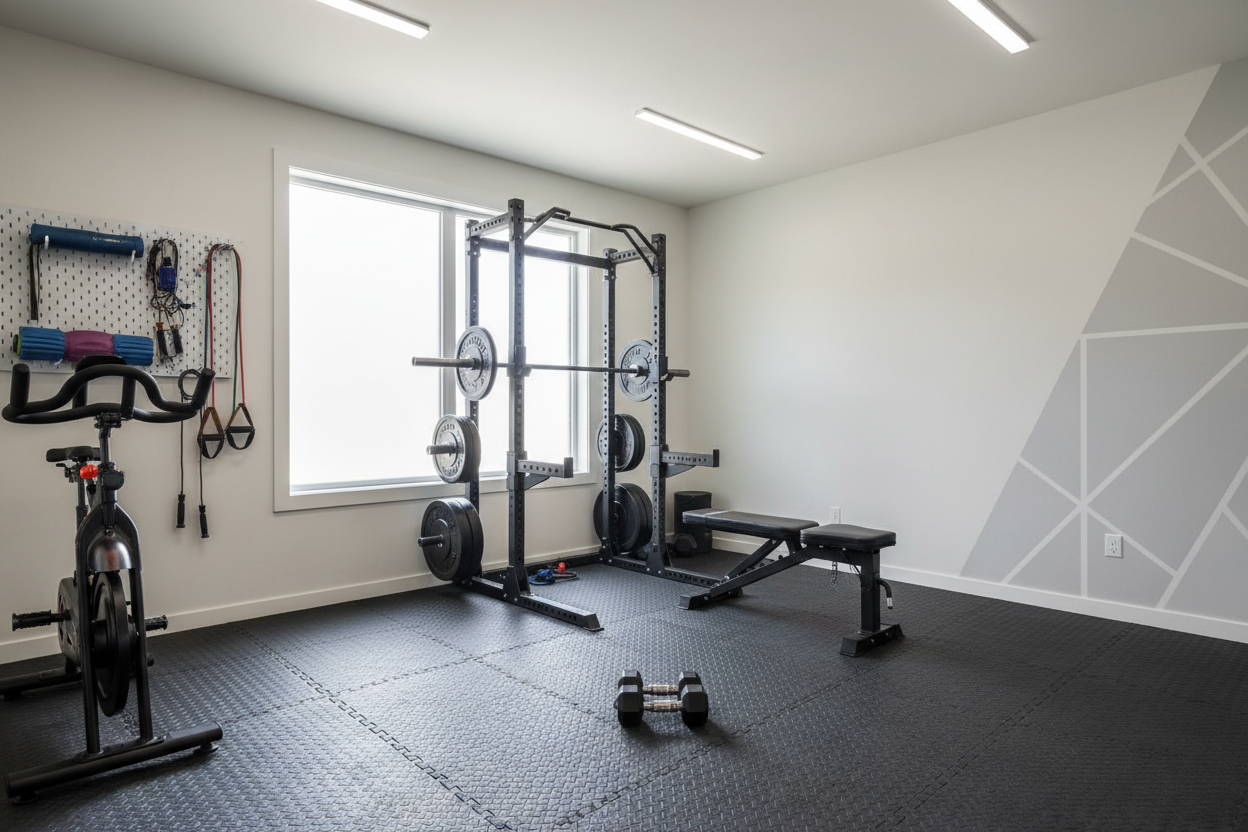
I remember the day I realized my $60-a-month commercial gym membership was basically a tax on my sanity. Between the guy hogging the squat rack for bicep curls and the broken cable machines, I was done. I went home and scrolled Amazon at midnight, nearly pulling the trigger on a 'complete' setup that cost $400. Luckily, I stopped myself. That cheap gear would have snapped the first time I loaded 225 on the bar. Finding the best home-gym under $1000 isn't about finding the most pieces of equipment; it's about finding the highest quality steel that fits your budget.
- Prioritize a 14-gauge or 11-gauge steel power rack.
- Skip the fancy machines; stick to the 'Core Four' (Rack, Bar, Bench, Plates).
- Buy a solid flat bench instead of a cheap, wobbly adjustable one.
- Source your plates used to save hundreds for a better barbell.
Why a Grand is the Magic Number for a Starter Gym
A thousand dollars is the exact sweet spot where you move past flimsy sporting-goods store gear and into legitimate, heavy-duty training territory. Below the $500 mark, you're mostly looking at 'weights' that belong in a toy aisle. These are the racks that shake when you rack a 135-pound squat and barbells that use bolts instead of snap rings. At $1,000, the physics of your gym change.
This budget allows you to invest in actual structural integrity. You can afford a rack that won't tip over and a bar that won't permanently bend the first time you deadlift. While perfection is expensive, putting together a functional at home gym is entirely possible on a strict budget. You just have to be disciplined enough to ignore the shiny gadgets and focus on the iron.
The Trap of the 'Do-It-All' Cheap Multi-Gym
You've seen them: the $400 towers that promise 50 different exercises in one 4x4 footprint. They look great on the box, but they are a total trap. These plastic-pulley nightmares usually have a weight capacity that a toddler could exceed. I've tested towers where the 'lat pulldown' felt like I was pulling a bungee cord through a bucket of sand. The friction is high, the stability is low, and the cable will likely snap within six months.
Compare those wobbly budget towers to a premium all in one home gym and the difference is staggering. When you're on a $1,000 budget, you don't have the cash to buy quality pulleys and cables. If you try to buy a machine at this price point, you're sacrificing the safety of your rack and the quality of your bar. Don't do it. Stick to free weights until you have the capital to upgrade to something that won't wobble dangerously during a simple set of rows.
The Core Four: Where Your Money Actually Belongs
To build a real home gym for under 1000, you need to be a minimalist. You need four things: a power rack, a barbell, a bench, and plates. That is it. These four pieces are the foundation of any home gym setup regardless of your ultimate fitness goals. If you can squat, press, and pull, you can get stronger than 99% of the population.
The Power Rack (Your $300-$400 Anchor)
The rack is your insurance policy. When you're training alone in a garage, those safety pins are the only thing between you and a trip to the ER. Look for a rack made of at least 2x2 inch steel tubing. Avoid anything with 1-inch uprights; they feel like toothpicks when you're racking a heavy bar. Ideally, you want a rack with a 500-lb to 700-lb static weight capacity. Also, pay attention to the hole spacing. If the holes are four inches apart, you'll never find the right height for your bench press safety spotters.
The Bench and Barbell Combo
People always make the mistake of buying a $60 adjustable bench from a big-box store. Don't. Those benches have gaps that eat your lower back and frames that creak under a 185-pound press. Buy a heavy-duty flat bench instead. It's more stable, cheaper, and safer. For the barbell, look for a 20kg (44lb) bar with a 28.5mm diameter. You want a bar with decent knurling—that's the 'sandpaper' grip. If the bar is smooth and shiny, it'll slip out of your hands the second you start to sweat. A $200 bar is the best investment you'll ever make.
Can You Fit a Machine Into a Budget Setup?
Usually, the answer is no. Machines take up a massive amount of floor space and budget. If you're building a home gym under 1000, a standalone leg press or cable crossover is going to eat 40% of your funds. It's much smarter to buy a $50 plate-loaded pulley attachment for your power rack. It's not as smooth as a commercial functional trainer, but it gets the job done for tricep extensions and face pulls.
However, I know some of you are strictly in it for the hypertrophy. If bodybuilding is your main goal and you hate the idea of balancing a barbell, saving up for a Smith machine home gym station might be a better phase-two investment. But for the initial $1,000 build, focus on the versatility of free weights. You can do 100 exercises with a barbell; a machine usually does one or two.
The Used Market: Stretching That Grand Even Further
Here is the pro tip: never buy brand-new cast iron plates. Iron is iron. It doesn't get 'old' or 'tired.' Scour Facebook Marketplace, Craigslist, or OfferUp for people selling 'rusty weights' in their garage. You can often find plates for 50 to 60 cents per pound, whereas new ones will cost you $1.50 or more. If you spend $300 on 300 pounds of used iron, you've just saved enough money to upgrade from a basic barbell to a high-end power bar. A little vinegar and a wire brush can make 30-year-old plates look brand new in a single afternoon.
Personal Experience: My $1000 Lesson
When I started my first garage gym, I tried to be 'smart' and bought a cheap adjustable bench because I wanted to do incline presses. Big mistake. The first time I tried to press 225, the locking pin sheared off and the backrest dropped into a flat position mid-rep. I didn't get hurt, but I learned my lesson: in a budget gym, simplicity equals safety. I sold that bench for $20 and bought a solid, welded flat bench that I still use today, ten years later.
FAQ
Is a 700lb capacity bar enough?
Yes. Unless you are an elite powerlifter squatting 600+ pounds, a 700lb-rated bar provides a massive safety margin. Just make sure it has snap rings, not bolts, at the ends.
Should I get bumper plates or iron?
If you're doing CrossFit or Olympic lifts where you drop the bar from overhead, get bumpers. If you're doing squats, deadlifts, and presses, get iron. Iron is cheaper and takes up less space on the bar.
How much floor space do I really need?
A standard power rack is about 4x4 feet, but you need a 7-foot width for the barbell. An 8x8 foot space (the size of two sheets of plywood) is the minimum for a comfortable, safe setup.
Share:
Finding the Best Complete Home Gym Comes Down to One Spec
I Got Burned Figuring Out Where to Buy Gym Equipments Online