
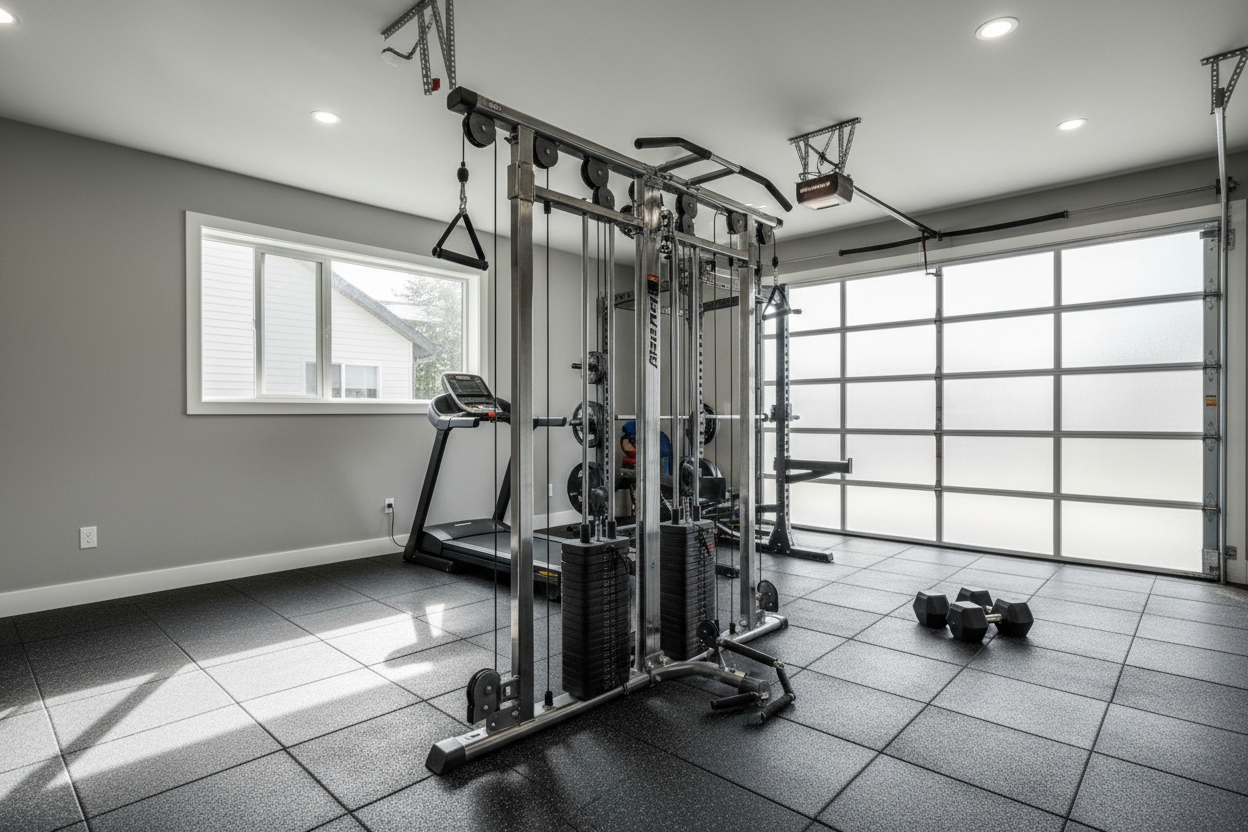
I spent a decade convinced that if it wasn't a rusty barbell and a pile of iron, it wasn't a real workout. My garage was a shrine to the power rack, but as my joints started complaining and my schedule got tighter, the purist life became a drag. I was spending twenty minutes just moving plates around for accessory work instead of actually lifting. I finally started looking into the best all in one home gyms to see if I could actually get a decent session without a massive footprint.
Admitting that a machine might be better than my old squat stand was a hard pill to swallow. But after testing several rigs, I realized I hate that I love it. The efficiency of jumping from a heavy press to a cable fly without stripping a bar is a total luxury for anyone training in a 40-minute window.
Quick Takeaways
- Look for 11-gauge steel frames; anything less will wobble when you are pushing heavy weight.
- Dual weight stacks are non-negotiable for true functional training and bilateral movements.
- Pulley ratios matter—a 2:1 ratio is standard for most, but 1:1 is king for heavy rows.
- A built-in Smith machine provides a critical safety net for solo lifters training to failure.
Why I Finally Caved and Tried a Multi-Station Rig
I used to be the guy who laughed at anyone using a pulley. To me, a cable was just a fancy way to avoid doing real work. But then I hit 35, and my shoulders decided they weren't interested in heavy overhead presses every single morning. I needed variety, and I needed it in a 6x8 foot corner of my garage. I started searching for the best all in one fitness machine to see if I could condense my row of separate stations into one heavy-duty unit.
The transition wasn't about getting soft; it was about getting smart. When you have a family and a job, spending your limited gym time hunting for a missing spring collar is a waste. These rigs allow you to flow from compound movements to isolation work in seconds. It turns out that the best all in-one workout machine isn't a compromise—it is a force multiplier for your hypertrophy goals.
The Problem With Most 'Do-It-All' Machines
Most of the junk you see on Amazon or at big-box retailers is garbage. They use thin 14-gauge steel that flexes if you breathe on it too hard. They advertise 200 exercises, but 180 of them feel like you are pulling on a rubber band attached to a screen door. When people talk about the best all in one gym equipment, they often get suckered in by plastic pulleys that melt under friction and cables that fray after three months of use.
The biggest red flag is a low weight capacity. If a machine tops out at 150 pounds of resistance, you are going to outgrow it in six months of consistent training. Most best all in-one gym equipment lists are written by people who have never actually loaded a stack to its limit. If the frame shakes when you do a pull-up, it does not belong in your house.
What Actually Makes a Rig Worth Your Money?
If you are going to drop a few thousand dollars, the specs need to be commercial grade. I am talking 3x3 inch or 2x3 inch 11-gauge steel. You want aircraft-grade cables and aluminum pulleys rather than the cheap nylon ones that come on budget rigs. A high-quality smith machine with cable crossover should feel as smooth as a hot knife through butter. If there is any 'catch' or friction in the travel, it is going to ruin your mind-muscle connection during slow eccentrics.
The best all-in-one home gym equipment must have dual weight stacks. This allows you to do cable crossovers, pec decks, and functional movements with independent resistance for each arm. It fixes the imbalances that a single-stack machine can actually make worse. Check the bearings too; linear bearings on the Smith bar are a must for that friction-free feel you get in a pro facility.
The Smith Machine Element (Stop Knocking It)
The Smith machine gets a bad rap from the 'functional' crowd, but if you train alone, it is a lifesaver. I have had days where I wanted to push my Bulgarian split squats to absolute failure, and I simply couldn't do that safely with a barbell. Having a guided track that needs a built in smith rack means you can rack the weight with a quick flick of the wrist if your legs give out.
It is also the ultimate tool for isolation. By removing the need to stabilize the weight, you can put 100% of your focus on the target muscle. For bodybuilding-style training, a fixed track is superior for hitting specific heads of the delts or quads without your form breaking down under fatigue.
Free Weights vs. The All-In-One: The Final Verdict
Do you need to sell your barbell? Not necessarily. The ultimate setup is a hybrid. I still keep my favorite power bar for heavy deadlifts, but 80% of my training now happens on the rig. If you are tight on space, the best all in one exercise equipment is hands-down a better investment than a bunch of scattered benches and cheap stands that you will eventually trip over.
If I were starting from scratch today, I would skip the basic squat rack and go straight for a comprehensive smith machine home gym station. It solves the storage problem, the safety problem, and the 'I don't have enough time' problem all at once. Just make sure you buy something heavy enough that you won't need to replace it when you actually get strong.
FAQ
Do these machines require a lot of maintenance?
Not if you buy quality. You will need to wipe down the guide rods with a silicone-based lubricant every few months to keep things smooth, and occasionally check the cable tension. Avoid WD-40; it actually attracts dust and gunk.
Can I really build muscle with cables?
Your muscles don't have eyes. They only know tension. Cables provide constant tension throughout the entire range of motion, which is something free weights can't do because of gravity's strength curve. For growth, cables are often superior.
How much floor space do I need?
Most of these rigs need an 8x8 foot area. You need room for the width of the Smith bar and enough clearance in front of the machine to pull out a bench or perform cable flys. Always measure your ceiling height too—some of these top out at 84 inches or more.
Share:
I Put a Fold Up Workout Machine in My Office (And It Didn't Suck)
I Maxed Out the Amazon Basics Flat Weight Bench (Here's What Broke)