
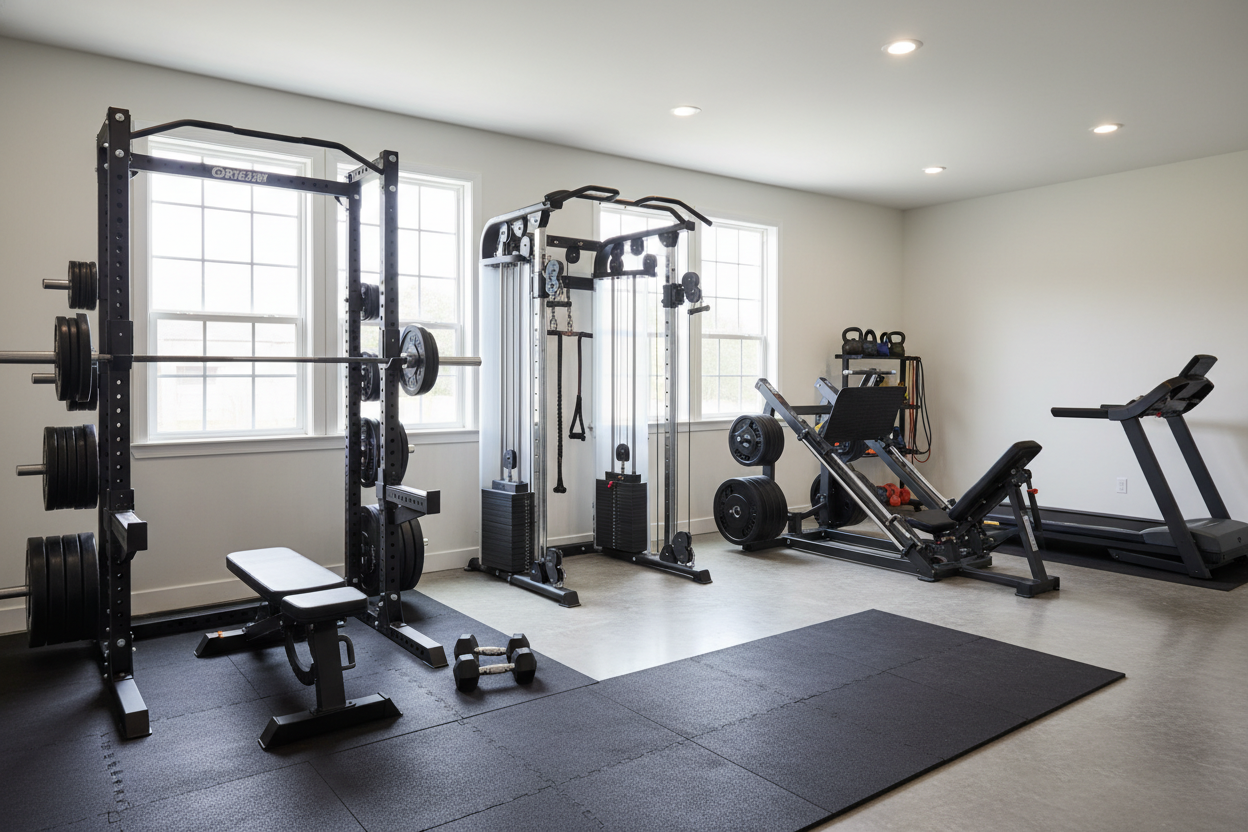
I remember staring at a commercial gym liquidation auction last year, nearly dropping three grand on a leg press that would have eaten forty percent of my garage floor. It is easy to get blinded by the shiny steel and commercial-grade labels. Understanding the various weight machine types is the difference between a functional training space and a glorified storage unit for laundry.
Buying the wrong rig is an expensive mistake that usually ends with a listing on Marketplace three months later. You need to know how the resistance actually gets to your muscles before you bolt anything to your floor.
Quick Takeaways
- Selectorized machines offer the fastest transitions but take up the most permanent space.
- Plate-loaded equipment is the most cost-effective for home lifters using existing iron.
- Leverage systems provide a safer, fixed path that mimics the feel of free weights.
- Cable machines are the ultimate tool for constant tension and isolation work.
Why You Need to Learn the Equipment Lingo First
Most people walk into a gym and just see 'the chest machine' or 'the leg thing.' If you are building a home setup, that lack of specificity will cost you. Every piece of equipment has a different mechanical profile that dictates how it feels, how much it costs to ship, and how much maintenance it requires. If you do not understand the mechanics, you are just buying based on the photo, which is a great way to end up with a machine that has a terrible strength curve.
Different types of weight machines solve different problems. Some are built for maximum load, while others are built for rehab or hypertrophy. Identifying the mechanism—whether it is a cable, a pivot point, or a weight stack—helps you filter out the marketing fluff and focus on what actually fits your programming.
Selectorized (Pin-Loaded) Machines: The Commercial Standard
These are the rigs you see in every big-box gym. You want to change the weight? You move a pin. It takes two seconds. That convenience is the primary selling point. If you are running high-volume drop sets, selectorized machines are unbeatable. The tension is usually very consistent because the weight is moving vertically on guide rods, meaning gravity is working against you in a predictable way.
However, for a garage gym, they are a tough sell. First, they are heavy. A 250-pound weight stack plus the frame means you are looking at 500+ pounds of dead weight on your floor. Second, they are expensive. You are paying for the iron in the stack and the shipping to get it to your driveway. Unless you have a massive budget and a dedicated floor, these are usually overkill for a solo lifter.
Plate-Loaded Systems: The Garage Gym Sweet Spot
This is where most of us live. Plate-loaded machines use sleeves where you manually slide on your own Olympic plates. Since you aren't paying for a built-in weight stack, the machine itself is significantly cheaper and lighter to ship. It is the most efficient way to add specialized movements to your gym without taking out a second mortgage.
The beauty here is versatility. Since you are likely already invested in iron, I Tested 5 Types of Weight Plates (And Kept Just One) and found that having a consistent set makes loading these machines much smoother. You get to use the plates you already own, and the footprint is typically much smaller than a selectorized unit. The only downside is the time spent loading and unloading between sets.
Independent Arm Leverage Machines: The Biomechanical Cheat Code
Leverage machines are a specific subset of types of weight lifting machines that use a fixed pivot point. The best ones feature independent arms. This is a massive win for anyone with muscle imbalances or those training around joint issues. Unlike a barbell, where your strong side can take over, independent arms force each side of your body to pull its own weight.
Take the Weight Bench Chest Press Machine Independent Arms Z1 Pro as a prime example. It mimics the converging path of a dumbbell press—meaning the handles move closer together at the top—but gives you the stability of a machine. You get the 'pump' of a machine with the natural feel of a free weight. It is the safest way to push to absolute failure without needing a spotter.
Cable Crossovers and Functional Trainers: The Do-It-All Hubs
If you only have room for one non-barbell item, it should probably be a cable system. Cables provide constant tension throughout the entire range of motion, something gravity-based plates can't do. When you're doing a cable fly, the weight is pulling against you just as hard at the start as it is at the peak contraction.
Pay attention to pulley ratios. A 2:1 ratio means 100 pounds on the stack feels like 50 pounds of resistance, but you get twice the cable travel. This is perfect for functional movements and fast, explosive work. A 1:1 ratio is 'true' weight, better for heavy lat pulldowns or rows. For most home gyms, a 2:1 functional trainer is the sweet spot for accessory work.
So, Which Rig Actually Belongs in Your Setup?
Choosing between these weight machine types comes down to your space and your goals. If you have a 10x10 spare bedroom, a compact functional trainer or a plate-loaded leverage arm system is your best bet. If you have a massive barn and a deep wallet, by all means, buy the selectorized stacks. Just remember that the machine is only half the equation.
Most of these systems, especially functional trainers and Smith machines, are useless without a solid foundation. You need a heavy-duty Weight Bench that can handle the angles required for incline presses, seated rows, and step-ups. Don't spend two grand on a machine and then use a thirty-dollar bench you found at a yard sale. Match the quality of your accessories to the quality of your main rig.
Personal Experience: The 'Cheap Cable' Lesson
Early in my lifting days, I bought a budget cable tower with plastic pulleys. I thought I was being smart by saving three hundred bucks. Within two months, the friction from the nylon cables started melting the plastic grooves. The movement became jerky, and eventually, the cable snapped during a tricep extension. I nearly punched myself in the face. Now, I never buy a machine unless it has aluminum pulleys and high-tensile aircraft cables. Sometimes, the 'expensive' option is actually the cheaper one in the long run.
FAQ
Are plate-loaded machines better than cables?
Neither is 'better,' they just serve different purposes. Plate-loaded machines are better for heavy, compound-style movements like presses and squats. Cables are superior for isolation and maintaining tension through weird angles.
How much space do I need for a functional trainer?
Budget for a 5x4 foot footprint for the machine itself, plus another 4 feet of clearance in front of it so you can actually pull the cables without hitting the wall.
Do leverage machines require a lot of maintenance?
Very little. Since there are no cables or pulleys to fray, you usually just need to grease the pivot points once a year. They are arguably the most durable machines you can buy.
Share:
I Ditched My Smart Treadmill for a Used Life Fitness 9500HR
The Truth About the Best Fitness Equipment Home Gyms Actually Use