
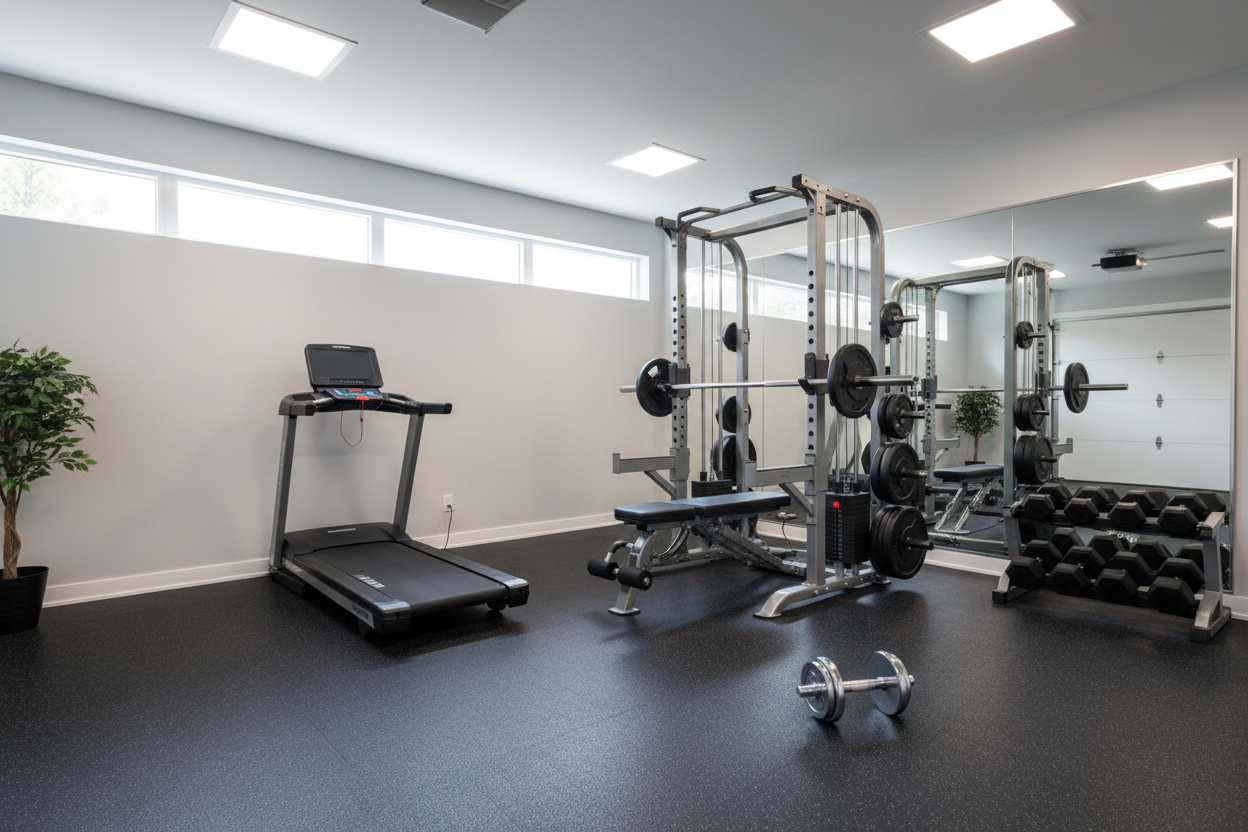
I remember the day I realized my basement dream was actually a height nightmare. I’d spent weeks researching the perfect setup, only to realize that most commercial-grade racks are built for people who live in converted warehouses, not 1950s bungalows with 7-foot ceilings. Finding the best smith machine for low ceilings isn't just about aesthetics; it's about not knocking yourself unconscious on a floor joist during a heavy set of squats.
Quick Takeaways
- Measure the lowest point of your ceiling (ductwork included), not the highest.
- Look for machines with a total height under 81 inches to account for bar travel.
- Subtract your flooring thickness (usually 3/4 inch) from your total clearance.
- Expect to do pull-ups with your knees bent—it is the standard trade-off for basement life.
The Brutal Reality of Basement Gym Clearances
Commercial gear is designed for 15-foot ceilings. When you decide to move your workouts to a home gym, you quickly realize that the 'standard' 90-inch power rack is a non-starter. In a basement gym low ceiling environment, you are fighting for every fraction of an inch. I have seen guys buy beautiful, $2,000 rigs only to find they can't even stand them upright because the top crossmember hits a water pipe.
You need specialized low ceiling gym equipment. This means hunting for 'short' or 'mini' versions of classic designs. The goal is to find a machine that provides a stable, fixed-path barbell experience without requiring you to renovate your foundation. If you have ductwork hanging at 82 inches, your equipment needs to be 80 inches or shorter. Period.
How to Measure Your Space (Without Ruining Your Drywall)
Grab a laser measure and find the lowest point in the room. This is usually a main drain pipe or an HVAC trunk. That is your ceiling height. If you measure the gap between the joists but plan to place the machine under a duct, you are going to have a very expensive paperweight in your basement.
Don't forget the floor. You aren't lifting on bare concrete unless you want to destroy your joints and your foundation. You need to subtract the 3/4-inch thickness of your rubber mats, which are the gold standard for home training, from your total height. If your ceiling is exactly 84 inches and you add a platform and mats, your functional clearance is suddenly 82.5 inches. That 1.5-inch difference is the difference between a successful lockout and a hole in the ceiling.
What Actually Makes the Best Smith Machine for Low Ceilings?
A true low ceiling smith machine usually caps out at 80 to 82 inches. But height isn't the only spec that matters. You need to look at the 'upward travel' of the bar. Some machines have guide rods that extend past the frame when the bar is at its highest point. If the frame is 80 inches but the rods pop up to 83 inches at the top of a press, you're in trouble.
I prefer a Smith machine home gym station for these tight spaces. These units often integrate cable pulleys and plate storage within the footprint of the rack. Look for slanted uprights; they follow a more natural pressing path and often allow the top of the machine to sit slightly lower than vertical models. Also, pay attention to the plate storage horns. If they are positioned at the very top of the frame, you won't be able to slide a 45-pound plate on without hitting the rafters. You want storage pegs that are mid-height or lower.
The Pull-Up Bar Problem: What You Compromise on Shorter Rigs
Let's be honest: you are going to sacrifice your ego on pull-ups. When I was testing rigs for a garage gym with 10-foot ceilings, I could hang fully extended. In a home gym basement low ceiling setup, you are doing 'L-sit' pull-ups or tucking your knees behind you. It is annoying, but it beats not having a pull-up bar at all.
The real priority here is the barbell. You want a machine that allows for a full range of motion on squats and overhead presses (even if you have to do those seated). Most short-stature machines use 11-gauge or 12-gauge steel to maintain stability despite the smaller frame. If the machine feels light, it probably is. Look for a total unit weight of at least 250 lbs to ensure it doesn't walk across the floor when you re-rack a heavy load.
Maximizing Your Compact Basement Setup
Positioning is everything. Don't put your machine directly under a light fixture. I once shattered a recessed light during a set of seated shoulder presses because I didn't account for the plate diameter. Leave at least 2 feet of space on either side of the machine so you can actually load the plates without hitting a wall.
If you're really cramped, look for a machine with front-loading pegs rather than side-loading ones. This allows you to tuck the machine closer to a side wall. Also, consider the bench. A low-profile bench that sits 17 inches off the floor will give you more 'working room' for seated exercises than a standard 19-inch competition bench.
Personal Experience: The 'Notch' Mistake
I once spent three hours assembling a 'compact' rig only to find out the linear bearings needed another two inches of clearance at the top of the guide rods to actually lock out. I was so stubborn that I actually notched out a piece of my drywall ceiling just to finish a set of presses. It looked terrible and my wife was furious. Learn from my stupidity: measure the 'max extension' height, not just the static frame height. If the manufacturer doesn't list it, email them and ask.
FAQ
Can I use a Smith machine if my ceiling is exactly 7 feet?
Yes, but you are limited to machines that are 80 inches or shorter. This gives you 4 inches of clearance for the floor mats and a tiny bit of breathing room at the top.
Do low-profile machines feel flimsy?
Not necessarily. Stability comes from the gauge of the steel and the width of the base. A short machine with a wide footprint can actually feel more stable than a tall, narrow one.
Are Smith machines better for basements than power racks?
In very tight spaces, yes. Because the bar moves on a fixed track, you don't need the 'safety zone' around the rack that you do with a free-weight barbell. It allows for a much tighter layout.
Share:
I Wasted $2K Before Finally Building a Home Gym on a Budget
I Traded My Barbell for a Portable Gym (Here's What Happened)