
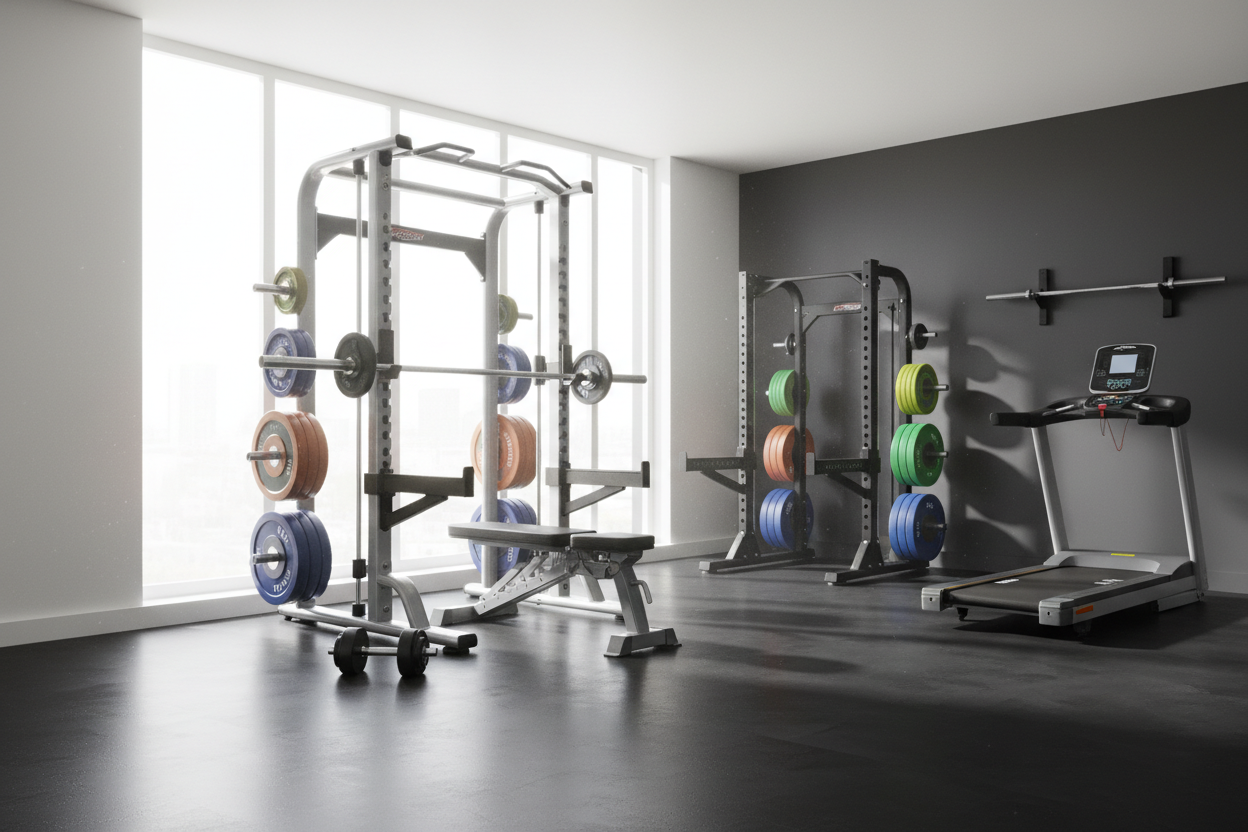
I remember the first time I loaded up three plates on a Smith machine at a commercial gym. My chest felt like it was going to pop the buttons off my shirt, and for a fleeting second, I thought I’d finally cracked the code to elite strength. Then I went back to my garage gym, tried the same weight on a standard bar, and nearly pinned myself to the bench. It was a humbling reality check that every lifter eventually faces.
If you are currently staring at the rack wondering is smith machine bench easier than the real thing, the answer is a resounding yes. But understanding why it feels easier—and how to use that to your advantage—is what separates a gym rat from a student of the iron. You aren't necessarily weaker; you're just working with a different set of physics.
Quick Takeaways
- The Smith machine removes the need for horizontal stabilization, letting you focus 100% on the push.
- Counterbalance systems in many machines can make a 45-lb bar feel like it weighs only 15 or 20 lbs.
- You can typically lift 10-20% more on a Smith machine due to reduced nervous system fatigue.
- It is an elite tool for hypertrophy (muscle growth) because it allows for safer training to absolute failure.
The Elephant in the Gym: Is Smith Machine Bench Press Easier?
Let’s address the ego in the room. If you just hit a massive PR on the rails, I hate to be the bearer of bad news, but it doesn't translate 1:1 to a barbell. When people ask is smith machine bench press easier, they are usually looking for a justification for their numbers. The truth is that the fixed track acts like training wheels for your nervous system.
On a free-weight bench, the bar wants to drift toward your face or your waist. Your body has to fight to keep that weight in a vertical plane. The Smith machine kills that battle entirely. Because the bar is locked into a track, your brain doesn't have to worry about the weight falling on your neck. This mental safety net allows you to exert more force without the 'brakes' of your nervous system kicking in to protect you from a catastrophic drop.
Why the Fixed Bar Path Hacks Your Nervous System
The biomechanical reason is smith machine easier than bench comes down to stabilizer recruitment. When you press a loose barbell, your rotator cuffs and anterior deltoids are working overtime to keep the bar steady. They act as the suspension system of your upper body. On a Smith machine, that suspension system gets to take a vacation.
Without the need to balance the load, your primary movers—the pectorals and triceps—can fire at maximum capacity. This is why you feel a much more intense 'pump' in the chest. You aren't wasting energy on micro-adjustments. You are simply a piston moving in a cylinder. This lack of horizontal sway means your nervous system can recruit more high-threshold motor units in the chest because it isn't preoccupied with the bar wobbling like a Jenga tower.
Can You Bench More on a Smith Machine? (The Real Numbers)
Most lifters find they can you bench more on a smith machine by a significant margin, often ranging from 15 to 30 pounds. This isn't just because of the stabilizers; it’s often due to the actual weight of the bar. In many commercial gyms, the Smith bar is counterbalanced with weights hidden in the side columns. While a standard Olympic bar is a guaranteed 45 lbs, a Smith bar might only have an effective starting weight of 15 or 25 lbs.
Then there is the issue of friction. While high-end machines use linear bearings that are smooth as silk, older machines might have a bit of drag. However, the mechanical advantage of the fixed path almost always outweighs the friction. If you're trying to track your progress accurately, you need to realize that Smith machine bench press conversion math isn't as simple as adding up the plates. You have to account for that counterbalance, or your logbook is lying to you.
Is Smith Machine Easier Than Bench for Hypertrophy?
Easier doesn't mean 'worse.' In fact, if your goal is strictly to build a massive chest, the Smith machine might actually be superior to the barbell. Because you don't have to balance the weight, you can push yourself much closer to failure without the fear of the bar tipping. It allows for a level of mechanical tension that is hard to replicate when you're struggling just to keep a barbell straight.
However, if you find that your shoulders are starting to ache from the rigid, unnatural path of the Smith machine, you might want to look at a chest press machine independent arms setup. These machines offer the same stability as a Smith machine but allow each arm to move through a more natural arc, preventing the muscle imbalances that can happen when a fixed bar lets your dominant side do 60% of the work. For pure muscle growth, the 'ease' of the machine is actually its greatest strength.
How to Transition Your Fake PRs to Real Barbell Strength
If you've spent the last three months living on the Smith machine and decide to switch to a free-weight rack, be prepared for a reality check. Your chest might be strong enough to push 225, but your stabilizers are likely still at a 185-lb level. To bridge the gap, you need to start incorporating 'raw' pressing movements into your routine at least twice a week.
I usually recommend starting with a multi function bench press set in your home gym where you can practice the 'J-curve' of a natural bench press. Start with about 70% of your Smith machine max and focus on bar control. Don't rush the weight. You need to give those tiny stabilizer muscles time to catch up to the raw power your pecs have developed on the rails. Once they do, your 'real' bench will skyrocket.
My Personal Take
I spent an entire year avoiding the Smith machine because I thought it was 'cheating.' That was a mistake. I eventually plateaued on my barbell bench because my triceps were giving out before my chest was fully taxed. I started using the Smith machine as a secondary movement—after my heavy barbell sets—and my chest thickness exploded. My mistake was thinking it had to be one or the other. Use the barbell to build 'real' strength and the Smith machine to finish off the muscle. Just don't brag about your Smith PR at a powerlifting meet unless you want to get laughed out of the building.
FAQ
Is a 225 Smith machine bench the same as a 225 barbell bench?
No. Due to the lack of stabilization and potential counterbalancing, a 225-lb Smith machine press is generally equivalent to about a 190-205 lb barbell press for most lifters.
Why does my shoulder hurt on the Smith machine but not the barbell?
The Smith machine forces you into a strictly vertical path. A natural barbell bench moves in a slight 'J' curve. If your bench setup doesn't align perfectly with the machine's track, it puts massive shear force on your rotator cuffs.
Should beginners use the Smith machine?
It’s fine for learning the basic pressing motion, but I wouldn't stay there. Beginners need to develop stabilizer strength early on, or they will hit a massive plateau (and risk injury) the moment they try to lift a real barbell.
Share:
Why Your Squat Machine Exercises Aren't Building Mass
Can a Sport Essentials Adjustable Workout Bench Handle 300 Lbs?