
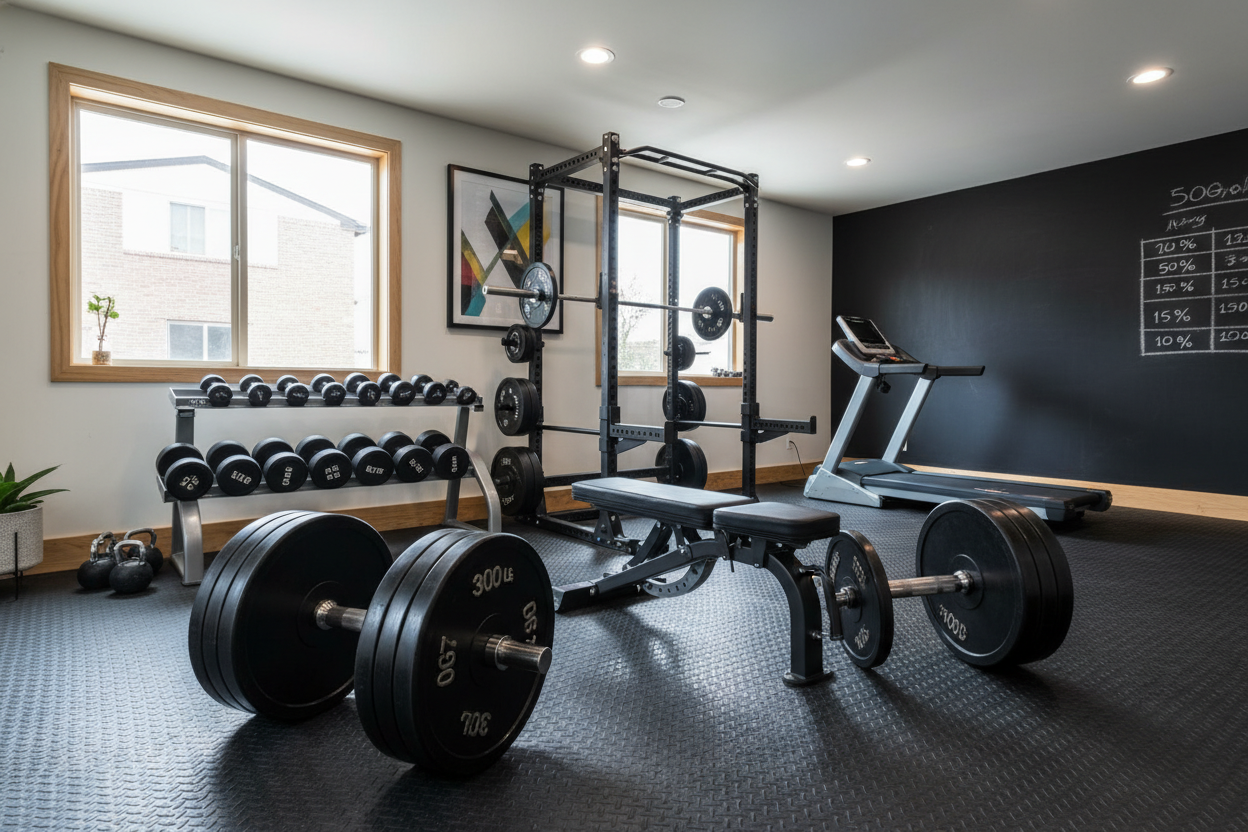
I still remember the day a pallet dropped a 300 lb dumbbell bundle in my driveway. I was convinced I’d finally built the ultimate garage gym and that these weights would last me years. I was wrong. Within three months, I was scouring local listings for heavier iron because I’d hit a wall I didn’t see coming.
- The Math: A 300 lb set usually only goes up to 40 or 45 lb pairs.
- The Lifespan: Most men will outgrow the heaviest pairs on rows and presses in 8-12 weeks.
- The Storage: Bundled A-frame racks are notorious finger-pinchers.
- The Alternative: Heavy adjustables often provide better long-term value for the same footprint.
What Actually Comes in a Standard 300 Pound Bundle?
When you see a 300 lb dumbbell set advertised, the number sounds massive. But you have to do the retail math. You aren’t getting a single 300 pound dumbbell; you’re getting a collection of pairs that usually spans from 5 lbs up to 40 or 45 lbs. In a standard 5-40 lb run, you’re looking at pairs of 5, 10, 15, 20, 25, 30, 35, and 40 lbs. That adds up to exactly 360 lbs, though many '300 lb' kits skip the 35s or 40s to hit a specific price point.
Most of these bundles feature the classic rubber hex dumbbell set design. I prefer these for garage floors because the heads don’t roll away when you drop them between sets of lunges. The knurling on the handles is usually middle-of-the-road—not sharp enough to shred your hands, but enough to keep a grip when things get sweaty. It’s a solid entry-level spec, but the weight distribution is heavily skewed toward high-rep isolation work rather than building raw strength.
The Day You Cap Out on Heavy Presses and Rows
Here is the cold, hard truth: if you are a novice lifter with a decent protein intake, you are going to outgrow a 40 lb dumbbell faster than you think. For lateral raises or bicep curls, those 20s and 25s will be your best friends for a long time. But for compound movements? You’re in trouble. A 40 lb dumbbell is roughly equivalent to a 95 lb barbell bench press. Most guys can hit that for reps within their first two months of consistent training.
Once you can comfortably row the 40s for 12 reps, your progress on that 300 lb dumbbell set effectively halts. You’ll find yourself doing endless 'burnout' sets just to feel a challenge, which is a recipe for boredom. That is the moment you’ll start looking into upgrading your heavy dumbbells by adding 50s, 60s, and 70s to your floor space. If you have the room, it’s a great progression, but it’s an extra expense you should budget for on day one.
The Truth About That Included A-Frame Storage
Most people searching for a 300 lb dumbbell set with rack are looking for a 'gym in a box' solution. The rack that comes with these is almost always a vertical A-frame 'tree.' On paper, they save space. In reality, they are a pain in the neck. These racks are often made of thinner gauge steel that can feel wobbly once you load the bottom tiers with the 40 lb pairs.
The biggest issue is the 'finger guillotine' effect. Because the weights are stacked vertically, the gap between the 35s and the 40s at the bottom is usually tiny. I’ve lost count of how many times I’ve pinched my knuckles trying to re-rack a heavy pair after a set to failure. If you have the floor space, I always recommend looking for better storage layouts for garage gyms, like a two-tier horizontal rack. It’s safer, more stable, and won’t make you dread putting your weights away.
Should You Buy This or Just Get Adjustables?
This is the $500 question. A fixed 300 lb set is great for 'circuit' style training where you need to swap weights instantly. However, for the same price as a full set and a rack, you could pick up a pair of heavy adjustable dumbbells that go up to 80 or 90 lbs per hand. The adjustables take up about 2 square feet of space, whereas a full rack takes up 4 to 6 square feet.
If you hate fiddling with pins or dials, stick with the fixed set. There is something satisfying about just grabbing a pair of weights and going. But if you know you’re going to get strong, the adjustables offer a much higher 'ceiling' for your training. You won’t be looking for new gear in three months because you’ll already have the 50s, 60s, and 70s built into the handle.
My Final Verdict on the 300 lb Starter Set
I still think the 300 lb bundle has a place. If you are focused on high-volume accessory work, or if you’re setting up a gym for multiple family members with different strength levels, it’s a smart buy. It covers the 'low end' of the weight spectrum perfectly. Just don’t buy it thinking it’s the only weight you’ll ever need. Treat it as a foundation, not the finished product.
Personal Experience: The 40-Pound Wall
When I started my home gym, I bought a 5-50 lb set. I thought 50 lbs was 'heavy.' Within twelve weeks, I was doing goblet squats with the 50s for sets of 20. I felt like I’d wasted my money because I couldn’t push my legs any harder without buying more gear. I eventually sold the rack and moved to adjustables, but I kept the 10s and 20s for warmups. My mistake was underestimating how fast the body adapts to light weights.
FAQ
Is a 300 lb dumbbell set enough for a home gym?
It’s enough for upper body isolation and high-rep endurance work, but most lifters will find it lacking for heavy rows, chest presses, and leg exercises within a few months.
Are hex dumbbells better than round ones?
For a garage gym, yes. Hex heads won't roll on uneven concrete, and they are much easier to use for floor-based movements like renegade rows or push-ups on the handles.
How much space does a 300 lb set with a rack take up?
A vertical A-frame rack usually takes up about 2 feet by 2 feet of floor space. A horizontal two-tier rack will need about 4 feet of wall length.
Share:
I Bought the 300lb Power Tower Life Fitness Built for Gyms
The Gap in Your Bench for Dumbbells Is Ruining Your Incline Press