
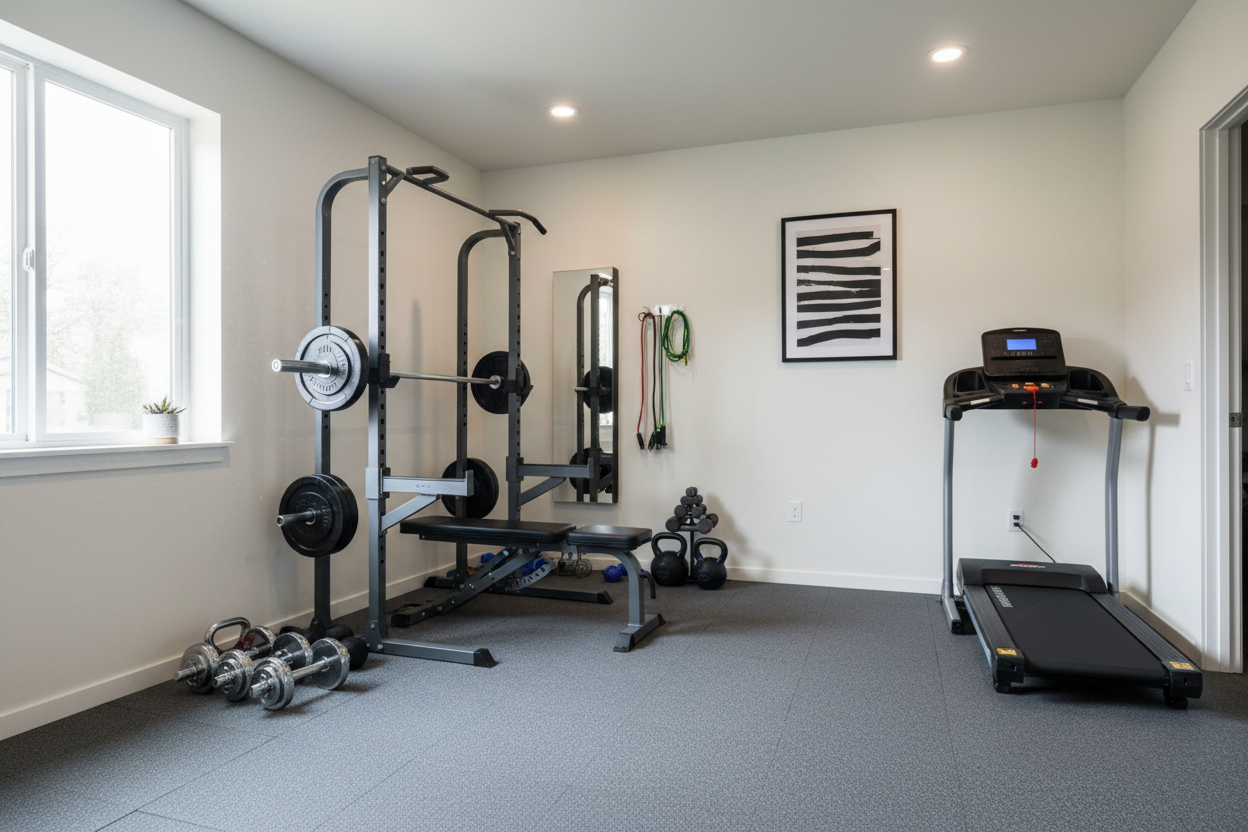
I remember standing in my 10x10 spare bedroom with a tape measure, feeling defeated. My local commercial gym just hiked dues to eighty bucks a month, and the 20-minute commute was killing my motivation. I needed a compact in home gym, but everything I saw online looked like it was made of plastic and hope. Most small gym for home options are glorified rubber bands or wobbly towers that feel like they might tip if you breathe on them too hard.
Building a home gym compact enough for a spare room shouldn't mean you have to settle for pink dumbbells and a yoga mat. You can move heavy weight in a small footprint home gym if you prioritize gear that pulls double duty. After three years of trial, error, and some very scratched drywall, I have figured out the formula for a heavy-duty iron sanctuary that fits in the corner of a bedroom.
Quick Takeaways
- Prioritize vertical storage to keep floor space clear for movement.
- Adjustable dumbbells are non-negotiable for a home small gym.
- Folding racks or wall-mounted systems save roughly 12 square feet when not in use.
- Always account for 'barbell path' and plate loading space, not just the machine's footprint.
The Problem With Most Space-Saving Gym Gear
The market is flooded with 'mini home gyms' that promise a total body workout in a box the size of a suitcase. Most of it is junk. If you are a serious lifter, those plastic pulleys and light-tension bands will be outgrown in three weeks. You might wonder if a portable fit home gym can actually build real muscle, but for most of us, nothing replaces the feel of knurled steel and actual iron plates.
The smallest home gym setups often fail because they lack stability. When you are trying to hit a PR, you don't want your rack shifting under the weight. A compact home gym system needs to be heavy-duty. Look for 11-gauge steel and 3x3 posts, even in smaller units. You aren't just looking for something small; you are looking for something dense. A compact weight machine should still have a weight stack that challenges you, not one that tops out at 100 pounds.
I have tested plenty of compact gyms that felt like toys. The key is to avoid 'all-in-one' machines that try to do twenty things poorly. Instead, look for three high-quality pieces that do five things exceptionally well. This approach prevents your room from becoming a graveyard of unused, flimsy gadgets.
Measuring Your Actual Footprint (Don't Guess)
The biggest mistake people make when building home gyms for small apartments is only looking at the machine's dimensions. If a rack is 48 inches wide, you still need a 7-foot Olympic bar, which is 84 inches. That means you need at least 9 feet of width just to avoid putting a hole in your wall when you slide a 45-lb plate on. This is where a compact home gym equipment strategy gets tricky.
Ceiling height is the other silent killer. Most standard ceilings are 8 feet. If you buy a 90-inch power rack, you won't be able to do a single pull-up without hitting your head on the drywall. For a low-profile home gym, look for racks in the 72-inch to 80-inch range. Always leave at least 18 inches of 'working space' around your equipment. If you are squeezed too tight, you will end up skipping workouts because the setup is a chore.
The Core Three: Foundation for Tiny Rooms
To build a functional compact home gym, you need the 'Core Three': a wall-mounted folding rack, an adjustable bench, and a pair of heavy adjustable dumbbells. A folding rack is the ultimate space-saving home gym move. It bolts to your studs and folds flat against the wall, sticking out only 4-5 inches when you aren't using it. This opens up the room for mobility work or just living your life.
Ditch the massive rack of fixed dumbbells. A full set of 5-50 lb hex dumbbells takes up a 5-foot horizontal footprint. A single pair of high-quality adjustable dumbbells, like those that go up to 80 or 90 lbs, fits on a small stand the size of a nightstand. This is the cornerstone of any home gym compact enough for a 50-square-foot corner.
Your bench needs to be low-profile and, ideally, storable. Some benches can stand vertically on their end. When you combine a vertical bench with a folding rack, you effectively clear 80% of your floor space in under sixty seconds. This turns a dedicated gym back into a functional room.
Fitting Heavy Leg Days in a Closet-Sized Room
Leg day is usually where a small home gym machine fails. You can't fit a commercial leg press and a squat rack in a spare bedroom. However, you don't have to rely solely on goblet squats. If you want to move serious weight without a 7-foot footprint, a compact 30 degree leg press is the move. These combo machines use a smaller angle to reduce the overall length of the unit while still providing a massive quad pump.
I prefer these over standalone hack squats because they use standard Olympic plates you already own. When space is at a premium, every piece of equipment must justify its existence. A small weight machine that allows for both leg presses and calf raises is worth its weight in gold. It provides the stability you need for hypertrophy without the 8-foot footprint of a traditional sled.
Getting Cable Work Without the Commercial Footprint
Cable work is essential for accessory movements, but a full cable crossover is massive. To keep your gym for small spaces functional, look at wall-mounted pulley systems. These use a single or dual track that mounts directly to the wall and takes up virtually zero floor space. You can do face pulls, tricep extensions, and lat pulldowns using your existing plates.
Another option is an all-in-one smith machine home gym station. These units integrate a rack, a smith bar, and a cable system into one footprint. While they are deeper than a folding rack, they eliminate the need for three separate machines. For many, this is the ultimate compact total gym because it centralizes all your heavy lifting and cable work into a 4x6 area.
My Go-To Layout for a 10x10 Room
If I were setting up a 10x10 room today, here is the blueprint. Place the folding rack on the main wall, centered. This gives you the most 'swing' room for the barbell. Your adjustable dumbbells sit in the corner to the left of the rack. On the right wall, mount your cable pulley system. This leaves the center of the room open for your bench and deadlift area.
This layout creates a functional home gym setup that doesn't feel claustrophobic. You have a clear path to load plates, and you aren't constantly tripping over gear. Remember to use rubber stall mats; they protect your floor and dampen the noise, which is vital if you're building a home small gym in an apartment or shared housing.
Personal Experience: The 'Shorty' Bar Mistake
When I first built my compact in home gym, I bought a 'shorty' barbell to save space. It was 6 feet long instead of 7. Big mistake. The sleeve length was so short I could barely fit three 45-lb plates on each side, and the rackable section didn't fit my standard power rack. I ended up selling it at a loss two weeks later. If you are tight on space, buy a high-quality folding rack that accepts a standard bar, and just be careful with your wall clearance. Don't compromise on the bar; it's the most important connection you have to the weight.
FAQ
Can I deadlift in a second-floor apartment?
Yes, but you need to be smart. Use crash pads or high-density foam blocks to absorb the impact. Never drop the weight from the top; control the eccentric to keep the neighbors happy and your floor intact.
Are adjustable dumbbells better than a full rack?
In a small space, yes. A full rack of dumbbells is a luxury you can't afford if you're under 100 square feet. High-end adjustable sets feel just as solid as fixed ones and save massive amounts of room.
How much ceiling height do I need for pull-ups?
Ideally, you want your chin to clear the bar without your head hitting the ceiling. If you have 8-foot ceilings, look for a rack where the pull-up bar is around 80-84 inches high. This gives you about a foot of clearance.
Share:
The Best Gym for Weightlifting Doesn't Sell Memberships
The No-BS Planet Fitness Workout Plan to Build Muscle