
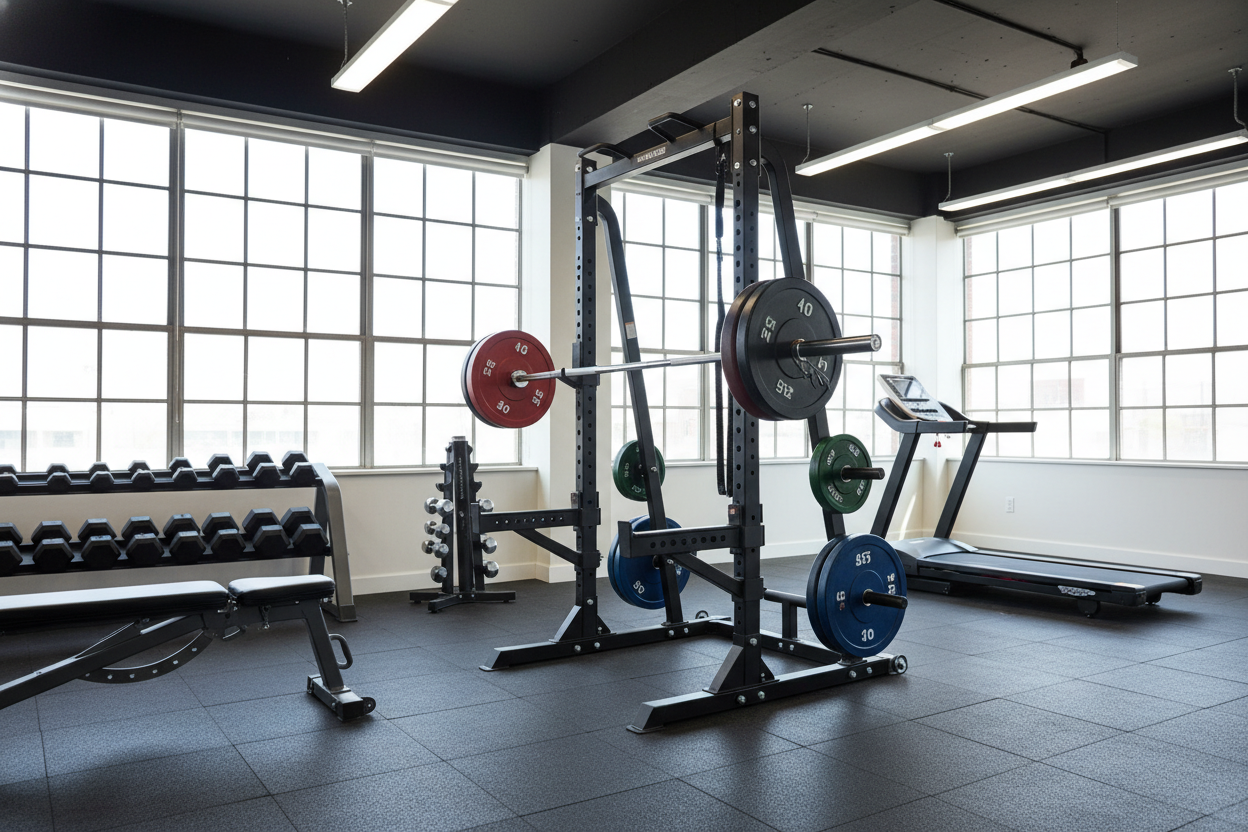
I remember the night I finally snapped. My local commercial gym hiked its monthly dues to $85, and the only squat rack was perpetually occupied by a guy doing curls while scrolling his phone. I went home and started hunting for an olympic barbell with weights, thinking I could score a pro setup for the price of a few months' membership. I was wrong.
The market is flooded with junk that looks like gym equipment but performs like scrap metal. If you are looking for a setup that survives more than six months of heavy deadlifts, you need to understand the math of steel, shipping, and plate calibration. Buying cheap usually means buying twice.
Quick Takeaways
- Avoid the $300 '300-lb bundles' at big-box stores; the bar is usually a hollow pipe rated for barely 300 lbs.
- Expect to spend $600 to $900 for a quality starter setup that includes a 190k PSI bar and 160+ lbs of plates.
- The barbell is your most important investment—allocate 40% of your budget here.
- Shipping heavy iron is expensive; 'free shipping' often means a lower-quality bar to offset freight costs.
The Illusion of the $300 Starter Package
We’ve all seen them: the '300lb Olympic Weight Set' sitting in the corner of a sporting goods store for $299. It looks like a steal until you actually use it. These sets are the reason people get frustrated with home gyms. The bar in these bundles is almost always a 'beater bar' with a low weight capacity, often lacking proper knurling or sleeve rotation.
When manufacturers aim for that $300 price point, they have to shave costs somewhere. Usually, that means using low-grade steel with poor tensile strength. If you load that bar to 315 lbs and leave it on a rack, it might just stay bent. It is incredibly easy to tell if an olympic weight set is trash just by looking at the sleeves—if they are held on by a giant bolt at the end rather than snap rings, run away.
Breaking Down the Bar: What Are You Actually Paying For?
The bar is the only thing connecting you to the weight. If the knurling is too passive, it slips out of your hands. If the sleeves don't spin, the inertia of the plates will wreck your wrists during a clean or a press. You want a bar with at least 190,000 PSI tensile strength—this is the industry standard for a bar that can take a beating and return to straight.
A solid mid-range bar like a 20Kg Olympic Barbell will usually run you between $250 and $350. That might seem steep when you haven't even bought the plates yet, but this is the piece that lasts a lifetime. You're paying for bronze bushings that provide a smooth, consistent spin and a finish—like black phosphate or chrome—that prevents the bar from turning into a rusted orange mess in your humid garage.
Iron vs. Bumpers: Picking the Right Weights for Olympic Bar Training
Once you have the bar, you need the density. You have two real choices for weights for olympic bar training: cast iron or rubber bumpers. Cast iron is the classic 'clanging' plate. It’s thinner, allowing you to fit more weight on the bar, and it’s generally cheaper per pound. However, if you plan on dropping weights (like in CrossFit or Weightlifting), iron will crack your concrete floor and eventually the plates themselves.
Bumper plates are made of high-density rubber. They are quieter and safer for home use, but they are bulkier. If you are a powerlifter moving 600+ lbs, you might run out of room on the sleeves. For 90% of home lifters, a mix is actually the best move: a pair of 45lb bumpers to act as a buffer, and then iron for the rest. This saves your floor and your wallet.
The Freight Trap When Searching for Olympic Bar Weights for Sale
Here is the dirty secret of the fitness industry: shipping 300 lbs of iron across the country costs a fortune. When you see olympic bar weights for sale with 'free shipping,' realize that the shipping cost is baked into the price. This is why many 'all-in-one' deals are actually a bad value. To keep the total price low while covering $150 in freight, the company has to give you a bottom-barrel bar.
I always recommend buying your bar and plates separately if you can't find a reputable local dealer. I’ve seen people buy a cheap olympic bar and weights set only to have the bar arrive bent because it was packed in a flimsy cardboard tube with 250 lbs of loose plates. It’s a logistics nightmare that often results in damaged gear before you even take your first set.
My Blueprint for Buying an Olympic Bar and Weights for Sale
If I were starting over today with a $700 budget, here is how I’d spend it. First, I’d buy a reliable olympic barbell. That’s $300 gone, but I know it won’t fail me. Then, I’d look for used iron plates on local marketplaces. Iron is iron—as long as it’s not cracked, a bit of surface rust can be cleaned off with a wire brush and some 3-in-1 oil.
If you prefer buying new, look for 'machined' iron plates. Unlike standard 'deep dish' cast iron, machined plates are shaved down to be more accurate to their stated weight. There is nothing worse than hitting a PR only to realize your '45lb' plates actually weigh 41 lbs. Aim for a pair of 45s, 25s, 10s, 5s, and 2.5s. That gives you 210 lbs total (including the bar), which is plenty to start with for most lifts.
Personal Experience: The 43-Pound '45'
I once bought a budget set of iron plates from a big-box clearance sale. I was struggling with my bench press for weeks, feeling like my left side was weaker than my right. I finally took the plates to a digital scale. One '45' was 47.2 lbs, and the other was 43.1 lbs. A four-pound imbalance is huge when you're pushing near your limit. I sold them that afternoon and invested in calibrated plates. Accuracy matters more than you think.
FAQ
Is a 7-foot bar necessary?
Yes. A standard 7-foot Olympic bar has the correct spacing to fit into power racks. Shorter '6-foot' bars often have shorter sleeves or a narrower shaft that won't reach the rack J-cups.
Can I mix different brands of plates?
Absolutely, but try to keep the diameters the same. If you have one brand of 45s that is 17.5 inches and another that is 17.7 inches, the larger plate will take all the impact when you deadlift, which can cause it to crack over time.
How do I stop my barbell from rusting?
Wipe it down once a week with a light coat of 3-in-1 oil or WD-40 Specialist Corrosion Inhibitor. If you sweat on the bar, wipe it off immediately. Rust is the silent killer of knurling.
Share:
I Ditched the Barbell: My Favorite Alternative to Bench
I Wasted $2K on Upper Body Workout Machines for Home (Buy This Instead)