
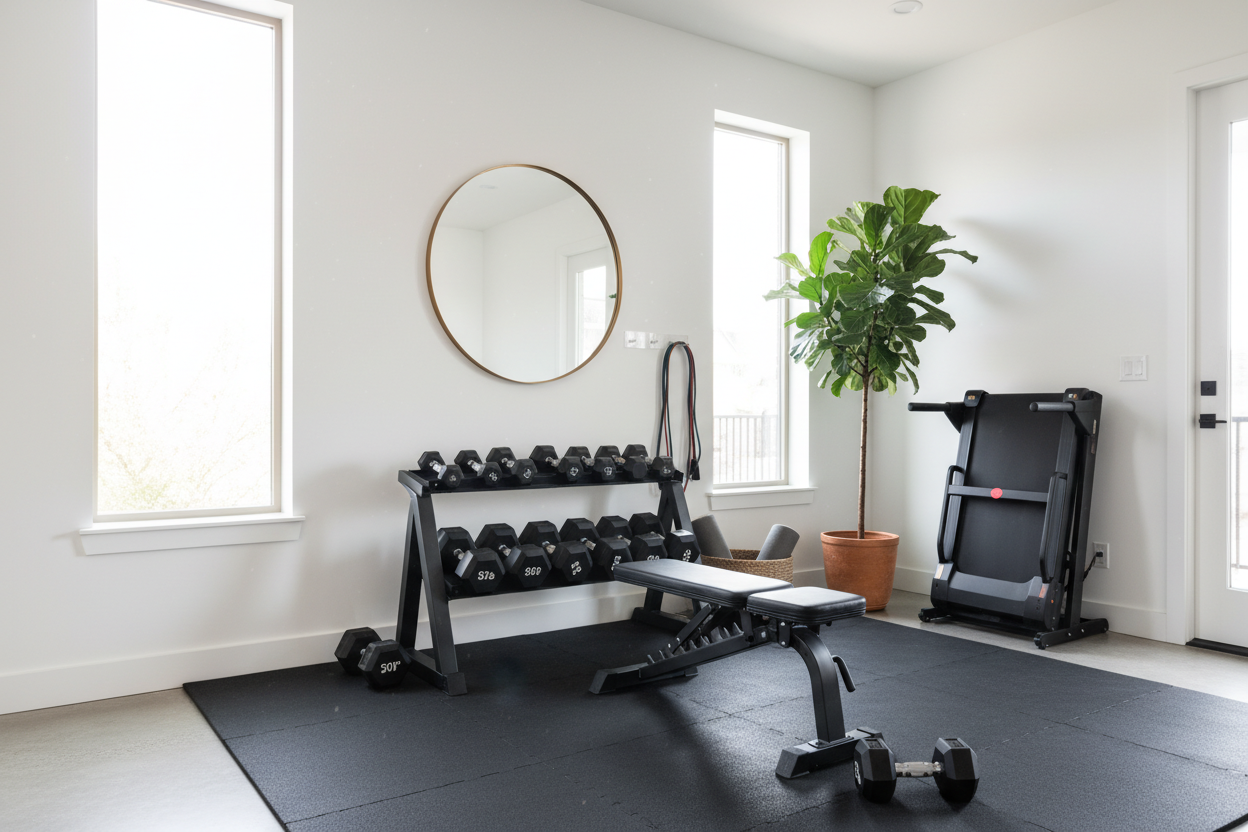
I remember the night I tried to sneak a 300-lb Olympic set into my one-bedroom apartment. My partner looked at me like I was trying to park a tractor in the kitchen. It was the ultimate wake-up call: if I wanted to keep training heavy at home, I had to stop treating my house like a commercial warehouse. Integrating workout equipment in living room spaces isn't just about finding a corner; it's about a strategic compromise between your deadlift and your dinner parties.
Quick Takeaways
- Stick to the 60-second rule: gear must be deployable or storable in under a minute.
- Prioritize adjustable weights over fixed sets to save roughly 15 square feet of floor space.
- Use furniture-grade storage or neutral colors to blend gear into the background.
- Invest in high-density mats that can be rolled up and tucked behind a sofa.
Why Most Living Room Gyms End in Arguments
The fundamental problem with most home setups is that gym gear is designed for industrial utility, while living rooms are designed for comfort. When you drop a powder-coated squat rack next to a mid-century modern credenza, the visual friction is immediate. I realized early on that I had to stop trying to recreate a hardcore dungeon in a shared space. You don't have to ruin my decor with living room exercise equipment just to hit your daily volume.
The trick is curating gear that looks like it belongs—or at least gear that doesn't scream for attention. Most commercial-style racks use 3x3-inch steel tubing that dominates a room's skyline. In a living room, you want low-profile footprints. Think about the 'invisible gym' concept: equipment that occupies the floor only when it's being used and retreats into the shadows the moment the last set is finished. This isn't about being less of a lifter; it's about being a better roommate.
The 60-Second Stash Rule for Free Weights
If it takes you ten minutes to clear the coffee table and drag out your weights, you aren't going to work out. Period. I live by the 60-second stash rule: if I can't have my gym ready to go in 60 seconds, it’s a failure. This rule is what led me to downsizing my gym equipment into home storage and focusing on high-impact, low-volume tools.
Adjustable dumbbells are the MVP here. A single pair of 52.5-lb or 80-lb adjustables replaces an entire rack of fixed weights that would otherwise eat up an entire wall. When you're done, they sit on a small stand or slide into a closet. Pair these with a truly flat-folding bench. I'm talking about a bench that collapses to a 6-inch height so it can slide under a couch. Look for one with a 500-lb plus weight capacity so you aren't sacrificing safety for storage. I’ve used flimsy 'Amazon special' benches that wobbled during chest presses—don't do that. Get a bench with a solid steel frame and a high-density foam pad that won't bottom out.
For the floor, skip the interlocking foam tiles that look like a daycare center. Invest in a single, high-quality 6x4-foot rubber mat. It provides the grip you need for lunges and protects your hardwood from the occasional light dumbbell tap. When the session is over, roll it up and stand it in a corner. It’s a gym equipment in living room solution that actually works without looking like a permanent construction zone.
Cardio and Mobility Gear That Actually Folds Flat
Cardio is the hardest part of the living room puzzle. A standard treadmill has a footprint of about 18 square feet and stands five feet tall—it’s a permanent monument to your fitness goals that nobody else wants to look at. If you need cardio, you have to look at gear that respects the vertical plane. I’ve found that high-end rowing machines with wood finishes actually look decent standing upright, but for those focused on low-impact strength and flexibility, a foldable pilates reformer machine is a better bet. It gives you a full-body resistance workout but collapses down to a fraction of its size when the session is over.
Mobility tools like foam rollers and yoga blocks are notorious for cluttering up corners. I use a decorative wicker basket or a wooden chest to store these. It sounds simple, but keeping your mobility gear out of sight makes the room feel like a home again. Even a high-end massage gun should have a dedicated drawer. The goal is to ensure that when guests walk in, they see a living room, not a physical therapy clinic.
Building a Setup That Actually Disappears
The secret to a long-term living room gym is modularity. You don't buy the whole gym at once; you buy pieces that fit your current space and can be tucked away. Consistency comes from accessibility, but domestic peace comes from invisibility. I’ve found that using neutral colors—blacks, greys, and natural woods—helps the gear blend into the shadows of the room. Avoid the bright reds or neon blues often found on budget gear; they draw the eye exactly where you don't want it.
By choosing equipment that is visually neutral and physically mobile, you remove the friction of starting a workout. You aren't 'going to the gym'; you're just unfolding it. It’s a mindset shift that has kept me training through three different apartment moves without a single argument about where the bench goes.
My Biggest Mistake
I once bought a commercial-grade GHD (Glute Ham Developer) because I found a 'great deal' on Facebook Marketplace. That thing was a beast—massive, heavy, and impossible to move. It sat in the middle of my living room like a giant steel spider for six months. I used it twice a week, but I tripped over it every single day. I eventually sold it at a loss just to get my floor space back. The lesson? Never buy 'commercial' for a 'residential' space unless you have a dedicated garage.
FAQ
Can I deadlift on a living room floor?
Not without a platform. Even with a mat, the vibration and impact of 315 lbs hitting the floor will eventually crack your subfloor or annoy your neighbors. Stick to Romanian deadlifts or high-rep work with dumbbells to keep the noise and impact down.
How do I hide a weight bench?
Look for a 'flat-fold' design. These benches have legs that pin-lock and fold flush against the frame. Most can fit under a standard bed or sofa, or stand vertically in a coat closet.
What is the best floor protection?
Skip the cheap foam. Use a 1/4-inch or 3/8-inch recycled rubber mat. It’s denser, doesn't slide, and doesn't look like a puzzle piece. It also protects the floor much better against heavy dumbbell drops.
Share:
I Tested a Working Out Machine That Claims to Do the Work
I Browsed First Place Equipment to See If Local Shops Still Matter