
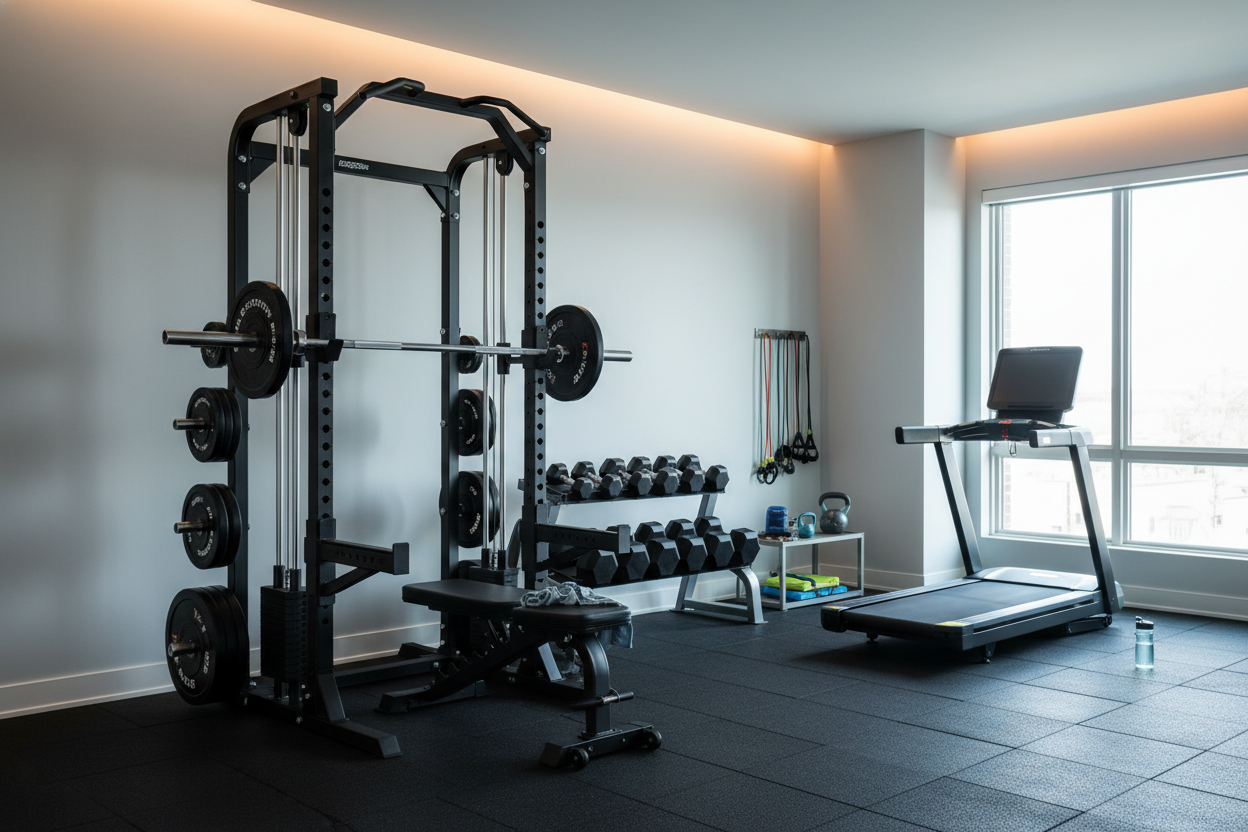
I have spent more time than I care to admit scrolling through every smith machine sale on the internet at 2 AM. I have been burned by 'deals' that turned out to be rickety cages that shook if I so much as breathed on them wrong. My first home gym purchase was a cheap smith machine that arrived with missing bolts and guide rods that felt like they were coated in 80-grit sandpaper. It is a frustrating cycle: you want to save money, but you do not want a 300-pound paperweight taking up half your garage.
- Check the Steel: If it is 14-gauge, keep scrolling; you want 11 or 12-gauge for actual stability.
- Bearings Matter: Linear bearings are the gold standard for a smooth bar path; avoid nylon bushings.
- Fake MSRPs: Many brands list a permanent 'sale' price to create fake urgency.
- Footprint: Measure your ceiling height twice—most smith machines need at least 84 inches of clearance.
The Dirty Secret About Fitness Equipment Discounts
Here is the reality of the fitness industry: the 'sale' price is usually just the actual price. Brands love to list a generic rig at a massive $2,500 MSRP, cross it out with a red line, and tell you that you are getting a steal at $1,200. This happens year-round. I have built multiple rigs to find the best value for my own space, and I have learned that if a machine is always on sale, it is never on sale.
When you are hunting for discount smith machines, look at the historical price. Use a browser extension to see if that 'limited time offer' has been running since last July. A genuine smith machine sale usually happens around major holidays—Memorial Day, Labor Day, or Black Friday—and typically offers a flat 10-15% off the real street price. If the discount looks like 50% or more, the brand is likely inflating the original value to make a mediocre machine look like a premium commercial unit.
Bearings vs. Bushings: Where Cheap Rigs Cut Corners
If you buy an inexpensive smith machine, the first thing you will notice is the 'drag.' This usually happens because the manufacturer used cheap nylon or plastic bushings instead of linear bearings. Bushings are just sleeves that slide over the guide rods. They are fine for a light lat pulldown, but when you load 225 lbs on a Smith bar, the friction increases exponentially. It creates a jerky, 'stick-slip' motion that makes it impossible to maintain a consistent tempo during squats or presses.
True commercial smith machines for sale use high-quality linear bearings. These are small steel balls housed in a carriage that allow the bar to glide with almost zero friction. It is the difference between sliding a cardboard box across concrete and rolling it on wheels. I once tested a bushing-based rig that actually got stuck halfway through a rep because the bar was slightly uneven. That is not just annoying; it is dangerous. If the spec sheet doesn't explicitly mention 'linear bearings,' expect a subpar lifting experience.
3 Red Flags When Browsing Smith Machines for Sale
The first red flag is 'thin skin.' I see so many cheap smith machines advertised with 'heavy-duty steel' that turns out to be 14-gauge. In the world of iron, the lower the number, the thicker the steel. 11-gauge is what you find in a real gym; 14-gauge is what you find in a cheap patio set. If you are a grown adult moving serious weight, thin steel will flex and vibrate, which eventually leads to cracked welds.
The second red flag is proprietary attachment sizing. Some brands design their racks so that you can only use their specific J-cups or spotter arms. They trap you in their ecosystem so you can't buy better, cheaper third-party accessories later. Always check if the uprights are standard 2x2 or 3x3 inches with standard hole sizing. I always tell people to browse a lineup of reliable smith machines from companies that are transparent about their steel gauge and hole dimensions before dropping a grand.
The third flag is exaggerated weight capacities. If a machine weighs 150 lbs but claims a 1,000-lb capacity, run away. A machine needs mass to support mass. If the rig doesn't weigh at least 250-300 lbs on its own, it is going to walk across your floor during a heavy set of lunges.
Two Rigs That Actually Deliver on Their Price Tag
If you are ready to make a smith machine buy, I have two specific recommendations that I have personally put through the wringer. First, for the guy with a cramped one-car garage, the S1 V4 all-in-one cable crossover is a solid pick. Most combo units have a 2:1 pulley ratio that feels light and flimsy, but this one uses a 1:1 ratio, meaning 50 lbs on the stack actually feels like 50 lbs. It combines a smith bar, a squat rack, and a functional trainer into one footprint, which is essential if you are fighting for floor space.
If you have more room and want something that feels like it belongs in a Gold's Gym, look at the DM01 full body training station. This is a significantly heavier rig. It uses a counterbalanced system that makes the bar feel weightless when empty, which is great for high-rep accessory work or rehab. I loaded 405 lbs on this bar for some heavy shrugs, and the frame didn't even groan. It is a more comprehensive solution for those who want to ditch the commercial gym membership entirely and need a centerpiece that handles daily abuse.
Final Verdict: Is Waiting for Black Friday Worth It?
I get asked this all the time: should I wait for a holiday smith machine sale? If it is October, yes, wait. If it is March, absolutely not. You are going to spend three or four months 'waiting' to save maybe $150. In that time, you could have finished a full 12-week training block. The value of three months of consistent training far outweighs a small discount. Shipping costs are also rising, so a 'sale' in six months might just be offset by a higher freight charge anyway.
Find a machine with 11 or 12-gauge steel, linear bearings, and standard hole spacing. If you find that combo at a price you can afford, buy it. Stop overthinking the marketing fluff and start moving some iron. Your future self won't care if you saved an extra fifty bucks, but they will care if the bar path is smooth and the rack doesn't wobble when you re-rack your final set.
Are cheap smith machines safe?
They can be, but you have to check the weight ratings and steel thickness. A 14-gauge steel frame with a 300-lb limit is fine for a beginner, but if you are squatting heavy, you need a sturdier 11-gauge frame to prevent tipping or structural failure.
What is the difference between a 1:1 and 2:1 pulley ratio?
A 1:1 ratio means 100 lbs of plates feels like 100 lbs of resistance. A 2:1 ratio (common on cheap machines) means 100 lbs feels like 50 lbs. 1:1 is better for heavy movements, while 2:1 allows for more cable travel and smoother micro-adjustments.
Do I need a professional to assemble my smith machine?
Not if you are handy with a socket wrench. Most home units take 3 to 5 hours to build. Just don't use the 'toy' wrenches they include in the box; use a real ratcheting set or you will be there all night and end up with sore hands.
Share:
The Brutal Truth About Buying Aussie Gym Equipment for Your Garage
I Stripped 4 Bolts: Why Your Smith Machine and Tool Setup Matters