
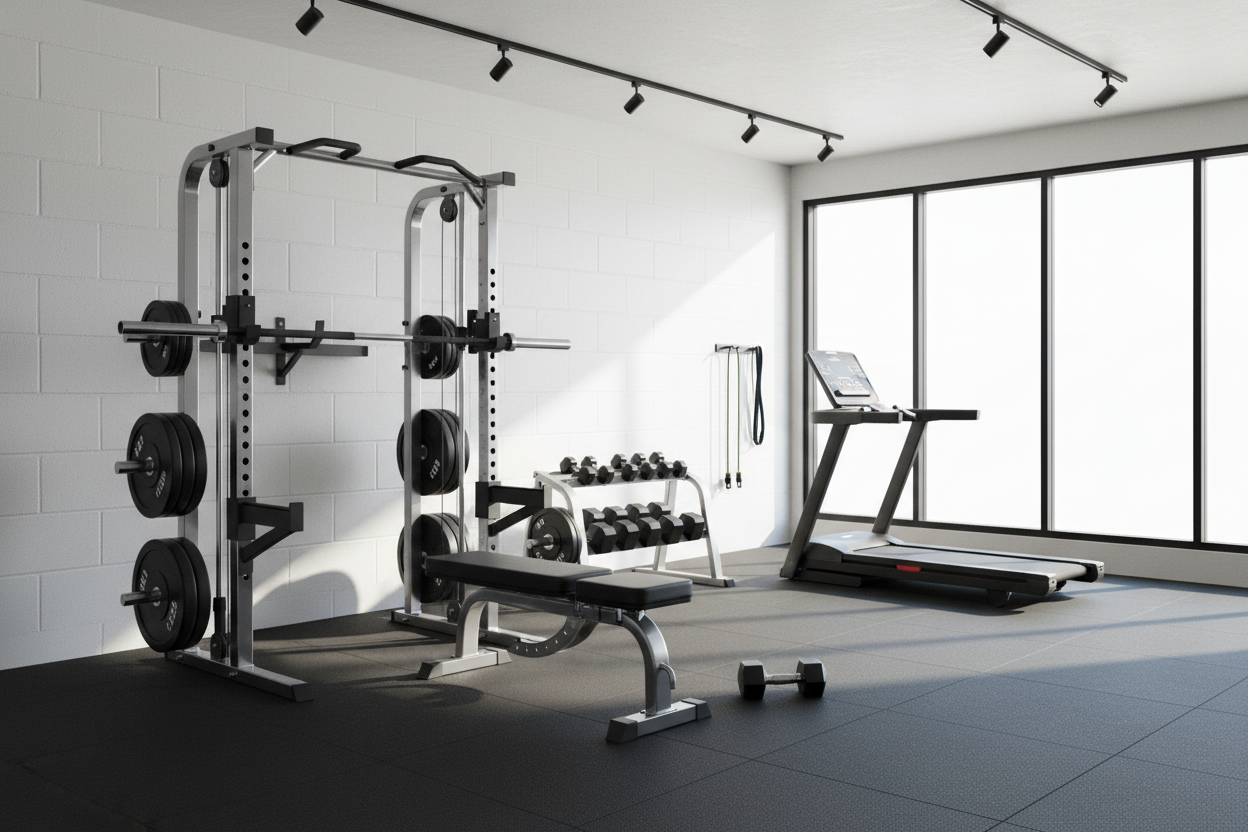
My garage used to be a graveyard of good intentions and zero floor space. I spent years doing the 'sideways shuffle' between my squat rack and my lawnmower, eventually realizing that my massive four-post cage was the enemy. I needed a solution that didn't require me to park my truck in the driveway during a snowstorm just to hit legs. That’s when I started looking at a wall mounted smith machine.
- Space Savings: You reclaim about 15-20 square feet of floor space compared to a cage.
- Stability: When bolted correctly, these things feel like part of the foundation.
- Installation: It is a two-person job, and you better own a high-quality level.
- Versatility: Perfect for solo lifting without a spotter, especially in tight quarters.
Why I Finally Gave Up on Four-Post Racks
I love a heavy-duty power rack as much as the next guy, but reality hits hard when you're working with a standard two-car garage. A full cage is a footprint hog. Between the uprights, the plate storage, and the safety zone, you're looking at a massive chunk of real estate that stays occupied 24/7.
I realized I was barely using the 'power' aspect of my rack for anything other than a glorified pull-up bar and a place to hang my gym bag. Switching to a wall smith machine allowed me to push the entire lifting station flush against the studs. Unlike a traditional standard Smith machine that sits in the middle of the room like a piece of heavy artillery, the wall-mounted version disappears when you aren't using it.
Will a Wall Mounted Smith Machine Rip My House Apart?
This is the first question everyone asks, and for good reason. You are effectively anchoring a moving 300-pound load to your home's skeleton. If you just drive a few lag bolts into 1/2-inch drywall and hope for the best, you're going to have a very bad Tuesday. The physics of a wall smith machine rely on shear strength.
You absolutely must use wood stringers—usually 2x6 or 2x8 lumber—bolted across at least three studs. This distributes the load and gives the machine a flat, solid surface to bite into. I used 3/8-inch lag bolts that went four inches deep. When I rerack a heavy set of squats, the house doesn't groan, and the drywall doesn't crack. If you skip the stringers, you're asking for structural failure.
Freestanding vs. Wall Smith Machine: The Honest Trade-Offs
The biggest trade-off is permanence. Once you bolt a smith machine wall mounted to your studs, that’s its home for the next five years. You aren't sliding it three inches to the left to make room for a new treadmill. It requires commitment and a very precise layout plan before the first hole is drilled.
If you're a renter or someone who likes to rearrange their gym every six months, a freestanding all-in-one Smith machine is the smarter play. It’s more versatile and usually includes cable pulleys or plate storage. But for the space-obsessed lifter, the rigidity of the wall-bolted unit is unbeatable. There is zero 'rack sway' when you're doing heavy shrugs or calf raises.
The Hidden Headaches of a Smith Machine Wall Mounted Setup
Let's talk about the things the glossy product photos don't show: sloped garage floors. Most garages are graded to let water drain toward the door. If your floor drops half an inch over the width of the machine, your guide rods will be crooked. This causes the bar to bind and ruins the smooth travel you’re paying for.
You also have to account for baseboards. I had to notch mine out so the bottom bracket sat flush against the wall. Turning a blank wall into a functional Smith machine home gym station is an exercise in 'measure thrice, drill once.' If your studs are unevenly spaced, you'll spend more time at the hardware store than actually lifting.
How to Actually Train on a Flush-Mount Rig
Training on a wall-mounted unit feels different. You’re working in a confined 'path' right against the drywall. I learned the hard way that if you don't position your bench correctly, you'll end up punching the wall during incline presses. I usually face away from the wall for most movements to give my elbows and the bar plates more breathing room.
You also need to be mindful of plate diameter. Standard 45lb iron plates are fine, but some oversized bumper plates might get uncomfortably close to your paint job. Once you’ve got the spacing down, you can follow a complete Smith machine workout guide to hit everything from rack pulls to Bulgarian split squats without ever worrying about balance.
FAQ
Can I install this on metal studs?
No. Metal studs in residential basements aren't designed to handle the dynamic, vibrating load of a Smith machine. Stick to wood studs or masonry with the proper anchors.
Do I really need a stringer?
Yes. Even if your machine's holes line up perfectly with your studs, the stringer provides a buffer that prevents the machine from crushing your drywall over time.
Is it as smooth as a commercial gym version?
If you keep the guide rods lubricated with silicone spray and ensure the unit is perfectly level, it's 95% of the way there. Just don't use WD-40; it gunk’s up the bearings.
Share:
Why I Only Recommend a Dumbbell Set Hex Over Round Iron
I Bought 4 Models to Find the Best Total Gym for Home