
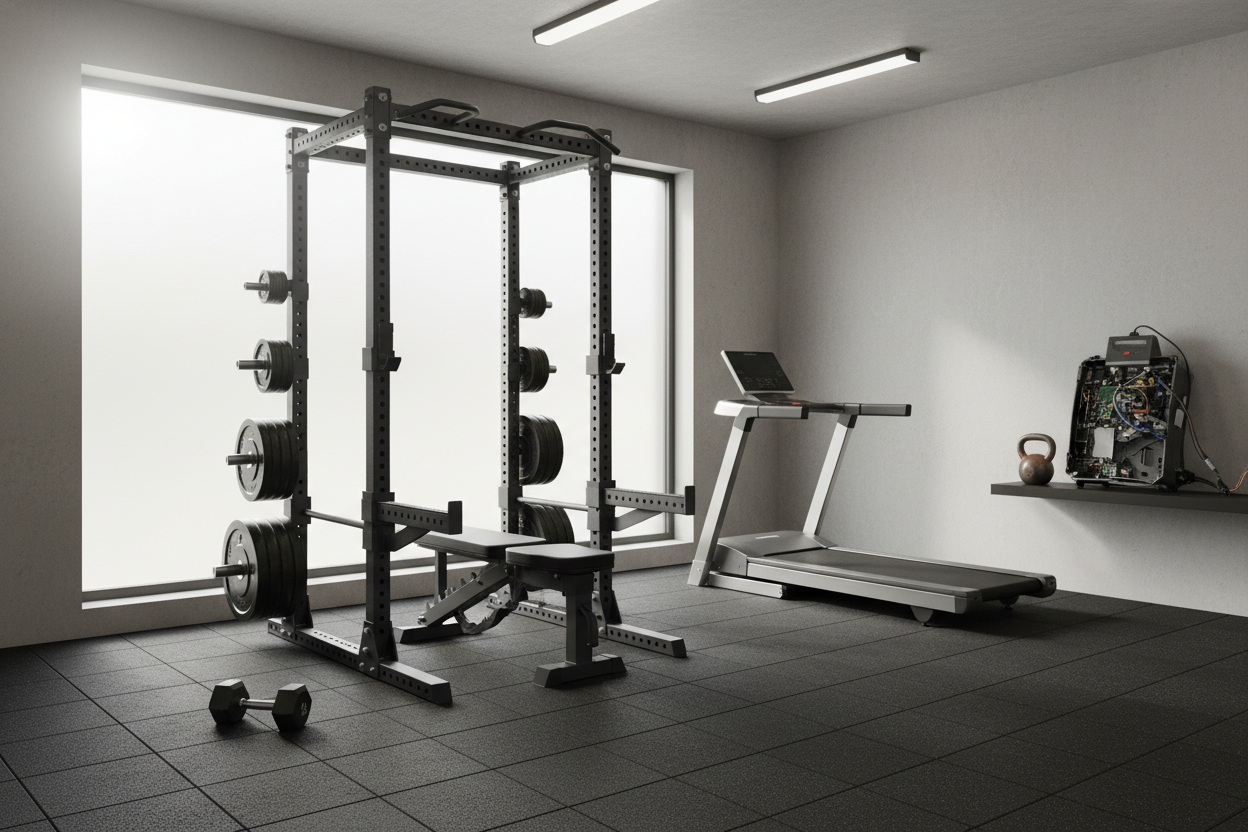
I was halfway through a pre-workout caffeine buzz when my $3,000 machine for fitness decided it didn't recognize my home Wi-Fi anymore. I wasn't even trying to stream a class; I just wanted to move some weight. Instead of a workout, I spent forty-five minutes on a live chat with a 'customer success specialist' named Kevin who told me to reset my router. My coffee went cold, my pump died, and I realized I’d just bought a very expensive, very heavy tablet with some cables attached to it.
- Smart machines have a shelf life dictated by software, not steel.
- Analog equipment like Smith machines and leg presses offer better long-term ROI.
- Prioritize 11-gauge steel and high-quality pulleys over screen resolution.
- Subscription-free equipment ensures you can always train, regardless of server status.
The Day My Expensive Touchscreen Finally Died
It started with a flickering logo. Then came the dreaded 'Update Required' screen that refused to progress past 12%. This high-end exerciser machine was marketed as the future of home training, but in that moment, it was less useful than a rusty kettlebell. The frustration of being locked out of your own equipment because of a software glitch is a special kind of hell. I’ve spent years testing gear, but this was the first time a fitness exercise machine made me feel like I didn't actually own the tools in my own garage.
We’ve been conditioned to think that more data equals better gains. We want the rep counters, the leaderboard, and the AI-generated coaching. But when the company behind that AI goes bankrupt or decides to stop supporting your specific model, your workout electronics become paperweights. I looked at that dark screen and realized I had traded reliability for a gimmick. The mechanical parts were fine, but the brain was dead, and there was no way to bypass the software to just get to the weight.
This isn't a rare occurrence. I’ve talked to dozens of lifters who have dealt with 'bricked' units. Whether it’s a failed motherboard or a mandatory subscription that doubles in price overnight, the tech-first approach to fitness is fragile. I ended up selling that unit for parts and went back to basics. If I can't fix it with a wrench and some 3-in-One oil, I don't want it in my gym anymore.
Why Workout Electronics Are a Ticking Time Bomb
The fundamental problem with modern machines exercise enthusiasts buy is the marriage of two completely different lifespans. A well-built steel frame should last thirty years. A tablet, however, is lucky to last five. By embedding the screen directly into the machine, manufacturers ensure that the entire unit becomes obsolete the moment the processor can't keep up with the latest app update. It’s planned obsolescence disguised as innovation.
Think about the hardware. You’re sweating on it. You’re creating vibrations by dropping weights or moving heavy stacks. Electronics hate moisture and they hate being rattled. It is the worst possible environment for a motherboard. When you buy a fitness exercise machine loaded with sensors and screens, you aren't just buying a weight stack; you're buying a maintenance nightmare. If a cable snaps on a standard pulley system, I can replace it for twenty bucks. If a proprietary sensor fails on a smart gym, you’re looking at a $500 service call.
Furthermore, these systems often rely on cloud-based servers. If your internet blips or the company’s servers go down, your 'smart' features vanish. You’re left with a machine that has no manual override. I’ve seen people lose months of data and access to their favorite routines simply because of a server migration. The more 'workout electronics' you add to the equation, the more points of failure you introduce into your training consistency. Consistency is the only thing that actually builds muscle, and tech is often the enemy of consistency.
Exercise Frames vs. Motherboards: What Actually Builds Muscle
Mechanical tension is the king of hypertrophy. Your muscles don't know if your reps are being tracked by an infrared sensor or if a digital avatar is cheering you on. They only know the load. A solid, unyielding exercise machine equipment setup provides that load without the fluff. I’ve found that the more time I spend fiddling with a touchscreen, the less intensity I bring to my sets. The 'toner machine workout' videos might look flashy, but they often distract from the raw effort required to actually change your physique.
Compare a flimsy, tech-heavy rig to a set of heavy-duty exercise frames. The steel doesn't care about your Wi-Fi signal. It doesn't need a firmware update to help you hit a PR on chest press. When you sit in a machine built with 11-gauge steel and oversized bolts, you feel a sense of stability that no digital interface can replicate. That stability allows you to push closer to failure safely. Digital weights—often driven by electromagnetic motors—feel 'thin' compared to the inertia of a real iron stack. There is a tactile feedback in physical weights that helps you dial in your mind-muscle connection.
I’ve tested 'toner machine workout' gadgets that promised to replace an entire gym with a single motor. They felt like pulling against a giant rubber band. It’s inconsistent resistance that changes based on the speed of your movement. Give me a 200-pound iron stack and a set of nylon pulleys any day. The resistance is predictable, the movement is smooth, and the results are measurable by the number of plates you add, not the badges you earn on an app.
The Analog Machines Exercise Purists Actually Recommend
If you want the convenience of a guided movement without the digital baggage, you need to look at high-quality mechanical systems. You can get a world-class workout without a single circuit board. For most home lifters, a heavy-duty Smith machine is the ultimate compromise. It provides the safety of a fixed track—perfect for solo sessions where you’re pushing your limits—but it uses standard Olympic plates. There are no subscriptions, no screens to break, and it will literally last as long as your house does.
Another heavy hitter for the home gym is the leg press. If you’re tight on space but want to move serious weight, something like a compact leg press hack squat combo is a massive upgrade over any 'smart' lower body gadget. These machines use gravity and high-quality bearings to provide a smooth, punishing workout. Because they are purely mechanical, the maintenance is minimal. A bit of grease on the guide rods every few months is all it takes to keep them feeling brand new. You aren't paying for a software developer's salary every month; you're just paying for the steel.
When you go analog, you also gain the freedom to use whatever 'tech' you actually like. Want to track your reps? Use a notebook or a free app on your phone. Want to watch a video? Mount a cheap TV on the wall. If the TV breaks, your gym still works. By decoupling the electronics from the exercise machine equipment, you protect your investment. You can upgrade your tablet for $200 in three years without having to throw away a 400-pound piece of strength equipment.
How to Choose Exercise Machine Equipment That Outlives You
When you're shopping for your next piece of gear, ignore the marketing fluff about 'integrated ecosystems.' Look at the specs that matter. Check the steel thickness—11-gauge is the gold standard for home use. Look at the pulleys; are they cheap plastic or aluminum with sealed bearings? Look at the weight capacity. A machine rated for 1,000 lbs is going to feel significantly more stable than one rated for 300 lbs, even if you’re only lifting a fraction of that. You want overbuilt, not under-engineered.
Check the cable quality as well. You want aircraft-grade cables with a high tensile strength. These are the lifeblood of any cable-based fitness exercise machine. If the manufacturer doesn't list the cable specs or the bearing type, they’re probably cutting corners. I always look for 'non-proprietary' parts. Can I buy a replacement pulley at a local hardware store or a general gym supply shop? If the answer is no, you’re at the mercy of the manufacturer’s replacement parts department (and their pricing).
Ultimately, the best exercise machine for full body workout plans is the one that is ready to go the second you walk into the gym. No boot-up sequence, no 'connecting to server,' no mandatory updates. You want a tool, not a toy. Invest in heavy steel, thick cables, and iron plates. Your future self—the one who just wants to get a quick 30-minute session in before work—will thank you when the internet goes down and you're still hitting your sets.
FAQ
Do smart fitness machines work without a subscription?
Many 'smart' machines lose 90% of their functionality without a monthly fee. You might be left with a basic manual mode, but some brands completely lock the resistance or the screen if you don't pay. Always check the 'offline' capabilities before buying.
What is the most durable type of home gym machine?
Plate-loaded mechanical machines are the most durable. Because they don't have internal weight stacks or complex cable routing, there are fewer moving parts to fail. A plate-loaded Smith machine or power rack is virtually indestructible.
Are digital weights as effective as iron plates?
Digital resistance can be effective, but it feels different. It lacks the inertia of physical weight, which can make the eccentric (lowering) portion of the lift feel 'off.' For pure strength building, most lifters still prefer the feel of real iron.
How can I tell if a machine uses high-quality steel?
Look for the 'gauge' number. A lower number means thicker steel. 11-gauge is professional grade, while 14-gauge is common in budget consumer gear. Also, check the total shipping weight; a heavier machine is almost always a more stable machine.
Share:
What Nobody Tells You About Lifting on Inspire Home Gyms
Why the Smith Machine Z Press Will Humble Your Shoulders