
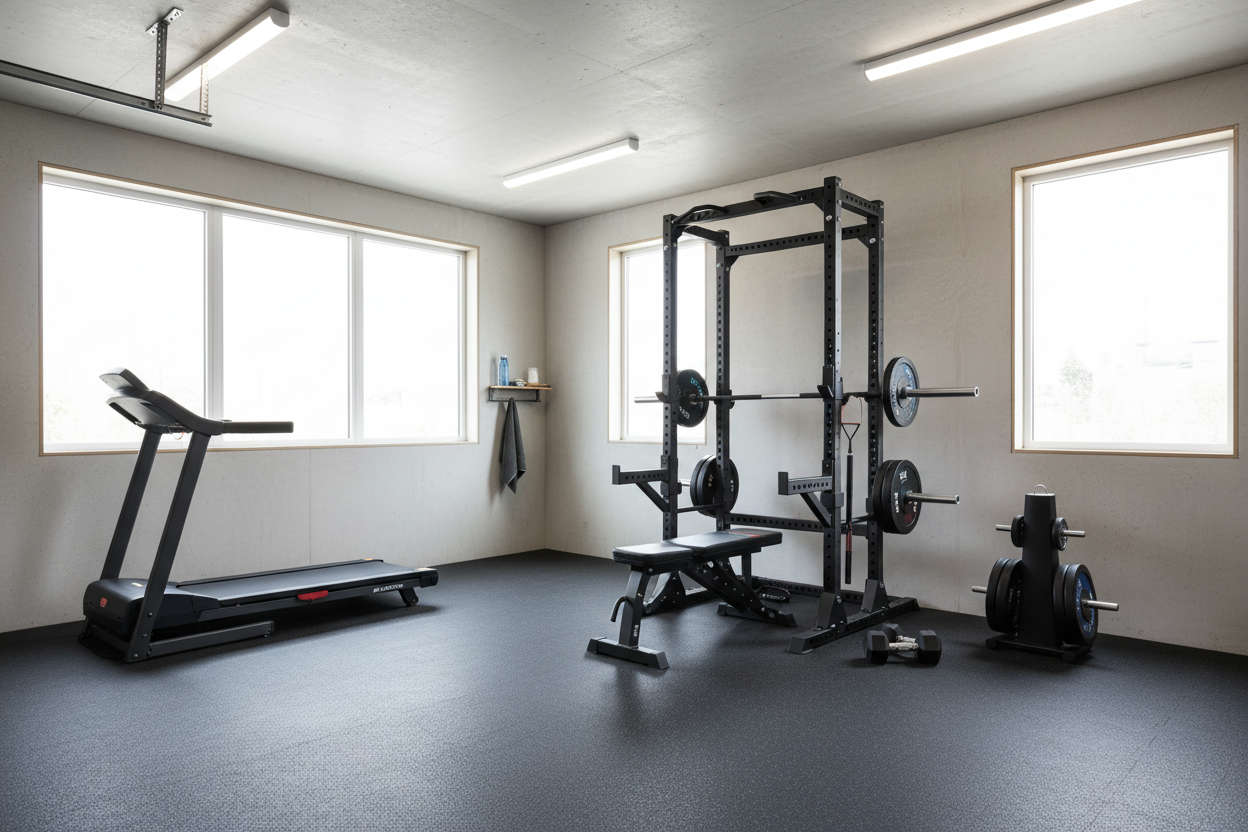
I remember the specific metallic 'ping' of a shear pin snapping while I was re-racking 315 pounds on a cheap wall-mount unit. It was one of those 'as-seen-on-TV' specials I bought because I was obsessed with keeping my garage floor clear for a car I never actually parked inside. I learned the hard way: a home gym space saver that compromises on structural integrity is just a liability waiting to happen.
Finding a setup for a small room isn't just about measuring the footprint. It is about understanding how much torque a folding hinge can actually handle before it starts to resemble a parallelogram. I have spent the last five years testing, bending, and occasionally destroying compact gear to figure out what actually holds up when the weights get heavy.
Quick Takeaways
- Steel Gauge Matters: Never buy a rack for a small space made of anything thinner than 11-gauge steel.
- Pivot Points: Look for oversized bolts and reinforced plates at folding joints.
- Verticality: The best space-saving gym gear goes up, not out.
- Footprint vs. Working Area: A machine might be small, but you still need 3 feet of clearance to load plates.
The 'As-Seen-On-TV' Compact Gear Trap
Most gear marketed to people in apartments or tight garages is built by companies that think a 200-lb total capacity is 'heavy.' They use 14-gauge steel and friction-based locking mechanisms that vibrate every time you drop a dumbbell. These flimsy all-in-one rigs often wobble under the slightest lateral movement, making them feel more like a playground set than a serious training tool.
Compare that to a heavy-duty smith machine home gym station designed for stability. A real piece of equipment uses mass and precision-machined guide rods to ensure that 'compact' doesn't mean 'unstable.' If you can shake the uprights with one hand, it has no business holding a loaded barbell over your chest.
Physics Doesn't Care That You Have a Small Room
In a home gym for small room layouts, the biggest enemy is the center of gravity. When you're working in a 4x4 or 6x6 area, you don't have the luxury of a wide-base power rack to offset a bad re-rack. If your equipment is too light, the whole unit can tip or shift when you're at your most vulnerable.
I have seen guys try to perform heavy rows on lightweight folding benches that literally lift off the floor during the eccentric phase. You need equipment that uses its own weight to stay anchored. If the total weight of the machine is less than the weight you plan to lift on it, you are asking for a physics lesson you won't enjoy.
The 3 Non-Negotiable Specs for a Home Gym Space Saver
If you are building a space saving home gym, stop looking at the color of the powder coat and start looking at the hardware. First, look for 3x3 inch or 2x3 inch uprights. This isn't just for show; larger tubing provides more surface area for the bolts to bite into, which prevents the frame from twisting.
Second, check the pivot points. A folding rack is only as strong as the pin that holds it open. I look for 1-inch thick locking pins made of hardened steel. If the pin looks like a bent piece of rebar, walk away. Third, ensure the unit has a 'true' pull-up bar that acts as a cross-member. This adds essential lateral rigidity that keeps the uprights from splaying outward under load.
Combo Machines That Don't Ruin Your Biomechanics
One of the smartest ways to save space is to find machines that pull double duty without forcing you into weird angles. I used to hate combo units because they usually did two things poorly instead of one thing well. However, engineering has come a long way. You can now find a compact leg press hack squat combo machine that occupies half the space of two standalone units while maintaining a natural range of motion.
The key is the sled angle and the footplate size. A well-designed combo machine ensures that your knees and ankles aren't under sheer stress just because the manufacturer wanted to shave six inches off the frame. If you can't hit full depth without your heels lifting, the machine is a failure, no matter how much floor space it saves.
Laying Out Your Space Saving Gym Without Losing Your Mind
The biggest mistake I made early on was pushing everything against the walls. It seems intuitive, but it makes loading plates a nightmare. You end up shimmying between a barbell and a wall like a cat. I eventually survived on these space-saving home gym corner ideas by angling my main rack 45 degrees. This opened up the 'dead' space in the corner for plate storage and gave me room to actually move.
Always map out your 'barbell path' before bolting anything down. Use blue painter's tape on the floor to mark where a 7-foot Olympic bar will sit. If that bar hits your water heater or prevents you from opening the door to the house, you need to rethink the layout before you start drilling into the concrete.
FAQ
Can I actually squat 500 lbs on a folding rack?
Yes, but only if it is a 3x3 11-gauge steel unit bolted into wall studs with heavy-duty lag bolts. If you are using the included hardware that came in a box from a big-box retailer, I wouldn't trust it with half that weight.
What is the minimum height for a home gym for small room setups?
Most standard power racks are 90 inches tall. If you have low ceilings, look for 'shorty' racks that sit around 72 to 80 inches. Just remember, you won't be able to do standing overhead presses inside the rack if you go that low.
Do I really need to bolt my equipment to the floor?
If you are using a space saving gym setup with a small footprint, yes. The smaller the base, the easier it is to tip. Bolting it down turns the entire floor into your counterweight, which is the cheapest insurance policy you can buy.
Share:
I Finally Found Hand Held Weight Sets That Don't Feel Like Toys
I Built a Cheat Sheet for Gym Equipment With Name and Pictures