
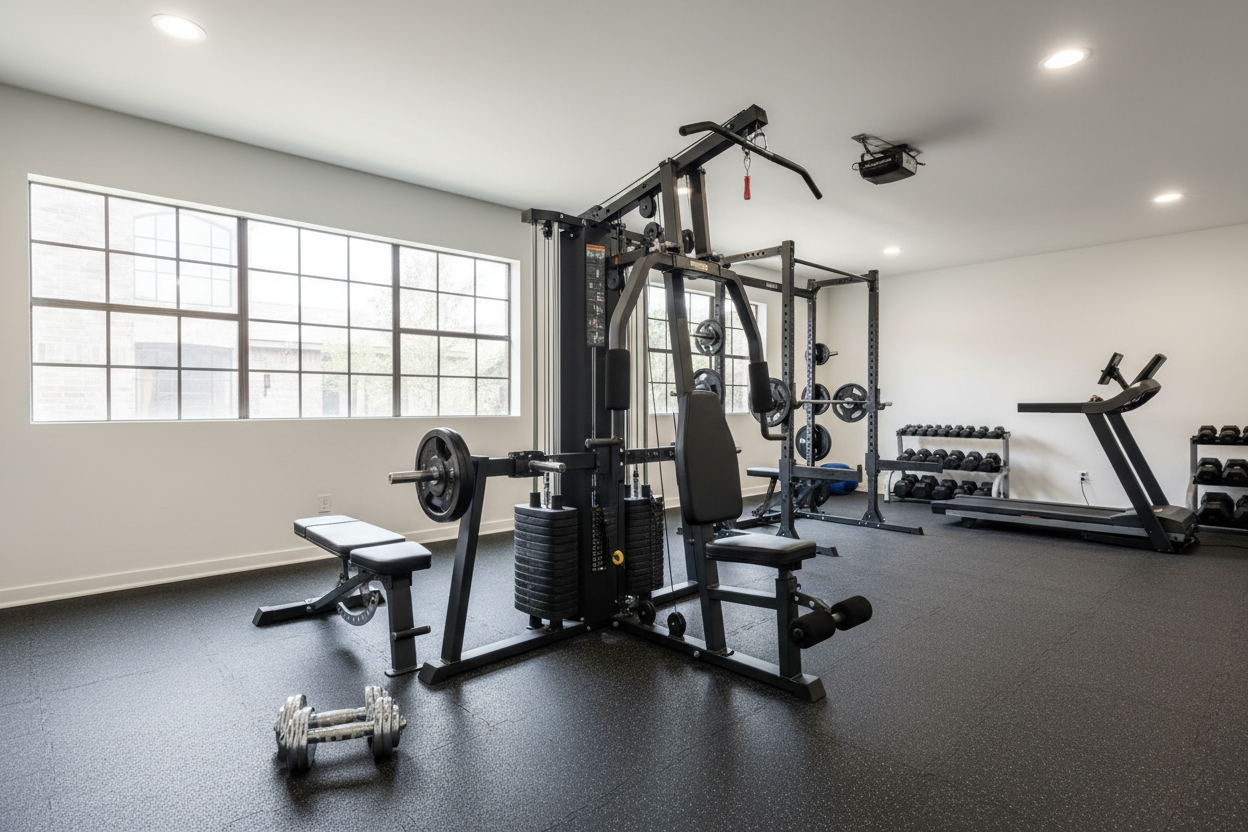
I remember the day I hauled a 400-pound box into my garage. It was a budget weight machine set I bought online after a few too many late-night sessions scrolling through equipment specs. Six hours of assembly later, I had a pile of leftover bolts and a machine that creaked every time I breathed on it. The glossy photos promised a professional-grade experience, but the reality was a wobbly mess of thin steel and gritty cables.
- Budget pulleys create friction that kills your mind-muscle connection.
- Fixed-path pressing arms often ignore human biomechanics, leading to joint strain.
- Standard leg extensions on multi-gyms rarely align with your natural pivot points.
- A modular setup with a high-quality bench is almost always a better investment than a massive tower.
The All-In-One Dream vs. The Flimsy Reality
The marketing for these rigs is incredible. They promise a total-body muscle strength machine that replaces an entire commercial gym in a 4x4 footprint. You imagine yourself crushing heavy sets in the comfort of your garage. Then you actually start building it. Most budget units use 14-gauge steel that feels more like a soda can than a tank.
Once it is finally bolted together, the wobble is undeniable. If you are pushing 200 pounds on a chest press and the entire frame shifts two inches to the left, your brain stops focusing on the muscle and starts focusing on survival. That is not how you build a physique.
Why the Pulleys Feel Like You're Dragging Sandbags
Friction is the silent killer of gains. On a high-end weight trainer machine, the resistance feels the same at the bottom of the rep as it does at the top. Cheap multi-gyms use nylon pulleys with sleeve bearings instead of ball bearings. Combine that with unlubricated, chrome-plated guide rods, and you get 'stiction.'
You end up fighting the machine’s mechanical drag more than the actual weight stack. This jerky movement makes it impossible to maintain constant tension on the muscle. If you want to grow, you need a smooth, predictable path of resistance, not a cable that feels like it’s being dragged through a sandbox.
Fixed Pressing Arms Are Wrecking Your Shoulders
The biggest flaw in the average budget weight lifting exercise machine is the fixed pressing arm. Your shoulders naturally want to move in a slightly converging arc as you press. Cheap rigs force you into a rigid, straight-line path. This is a recipe for impingement and chronic inflammation.
I have seen more guys drop their home training routine because of shoulder 'niggles' caused by these machines than almost anything else. If you want to save your joints, you need independent movement. A setup like the Weight Bench Chest Press Machine Independent Arms Z1 Pro allows your hands to move naturally, mimicking the feel of dumbbells while keeping the stability of a machine.
The Leg Extension Dilemma on Budget Rigs
Most leg developers on all-in-one units are an afterthought. The pivot point—the bolt the arm swings on—is rarely aligned with the human knee joint. When you go to extend your legs, the foam rollers end up sliding up and down your shins, creating shear force on your ACL instead of tension on your quads.
It is frustrating because you want to isolate the legs, but you end up with bruised shins and cranky knees. If you are tight on space, I usually recommend something like the Weight Bench With Barbell Rack And Biceps And Leg Extension Curl Station Z3. It provides a much more natural alignment for leg work without requiring a massive, dedicated tower that eats your entire garage floor.
Building a Smarter Setup Without Wasting Floor Space
The truth is, you do not need a 10-station workout machines with weights permanently attached to the frame. Those rigs are hard to move, hard to fix, and usually end up as expensive clothes hangers. A smarter approach is a modular one. Start with a heavy-duty, adjustable Weight Bench as your foundation.
By using a solid bench and adding specific attachments or a functional trainer, you get a commercial-grade feel in a fraction of the space. You can actually adjust the equipment to fit your height and limb length, which is something a budget multi-gym will never let you do. Stop buying for the number of 'stations' and start buying for the quality of the movement.
My Personal Take
I once owned a generic multi-gym where the cable snapped mid-lat pulldown. The bar hit me square in the head, and I spent the next hour icing a goose egg and questioning my life choices. I realized then that 'all-in-one' usually means 'none-of-it-well.' I sold that rig for fifty bucks on Marketplace and switched to a modular bench setup. My joints—and my skull—have been much happier ever since.
FAQ
Are budget weight machine sets safe for heavy lifting?
Most are rated for 200-300 pounds, but the stability is questionable at the limit. If you are moving serious weight, stick to a rack or a high-quality independent bench setup.
How can I make my cheap machine feel smoother?
A little dry silicone spray on the guide rods helps, but it won't fix poor pulley alignment. If the pulleys are plastic, consider swapping them for metal ones with actual bearings.
Do I really need independent arms for chest pressing?
You don't 'need' them, but your shoulders will thank you. Independent arms allow for a natural convergence that prevents your joints from being forced into a fixed, uncomfortable track.
Share:
Why I Ditched Rubber Hex for a Bare Stainless Dumbbell Set
Why Your Wrists Hurt After Upgrading to a Heavy Dumbbell Set