
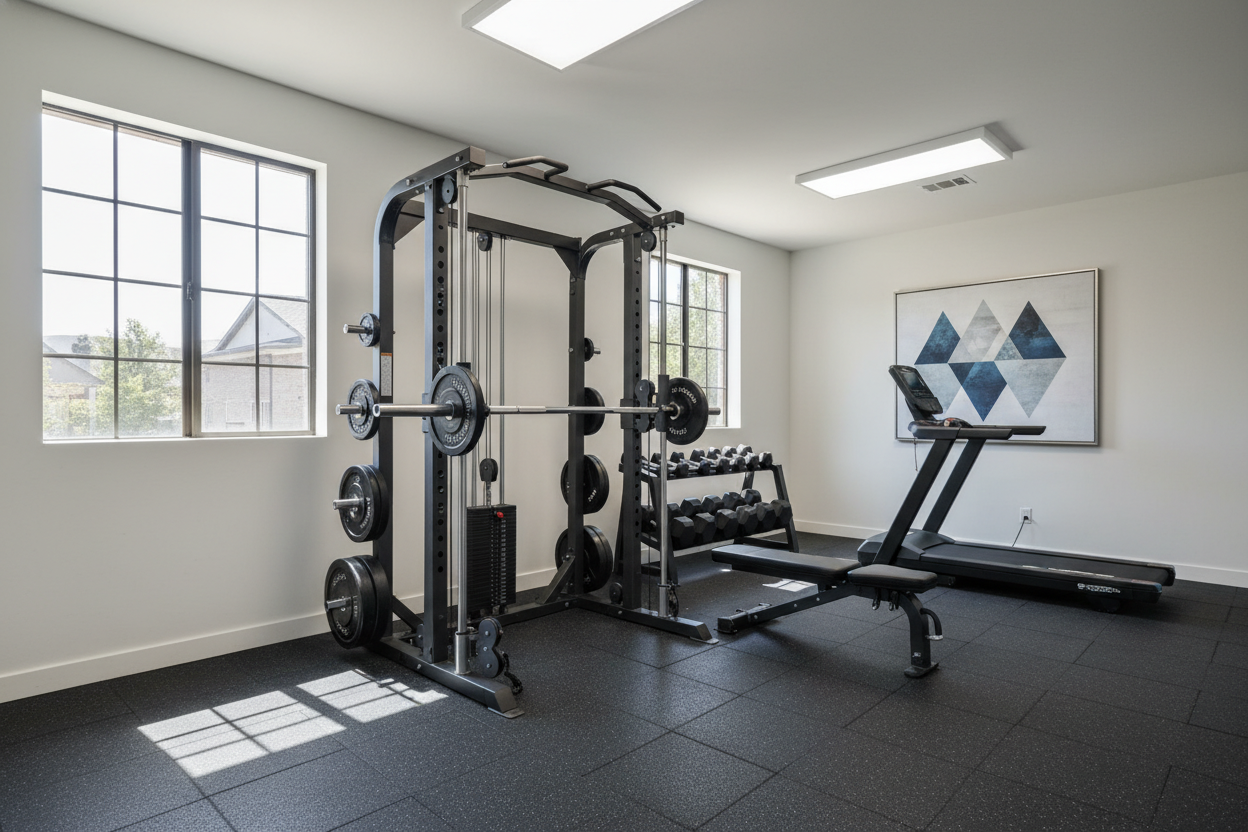
I remember the first time I hit a 'PR' on a freemotion smith machine at my local big-box gym. I walked out feeling like a Greek god, ready to conquer the world, until I tried the same weight on a standard Olympic barbell the following week and nearly crushed my windpipe. It turns out my ego was being inflated by a hidden system of cables and pulleys designed to keep me safe, not necessarily strong.
If you have ever stood in the middle of a crowded gym floor, staring at a massive silver bar and wondering if you should count it as 45 pounds or zero, you are not alone. Most people just guess, which is the fastest way to stall your progress. Tracking your lifts accurately is the only way to ensure you are actually getting stronger and not just getting better at manipulating physics.
Quick Takeaways
- The bar on most Freemotion Smith units effectively weighs between 15 and 20 lbs.
- Counterweights inside the frame reduce the starting resistance significantly compared to free weights.
- Linear bearings provide a 'floating' feel that can mask your true strength levels.
- Always record the weight of the plates plus the machine's specific bar offset in your logbook.
Why That Commercial Bar Feels Like You're Lifting Air
Commercial gyms are built for the masses, which means they are built for safety. A standard 45-pound barbell is heavy enough to injure a beginner before they even add plates. To solve this, Freemotion and other high-end manufacturers use a counterbalance system. Inside those vertical steel towers, there are weights attached to cables that pull upward on the bar, offsetting its actual physical mass.
This engineering feat makes the bar feel nearly weightless at the start of the movement. It is great for physical therapy or learning a new movement pattern, but it is a headache for anyone trying to calculate their 1RM. You aren't just fighting gravity; you are fighting a machine that is actively trying to help you lift the load. This is why 225 lbs on a Smith machine feels like a warm-up compared to 225 lbs on a flat bench.
Solving the Freemotion Smith Machine Bar Weight Mystery
Let's get to the numbers. After testing several models and checking the manufacturer specs, the functional freemotion smith machine bar weight is typically 15 lbs. While the steel bar itself might physically weigh 25 or 30 lbs, the counterbalance system negates a huge chunk of that. When you unrack the bar, the resistance your muscles actually feel is closer to a light technique bar than a standard power bar.
Some older Genesis models or the dual-axis rigs might vary slightly, but 15 lbs is the gold standard for your math. If you want to be 100% sure, you can perform the 'fish scale test' by hooking a digital hanging scale to the bar and seeing what it registers when it's hovering. In almost every case, you are looking at a 15-to-20-pound starting point. Don't let your ego tell you it's 45 just because it looks the part.
How to Do the Math for Progressive Overload
To keep your gains honest, you need a consistent way to log these sets. I always tell people to log it as 'Plates + 15.' If you have two 45s on each side, that is 180 lbs of plates plus the 15-lb bar, totaling 195 lbs. It might hurt your pride to realize you aren't benching 225 yet, but your future self will thank you when you transition back to free weights and your numbers actually align.
If you find that the fixed path of the Smith machine is bothering your shoulders, you might want to look into a Weight Bench Chest Press Machine Independent Arms Z1 Pro. Machines with independent arms allow for a more natural arc and force each side of your body to pull its own weight. Unlike a counterbalanced Smith, these machines usually have a more predictable weight-to-tension ratio, making it easier to track real-world strength increases without the pulley-system guesswork.
Should You Hunt Down a Used Freemotion Rig for Your Garage?
I see these things pop up on Facebook Marketplace all the time for a 'steal.' Before you rent a U-Haul, realize that a commercial Freemotion rig is a massive beast. We are talking about a footprint that can easily swallow a 6x8 foot section of your gym, and they are often too tall for standard 8-foot basement ceilings. They are built to survive 24/7 abuse in a Gold's Gym, which makes them overkill for most home setups.
Unless you have a dedicated outbuilding with high ceilings, a standard Smith Machine designed for home use is usually a better bet. Home-grade units often skip the complex internal counterweights, meaning the bar weight is usually a true 15-25 lbs without the 'ghost' assistance of a pulley. Plus, you won't need a team of four people and a specialized toolkit just to move the thing across the room.
Home Gym Reality Check: Do You Really Need Commercial Bearings?
The main reason people crave the Freemotion brand is the 'glide.' It uses high-grade linear bearings that feel like sliding on ice. In a home gym, that level of smoothness is nice, but it isn't always necessary for building muscle. I've used plenty of mid-tier machines that get 90% of the way there for 30% of the price. You just have to be willing to maintain them with a little silicone spray every few months.
If you are on the fence about whether to go pro-grade or home-grade, consider the friction. A cheap machine will catch and stutter under heavy loads. Before you drop three grand, read up on how other brands handle heavy weight. For instance, Is the Valor Fitness Smith Machine Actually Smooth Under Heavy Weight? is a great deep dive into how a more affordable track stacks up against the commercial titans. Most of the time, the 'commercial' tax isn't worth it for a solo lifter.
Frequently Asked Questions
Is the bar on a Freemotion Smith machine always 15 lbs?
Usually, yes. While the physical bar is heavier, the counterbalance system is tuned to make the starting resistance feel like 15 lbs. Always check for a sticker on the frame, as some newer models list the effective weight explicitly.
Why does my Smith machine bench feel easier than my barbell bench?
Two reasons: the counterbalance reduces the weight, and the fixed track eliminates the need for stabilizer muscles. You aren't balancing the weight; you are just pushing it. This allows you to move more weight, but it doesn't always translate to raw strength.
Can I remove the counterweights to make the bar heavier?
I wouldn't recommend it. These machines are engineered with specific cable tensions. Messing with the internal weights can lead to cable snaps or the bar crashing unevenly. If you want a heavier bar, just add 10-lb plates.
Share:
I Tested Electric Generating Exercise Equipment (Did It Cut My Bill?)
Can You Actually Build Big Delts With a Shoulder Press on Smith Machine?