
I spent my 20s as a total barbell snob. If it wasn't a 45-lb iron plate clanking against a sleeve, I didn't think it counted. I spent years scrolling through forums and watching garage gym tours, convinced that a power rack and a flat bench were the only tools a 'serious' lifter needed. But after a decade of heavy triples and the inevitable joint aches that follow, I realized I was hitting a wall. My CNS was fried, my lower back was constantly 'aware' of itself, and my hypertrophy had stalled because I was too tired to balance the weight. That is when I finally learned how to exercise with machine rigs properly, and honestly, I wish I’d swallowed my pride sooner.
Quick Takeaways
- Machines eliminate the stability requirement, allowing you to push a muscle to 100% failure without your form breaking down.
- Joint alignment is everything; if you aren't lined up with the machine's pivot point, you're wasting your time.
- The Smith machine is one of the best tools for quad development when used with a fixed vertical path.
- Fixed-path rigs allow for slower, controlled eccentrics that are nearly impossible with heavy free weights.
Why I Stopped Worshiping the Barbell
The cult of the barbell is real, and it is loud. We are told that 'functional' strength only comes from stabilizing a heavy load in space. While that is true for athletes, it is a limiting factor for someone just trying to get bigger and stay healthy. When you are doing a set of 12 on the bench press, your triceps or chest should be the reason you stop. But often, it is the small stabilizer muscles in the shoulder or the sheer mental fatigue of not dropping the bar on your neck that ends the set. That is not training to failure; that is training to technical breakdown.
By incorporating mechanical rigs, I removed the 'balance' variable from the equation. I could finally load up three plates on a chest press and drive until my pecs literally couldn't move the handles another inch. There is no fear of being pinned. There is no 'wobble.' Just pure tension on the target tissue. If you want to train for longevity, you have to accept that your joints have a finite number of heavy, unstable reps in them. Moving to a fixed path for my accessory work has kept me in the gym five days a week instead of three days of lifting and two days of icing my knees.
The Right Way to Set Up a Machine Exercise
The biggest reason people hate machines is that they feel 'clunky.' Nine times out of ten, that is user error. You cannot just sit down in a seated exercise machine and start pushing. These rigs are designed with a specific axis of rotation—a pivot point where the arm of the machine moves. If your joint (elbow, shoulder, or knee) isn't perfectly aligned with that pivot, the machine is going to fight you. You'll feel a 'shearing' sensation that ruins the mind-muscle connection and puts unnecessary stress on your connective tissue.
When I set up for a machine exercise, I spend at least sixty seconds just adjusting the seat height and back pad. For a leg extension, the side of your knee needs to be exactly parallel with the bolt that the arm rotates on. For a chest press, the handles should start at mid-chest, not up at your chin. I see guys in commercial gyms all the time with the seat too low, shoulders shrugged to their ears, wondering why their rotator cuffs hurt. It isn't the machine's fault; it's the setup. Take the time to find the 'sweet spot' where the resistance feels smooth from the bottom of the rep to the top lockout.
Rescuing the Smith Bar From Coat Rack Duty
It is time we stop the Smith machine slander. For years, I called it the 'shame rack.' Then I actually used one for a block of high-volume leg training. If you are trying to grow your legs without compressing your spine into a pancake, a Smith machine for quads is a cheat code. Because the bar is on a fixed track, you can place your feet further forward than you ever could with a barbell squat. This allows you to keep your torso completely vertical, putting the entirety of the load onto the quadriceps rather than the spinal erectors.
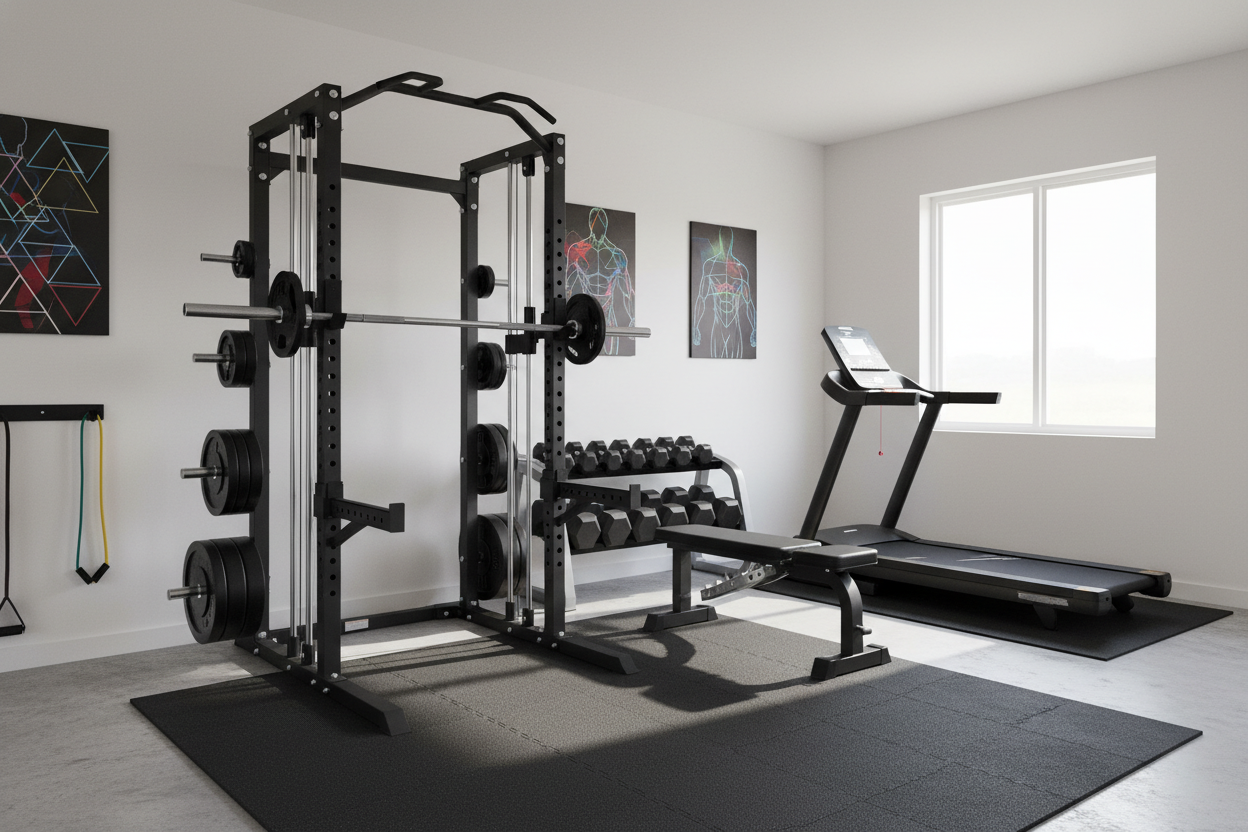
For home gym owners, space is the ultimate currency. If I had to pick one rig to dominate a 6x8 footprint, I’d look at a Smith machine with cable crossover. It solves the two biggest issues in a garage: the need for heavy, safe pressing and the need for versatile cable work. You get the 11-gauge steel stability of a rack with the refined feel of a commercial selectorized stack. I’ve found that doing 'Hatfield' style squats or even behind-the-back shrugs on a Smith bar provides a level of isolation that a free bar simply cannot match. It’s about using the right tool for the job, not just the one that looks the most 'hardcore' on Instagram.
The One Rule for Growing Muscle on Fixed Paths
The secret to making machine work effective is 'earned stability.' Since the rig is handling the balance for you, you no longer have an excuse for sloppy reps. You have to make the movement harder, not easier. This means utilizing agonizingly slow eccentrics. On a machine press, I’ll take a full three to four seconds on the way down, feeling every fiber stretch, followed by a dead-stop pause at the bottom to eliminate momentum.
When you take away the need to stabilize, you can focus entirely on the quality of the contraction. I like to imagine I’m trying to 'break' the machine handles. This internal tension, combined with the safety of a fixed path, allows for intensity techniques like drop sets or rest-pause sets that would be suicidal with a barbell. You haven't truly trained legs until you've done a triple-drop set on a hack squat where you're literally crawling out of the machine. That is the level of effort machines facilitate.
Personal Experience: The Day I Swallowed My Pride
I remember the specific workout that changed my mind. I was trying to hit a new PR on overhead press with a barbell. My lower back was twingey, and my left shoulder felt 'loose.' I missed the lift not because my shoulders were weak, but because my core gave out. Frustrated, I walked over to a plate-loaded shoulder press machine. I pinned my back against the seat, grabbed the handles, and repped out more weight than I had ever touched on the platform. The pump was insane. The next day, my shoulders were actually sore, but my back felt fine. My mistake for years was thinking that 'harder' always meant 'better.' Sometimes, harder just means more dangerous. Now, I use machines to finish what the barbell started.
Frequently Asked Questions
Can I build as much muscle with machines as with free weights?
Absolutely. Hypertrophy is about mechanical tension and metabolic stress. Your muscles don't have eyes; they don't know if you're holding a dumbbell or a machine handle. They only know how much tension they are under. For pure size, machines are often superior because they allow for better isolation.
Are machines safer for beginners?
Generally, yes, because they guide you through a fixed range of motion. However, a beginner can still get hurt if they set the seat height incorrectly. The 'safety' of a machine is dependent on the user's ability to align their joints with the machine's mechanics.
Do I need a huge garage for a machine rig?
Not necessarily. While commercial machines are bulky, modern home gym 'all-in-one' units are designed to fit in a standard 8x8 or 10x10 space. Look for units that combine a Smith bar with a functional trainer to get the most bang for your buck in a small footprint.
Share:
Why Your Joints Hate Most Home Fitness Machines (And How to Fix It)
What Is That Lower Back Machine Gym Name? (Mystery Solved)