
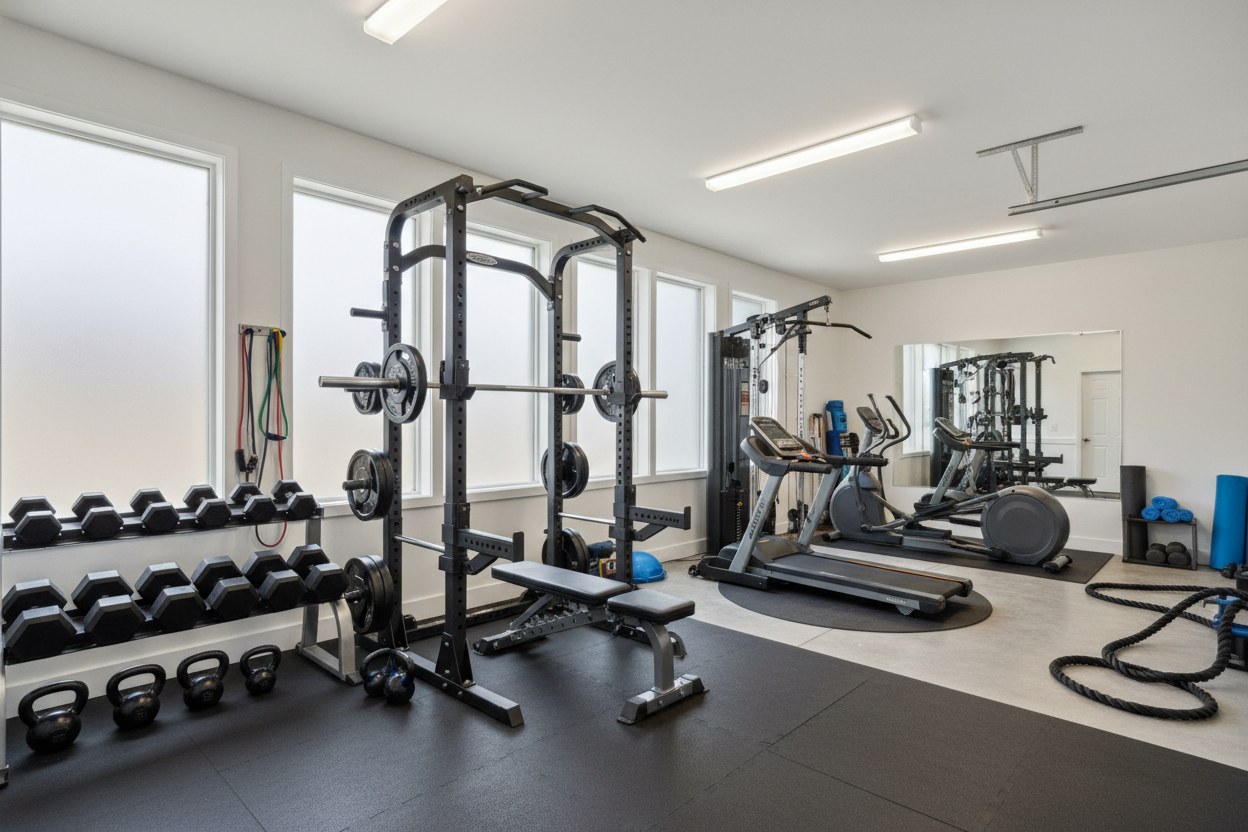
We have all been there. You walk into a commercial gym, pay your twenty bucks for a day pass, and stare at a sea of steel that looks more like an engine room than a place to get fit. You want to follow your program, but the 'back machine' listed doesn't look like the one in the video, and you are too proud to ask the teenager at the front desk for help.
I spent three years scouring Facebook Marketplace and liquidating old commercial spaces before I could accurately pair every gym machine with name and function without looking like a total rookie. Knowing the difference between a hack squat and a pendulum squat isn't just about ego; it is about knowing exactly what you are searching for when you finally decide to build your own setup.
Quick Takeaways
- Names Matter: Knowing specific exercising machines names helps you find better deals on used gear.
- Isolation vs. Compound: Most machines isolate one muscle; racks and pulleys do everything.
- Footprint is King: Commercial machines are built for 20,000 sq ft gyms, not your 2-car garage.
- Cables over Cams: Functional trainers offer more versatility than any single-purpose unit.
Why You Actually Need to Know What That Contraption is Called
If you are looking at a list of gym equipment and it all looks like 'the pulling thing' or 'the leg pressy one,' you are going to struggle. First, your programming will suffer. If your app says to hit the 'Seated Row' and you end up on a T-Bar Row machine, you are hitting the same muscles but with a completely different stability profile. You need to know these names to follow a linear progression effectively.
More importantly, knowing the names of weight lifting equipment is your secret weapon for the used market. Sellers often list a $3,000 piece of gear as 'exercise machine' because they don't know what it is. If you know that it is actually a selectorized lateral raise, you can swoop in and snag a deal while everyone else is searching for 'shoulder thing.'
The Upper Body Section: Pushing and Pulling Decoded
Upper body machine names are usually descriptive, but the mechanics vary wildly. You have your standard Lat Pulldown—the tall one with the long bar—and your Seated Row, which mimics a rowing motion. But the real gems are the plate-loaded units. A chest press machine with independent arms is a massive step up from a basic bench because it forces both sides of your body to pull their own weight, preventing your dominant side from taking over.
Then you have the 'Back Machine' category, which is a catch-all for everything from the T-Bar Row to the Low Row. The key is looking at the line of pull. If you are pulling from high to low, it is a lat-focused movement. If you are pulling straight back toward your belly button, you are hitting the mid-back and traps. Most commercial gyms will have a 'Chest-Supported Row,' which is a godsend for anyone with lower back issues who still wants to move heavy weight.
Decoding the Lower Body Gauntlet
Leg day is where the nomenclature gets truly confusing. The Leg Press is the big 45-degree sled everyone loads too many plates on. But what about the Hack Squat? That is the one where you stand in the machine at an angle, and the weight sits on your shoulders. It is one of the best quad-builders ever made, but it takes up a massive 4x7 foot footprint.
You also have your isolation staples: the Leg Extension (sitting, kicking out) and the Lying or Seated Leg Curl (pulling the weight toward your glutes). If you see a machine where you are standing and pushing one leg back, that is a Glute Kickback machine. These are often the first things people buy for a home gym, but they are usually the first things they regret because they only do one thing.
The Giant Metal Cages: Racks, Rigs, and Pulleys
This is the heart of any serious training space. People often confuse a Power Rack (the four-post cage) with a Smith machine. A Smith machine home gym station uses a barbell fixed on tracks, which is great for safety when training alone but doesn't require the same stabilizing muscles as a free-weight rack. It is a 'guided barbell system,' and it is a staple for high-volume hypertrophy work.
Then you have the Functional Trainer. This is the big unit with two adjustable pulleys. If I could only have one 'machine' in my house, this would be it. It covers almost the entire exercise machine list in one footprint. You can do chest flies, tricep extensions, cable rows, and even weighted crunches. It is the ultimate multi-tasker for small spaces.
Cardio Row: Navigating the Sea of Screens
Cardio equipment names are usually straightforward, but the quality varies. You have your standard treadmills and ellipticals, but if you want real results, you look for the manual stuff. I’ve found that the best equipment for home gym gains usually doesn't even plug into a wall. Think of the Air Bike (or Assault Bike) and the Concept2 Rower.
These machines use air resistance—the harder you push, the harder it pushes back. A Stair Climber (or 'StepMill') is the one that looks like a miniature escalator. It is brutal, it is huge, and it is the fastest way to get your heart rate to 180 beats per minute. If you see something called a 'SkiErg,' that is the vertical rowing machine that mimics cross-country skiing—great for lats and heart health.
Which of These Actually Belong in Your Garage?
Here is the cold, hard truth: I once sold most of my home gym equipment because I fell into the trap of buying 'cool' commercial machines. I bought a dedicated Pec Dec and a Seated Calf Raise. Within six months, I realized I had no floor space left and I was barely using them. Unless you have a 2,000-square-foot barn, avoid single-use machines.
If you are ready to build your own home gym, prioritize a solid rack, a functional trainer, and a good adjustable bench. You can mimic almost every 'gym machine' with a cable and a different handle. Don't buy a machine just because it has a fancy name; buy it because it fits your space and your goals. A 300-lb weight stack is great, but not if you have to crawl over it to get to your car.
Frequently Asked Questions
What is the bench press machine called?
It is usually called a Chest Press machine. It comes in two main styles: selectorized (where you move a pin in a weight stack) or plate-loaded (where you add your own Olympic plates). Some people also use the Smith machine for a guided bench press.
What is the difference between a Power Rack and a Smith Machine?
A Power Rack is a cage for free-weight lifting where the bar is not attached to the frame. A Smith Machine has a bar fixed to vertical or slightly angled tracks. The Smith machine is more stable, while the Power Rack requires more balance and hits more stabilizer muscles.
What is the best machine for back workouts?
The Lat Pulldown and the Seated Row are the 'big two.' If you want to get specific, look for a Chest-Supported T-Bar Row to take the strain off your lower back while still moving heavy weight.
Share:
The 12-Month Roadmap for Buying Fitness Equipment at Home
What Is the Best Machine for Cardio If You Actually Lift?