
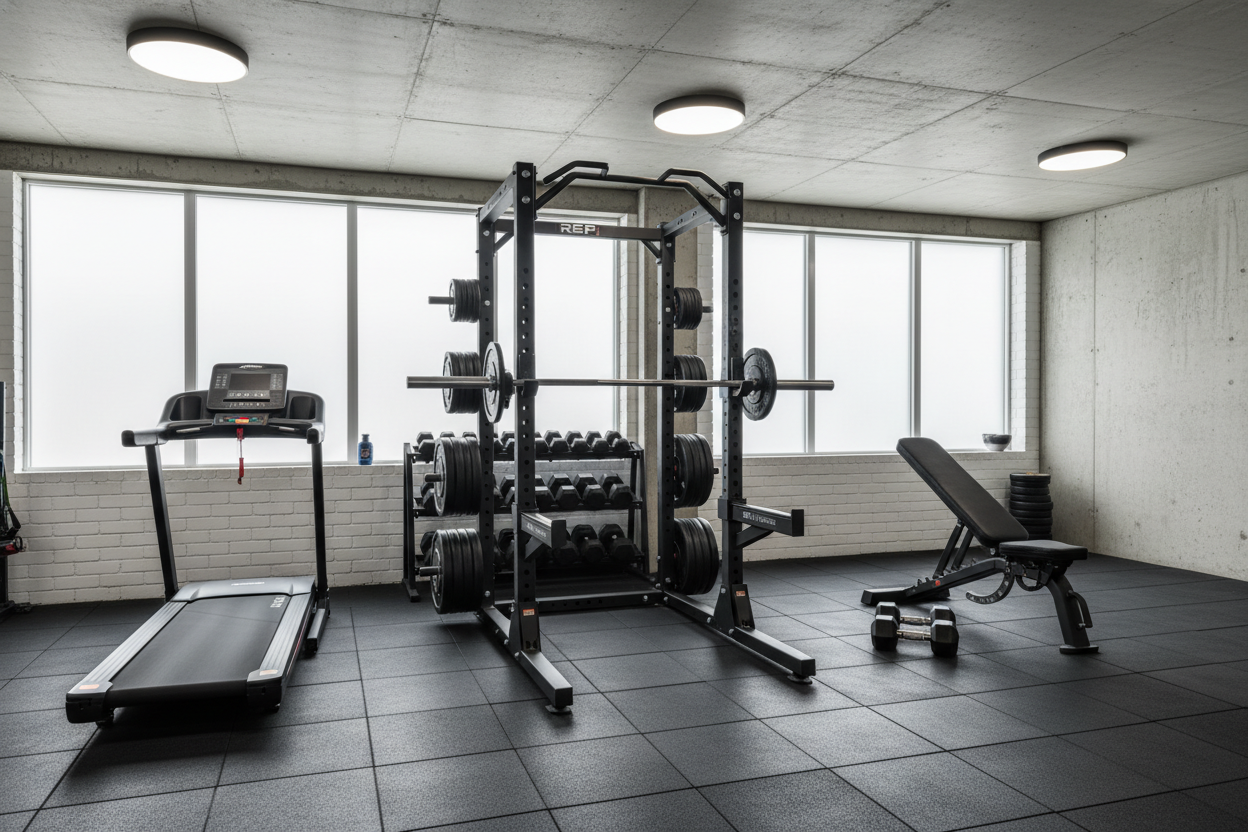
I spent years sneering at Smith machines. I thought if you weren't balancing a free-weight barbell on your back, you weren't really training. Then I hit a plateau on my hack squats and my lower back started sending me invoices for past abuse. I realized that chasing a pump with the rep fitness smith machine wasn't 'cheating'—it was being smart about stability.
After six months of loading this thing with every 45-pound plate I own, I’ve learned exactly where it shines and where it starts to creak. If you are looking to add a rep smith machine to your modular rack, you need to know if it's actually worth the footprint it steals from your garage.
- Smoothness: High-end linear bearings that rival commercial gym quality.
- Starting Weight: A manageable 25 lbs, making it great for accessory work.
- Build Time: Expect a 3-hour project and a few choice words for the guide rods.
- Durability: Handles 400+ lbs without the 'shudder' common in cheap rigs.
The Elephant in the Garage: Why Buy a Fixed Track?
For the longest time, my garage was a barbell-only zone. But as I leaned more into hypertrophy, I got tired of my core being the limiting factor on leg day. I wanted to smash my quads without worrying about falling over. Adding a fixed track meant I could push to absolute failure safely.
The REP rig appealed to me because it wasn't a standalone eyesore. It integrates into the PR-4000 or PR-5000 racks I already liked. Transitioning from a purist to a 'stability seeker' changed my physique more in six months than the previous two years of grinding out shaky back squats.
Unboxing and Building the Rig (Without Losing Your Mind)
REP packs their gear like they’re shipping fine china. Everything arrived in heavy-duty cardboard, but be warned: this is a heavy delivery. You’ll want to unbox it where you plan to build it. Putting it together is a one-person job until you get to the guide rods. That’s when you’ll want a second pair of hands to keep things vertical while you thread the bolts.
The biggest mistake people make is tightening everything down too early. If you crank the bolts before the bar is seated, your alignment will be off, and you'll feel it in every rep. Keep it loose, slide the bar up and down a few times to let the rods find their natural center, then lock it down. It took me about three hours from opening the first box to my first set of calf raises.
The 'Butter' Test: How Good Are Those Linear Bearings?
A Smith machine is only as good as its bearings. If there is any grit or friction, the mind-muscle connection is ruined. I’ve spent time on the Valor Fitness Smith machine, and while that’s a solid unit, the REP version feels a notch more refined. It uses high-quality linear bearings that glide without that annoying 'scratchy' sound.
Even with just the 25-lb bar, the movement is effortless. There’s no stick-slip phenomenon here. It feels like the bar is floating on a layer of oil. This is crucial for things like behind-the-back shrugs or JM presses where any deviation in the track can mess with your joints.
Stress Testing the Bar: What Happens When You Go Heavy?
I eventually loaded this up with 405 lbs for some heavy rack pulls and partial squats. This is where you find out if a machine is built for home use or actual abuse. At four plates per side, the bar did exhibit a tiny bit of whip, but nothing that felt unsafe. The 11-gauge steel of the rack integrated perfectly with the Smith attachment, so there was zero sway.
The lockout mechanics are crisp. A simple flick of the wrist catches the pins instantly. One thing I noticed: the safety catches are beefy. I actually 'dropped' a heavy set of inclines onto the safeties to see if they’d bend. They didn't. They took the hit, stayed in place, and gave me the confidence to keep training solo without a spotter.
The Footprint Fact-Check: Does It Eat Up Too Much Space?
Space is the ultimate currency in a garage gym. If you have a two-car garage, every inch matters. Because this is a modular attachment, it doesn't add much depth to your rack, but it does require you to have the specific 4-post or 6-post setup. If you are tight on space, you might find that an all-in-one Smith machine with cable crossover offers more utility per square foot.
However, if you already own a REP rack, this is the most efficient way to get a professional-grade track. It doesn't interfere with your pull-up bar or your ability to use J-cups on the front of the rack. It just sits there, tucked away until you need to blast your triceps or quads.
Final Verdict: Who Should Actually Drop the Cash on This?
This isn't for the guy who only cares about his total at a powerlifting meet. This is for the lifter who wants to isolate muscles, train to failure safely, and build a physique without constant joint pain. It’s a premium attachment with a price tag to match, but the build quality justifies the spend.
If you have the room and the budget, it's a no-brainer. But if you aren't already tied into the REP ecosystem, you might want to look at a dedicated Smith machine that stands on its own. For me? It’s staying in the rack. My back thanks me every leg day.
How much weight can the REP Smith machine handle?
The unit is rated for heavy use, comfortably handling over 500 lbs. While the bar may show slight flex at those weights, the bearings and safety catches are more than capable of managing heavy loads without binding.
Is the bar Olympic sized?
Yes, the bar features standard 2-inch sleeves, so all your existing Olympic plates will fit perfectly. The knurling is moderate—grippy enough for heavy rows but won't cheese-grate your palms during high-rep sets.
Can I install this on a non-REP rack?
It is specifically designed for the hole spacing and upright dimensions of the REP PR-4000 and PR-5000. While some DIY enthusiasts have forced it onto other 3x3 racks, I wouldn't recommend it. Alignment is everything for linear bearings.
Share:
Is a Portable Barbell Just a Gimmick for Traveling Lifters?
Why Real Military Exercise Equipment Rarely Belongs in a Home Gym