
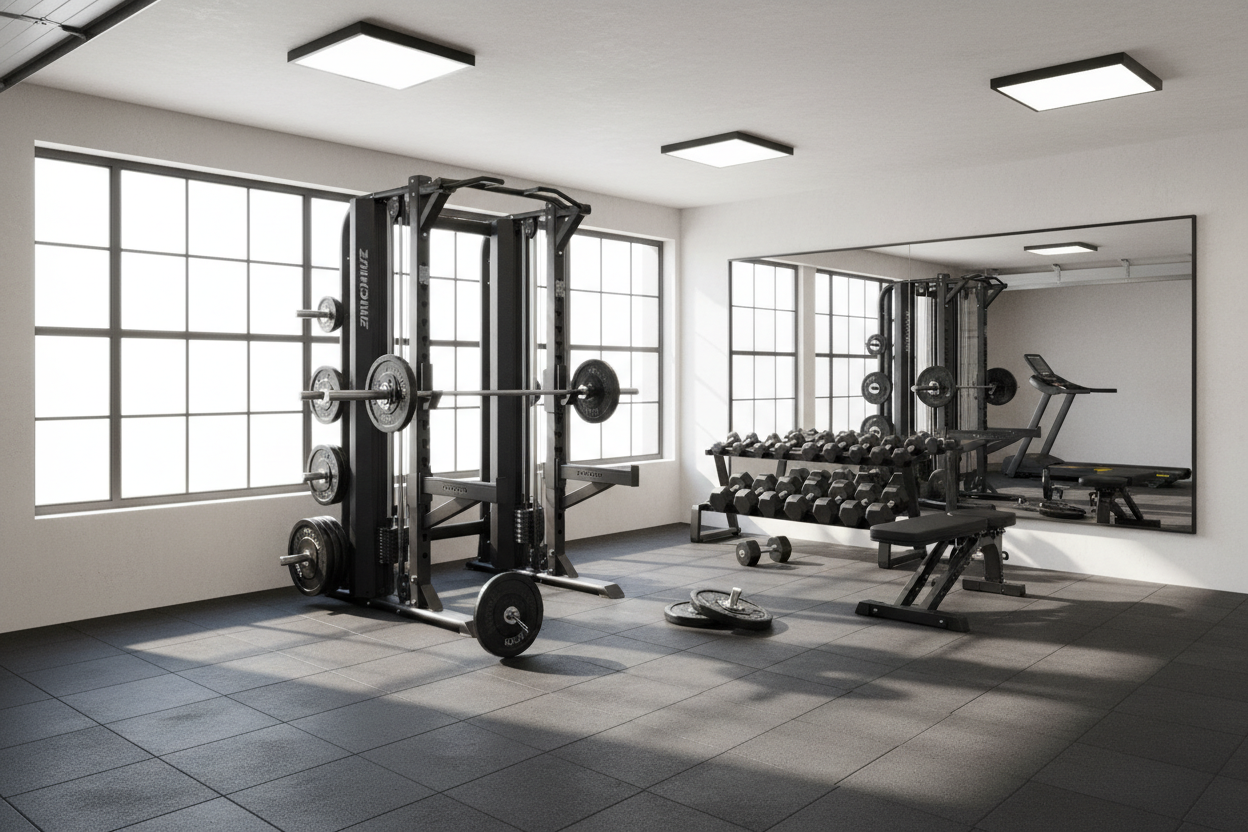
My garage gym used to look like a scrap metal yard. I had a budget squat stand that wobbled if I breathed on it too hard and a cable tower that felt like it was lubricated with sand. When I started seeing the sunhome smith machine popping up in my feed, I was skeptical. Most all-in-one rigs are a collection of compromises where nothing actually works well, and the marketing usually hides the fact that the steel is thin enough to bend with your bare hands.
I decided to clear out the clutter and see if Sunhome fitness gear could actually handle the abuse of a real training program. I’m not talking about three sets of air squats. I’m talking about heavy eccentric loading, high-volume cable work, and the kind of floor-shaking drops that make my neighbors hate me. After a month of treating this machine like it owed me money, I’ve finally figured out where it shines and where it falls short.
- Build Quality: Heavy-duty 11-gauge steel tubing that provides a rock-solid foundation.
- Bearing Performance: Commercial-grade linear bearings that offer a friction-free glide.
- Cable System: Dual 2:1 ratio pulleys that are actually smooth enough for isolation work.
- Footprint: It is a beast; you will need a dedicated 6x8 foot area at the minimum.
The All-In-One Hype: Why This Rig Caught My Eye
The appeal of a rig like this is simple: space. Most of us are fighting for every square inch in our garage. If you want a power rack, a functional trainer, a lat pulldown, and a Smith machine, you’re usually looking at four separate footprints and a bill that looks like a down payment on a truck. Sunhome fitness has positioned itself as the brand that stuffs all of that into a single cage without the 'toy' feel of entry-level Amazon brands.
I was specifically looking for something that didn't feel like a compromise. I’ve used all-in-ones before where the Smith bar felt hollow or the pulleys were so jerky that they’d ruin your mind-muscle connection on a simple tricep extension. This rig promised to be different, using thicker steel and better internal components. In a world where gym memberships are hitting $80 a month for basic access, the idea of a one-and-done purchase to handle everything from heavy squats to accessory burnout sets is incredibly tempting.
Unboxing and Assembly: Prepare Your Weekend
Let’s be real: the delivery day is both the best and worst day of your life. The Full Body Multi Training Station Smith Machine Dm01 arrived in three massive wooden crates that weighed more than my first car. The parts were organized surprisingly well, but this is not a solo afternoon project. If you try to bolt this beast together by yourself, you’re going to end up frustrated and probably nursing a bruised toe.
It took me and a buddy about six hours of focused work to get it fully functional. The hardware quality is a step above the usual grade-5 bolts you see in residential gear. Everything felt heavy and overbuilt. One tip: don't tighten any of the frame bolts until the entire structure is upright and squared. If you torque everything down early, you'll be fighting the alignment when you try to slide the Smith bar into place. The instructions were decent, but I spent a good twenty minutes staring at the cable routing diagram like it was a 3D puzzle before it finally clicked.
The Lift Test: How Smooth Are the Bearings?
The soul of any Smith machine is the bearing system. If the bar catches when you’re halfway through a 315-pound squat, it’s not just annoying—it’s dangerous. I’ve spent time wondering Is the Valor Fitness Smith Machine Actually Smooth Under Heavy Weight?, and while that’s a solid mid-tier option, the Sunhome unit feels noticeably more industrial. The linear bearings on this rig are the real deal. Even when I intentionally pushed the bar off-center to see if it would bind, it glided cleanly.
I ran through a series of heavy presses and Bulgarian split squats to test the stability. The knurling on the Smith bar is aggressive enough to be useful without shredding your palms into ribbons. One thing I noticed is that the safety catches are easy to engage with a quick flick of the wrist, which is a lifesaver when you're training solo and hitting failure. It doesn't have that 'tinny' sound when the bar moves; it’s a low, smooth hum that tells you the tolerances are tight. If you’re used to the shaky machines at a hotel gym, this will feel like a massive upgrade.
Testing the Pulleys and Cable Crossover
A Smith machine is great, but the dual pulley system is where the real versatility happens. The All In One Smith Machine With Cable Crossover S1 V4 setup uses a 2:1 ratio, which is standard for functional trainers. This means if you have 100 pounds on the stack, it feels like 50 pounds of actual resistance. This is perfect for things like cable flyes or lateral raises where you need micro-adjustments and a long travel distance for the cable.
The pulleys themselves swivel 180 degrees, so I could stand outside the rack for chest presses or move inside for close-grip rows. I didn't experience any of the 'stuttering' that usually happens with cheap plastic pulleys. These are aluminum, and they make a difference. My only gripe is the weight storage. If you’re using the plate-loaded version rather than a selectorized stack, you have to be mindful of how you balance the plates to keep the movement consistent, but that’s a minor trade-off for the price difference.
The Final Verdict: Does It Belong in Your Garage?
After a month of daily use, I’m sold on the durability. Is it perfect? No. The footprint is massive, and if you have a cramped one-car garage, you’re going to be doing some serious Tetris to make it fit. But if you have the space, the value is hard to beat. You’re getting a professional-grade Smith bar, a functional trainer that doesn't feel like a toy, and a rock-solid pull-up station in one unit.
I’d recommend this to anyone who is serious about hypertrophy and wants the safety of a Smith machine for solo sessions. If you’re a pure Olympic lifter who only cares about the 'big three' and needs to drop 500 pounds from overhead, stick to a dedicated power rack. But for the 95% of us who want a mix of heavy compound lifts and high-quality accessory work, this is a powerhouse. If you’re ready to stop making excuses and start building a real home gym, browse the Smith Machine Home Gym Station lineup and see which configuration fits your goals.
How much ceiling height do I need?
You need a minimum of 84 inches for the machine to clear, but I wouldn't recommend anything less than 8 feet if you plan on doing pull-ups. There is nothing worse than smashing your forehead into the rafters on your first set of chin-ups.
Can I use standard 1-inch plates?
No, this is built for 2-inch Olympic plates. The sleeves are designed for heavy loading, and honestly, if you're buying a rig of this caliber, you should be using Olympic iron anyway.
How often do I need to lubricate the bars?
I’d hit the guide rods with a dry silicone spray once every three months. Don't use WD-40—it attracts dust and will eventually gum up those expensive linear bearings.
Share:
Is a Body Solid Smith Machine Actually Worth Your Floor Space?
Does a Smith Machine With Pulley Actually Replace a Cable Tower?