
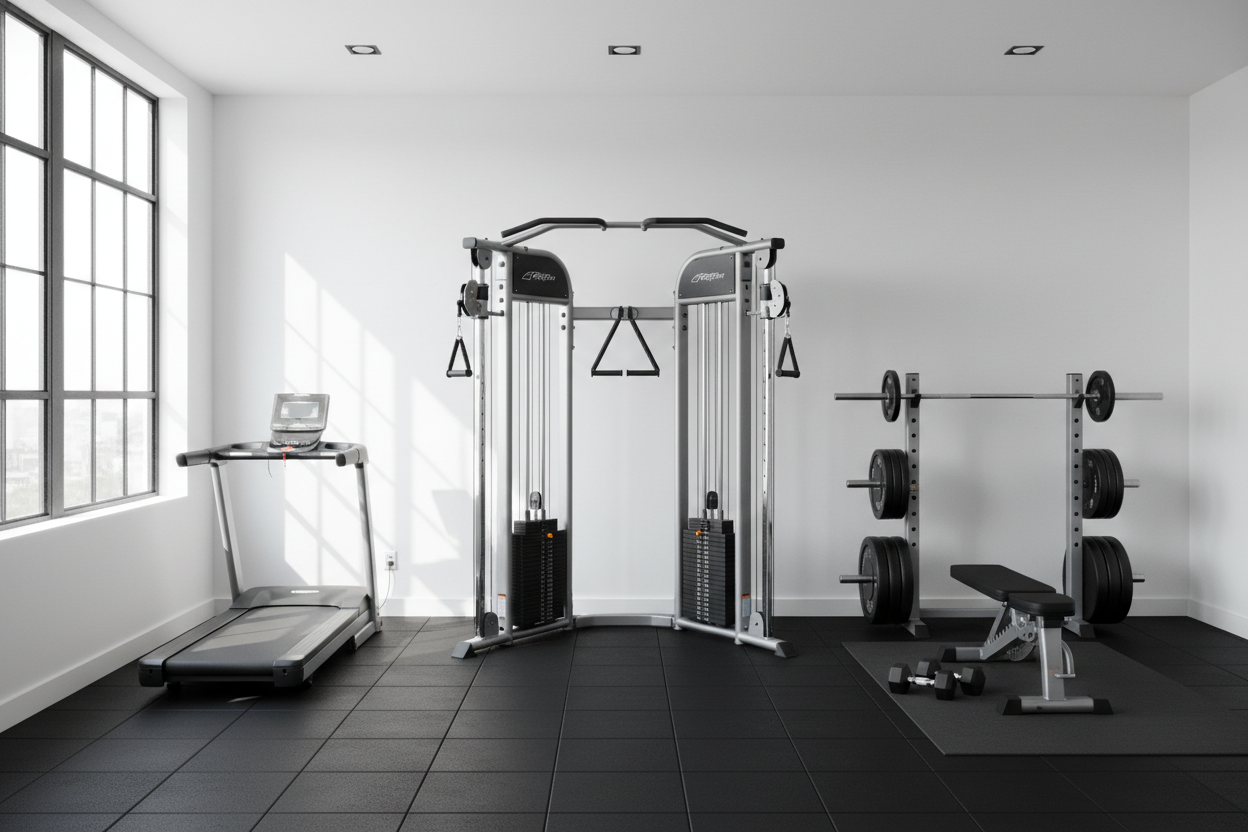
I remember the day I realized my garage was less of a gym and more of a graveyard for 11-gauge steel. I’d spent thousands trying to replicate my local powerhouse, only to find that gym machines at home are a completely different beast than commercial units. In a commercial club, floor space is infinite; in your garage, every square inch is a premium asset.
Most residential weight systems are wobbly junk. They use thin cables that stretch after three months and plastic pulleys that scream under a 100-pound load. I’ve tested the stuff that snaps and the stuff that lasts, and I’m here to tell you that most of it isn't worth the assembly time.
- Footprint is King: If a machine only does one thing, it better do it perfectly.
- Cables Over Cams: High-quality pulley systems offer more versatility than fixed-path machines.
- Steel Gauge Matters: Look for 11 or 12-gauge steel; anything higher (thinner) will shake when you go heavy.
- The Ratio Trap: Understand 2:1 vs 1:1 pulley ratios before you buy a home weight system.
The Commercial Club Illusion (And Why It Fails in Garages)
We’ve all done it. You walk into a big-box gym, see a row of twenty Hammer Strength machines, and think, 'I need that chest press.' So you go online and buy a cheap knock-off weight machine for home. Three weeks later, you realize that one machine takes up 15 square feet and you only use it for four sets a week.
The biggest mistake I ever made was trying to buy specific machines for every body part. I Built the Best Weight Home Gym (And Made 3 Massive Mistakes), and at the top of that list was cluttering my floor with single-use stations. You don't need a dedicated leg extension machine if you have a functional trainer and a decent bench.
Commercial gyms have the luxury of space. You don't. Every piece of equipment in your home weight system needs to justify its existence daily. If it’s just a place to hang your laundry, it’s a failure.
Multi-Gyms vs. Single Stations: What Actually Makes Sense?
The 'all-in-one' weight lifting machines for home are tempting. They promise 50 exercises in one footprint. The reality? Most of them do 50 things poorly rather than five things well. When you try to cram a leg press, a lat pulldown, and a pec deck into a 4x4 space, something has to give.
Usually, what gives is the structural integrity. Why Most Compact Gym for Home Setups Snap Under Heavy Weight often comes down to the pivot points. Cheap home fitness machines use bolts as axles instead of sealed bearings. After a year of heavy lifting, those pivot points go oval, and the machine starts to track crookedly.
If you are looking for an at home weight machine, prioritize cable travel and stack weight. A 160-lb stack sounds like a lot until you realize the pulley ratio makes it feel like 80 lbs. Look for systems that allow for at least 200 lbs of actual resistance if you're serious about hypertrophy.
The Only 3 Machines Actually Worth Your Floor Space
If I had to clear out my gym today and start over, I’d only keep three specific types of weight machines for home gym use. These are the workhorses that actually build muscle without making you park your car on the street.
1. Functional Cable Trainers (The King of Versatility)
A dual-pulley functional trainer is the ultimate weight machine home gym centerpiece. It replaces your cable crossovers, tricep stations, and even your row machines. The footprint is relatively small, but the exercise library is infinite. Look for adjustable columns that slide smoothly; if the carriage sticks, you'll hate using it.
2. Smith Machine Combos (For Safe, Heavy Solo Lifting)
I used to be a free-weight snob, but training alone in a garage changed my mind. A Smith Machine Home Gym Station gives you a built-in spotter for those 6:00 AM bench sessions where nobody is around to save you from a failed rep. Modern versions often integrate pull-up bars and plate storage, making them a very efficient use of space.
3. Dedicated Chest/Back Multi-Presses
If you have the room for one isolation piece, make it a leverage press. The feel of independent arms moving on a high-quality bearing is miles ahead of any cheap cable-pull system. I personally vouch for the Weight Bench Chest Press Machine Independent Arms Z1 Pro because it replicates that heavy, plate-loaded feel you get from commercial-grade gear without needing a 20-foot ceiling.
Red Flags When Shopping for Home Weight Systems
Don't get blinded by shiny paint. When you're looking at a weight system for home use, look at the cables first. Are they nylon-coated aircraft grade? If they look like the wire you’d use to hang a picture frame, walk away.
Another red flag is proprietary weight stacks. If the machine uses a weird, non-standard plate size or a unique pin, you’re stuck. If a part breaks five years from now and the company is out of business, your mini gym machine is now scrap metal. Standard 1-inch or 2-inch plate-loaded systems are much more 'future-proof' for the average lifter.
Check the max user weight and the max load capacity. If a weight system home gym is rated for 300 lbs total, and you weigh 220, you only have 80 lbs of headroom for the actual weights. That's a recipe for a wobbly, dangerous workout. Aim for a frame capacity of at least 600-800 lbs to ensure stability.
My Final Verdict on What You Actually Need
Stop trying to buy a 'gym in a box' from a late-night infomercial. An in home weight machine should feel like an extension of your body, not a puzzle you’re afraid to break. Start with a solid rack or a high-end functional trainer and build out from there based on your specific weaknesses.
A curated, heavy-duty Home Gym setup will always outperform a room full of low-tier stations. Buy once, cry once. Your joints and your PRs will thank you for choosing the 11-gauge steel over the plastic-and-bolt specials.
FAQ
Are home weight machines as good as gym ones?
Only if you spend the money. High-end residential brands use the same bearings and steel as commercial brands. Cheap ones use plastic bushings and will feel 'stuttery' during the eccentric phase of your lift.
How much space do I need for a full weight system?
Expect to dedicate at least an 8x8 foot area for a multi-function machine. You need 'working room' around the machine to load plates and move through a full range of motion without hitting a wall.
Can I build muscle with just a cable machine?
Absolutely. Constant tension from cables is elite for hypertrophy. As long as the stack is heavy enough to keep you in the 6-12 rep range for failure, you’ll grow.
Share:
Why Your Fried Lower Back Needs Seated Workout Machines
Why the Best Exercises Equipment for Weight Loss Isn't Cardio