
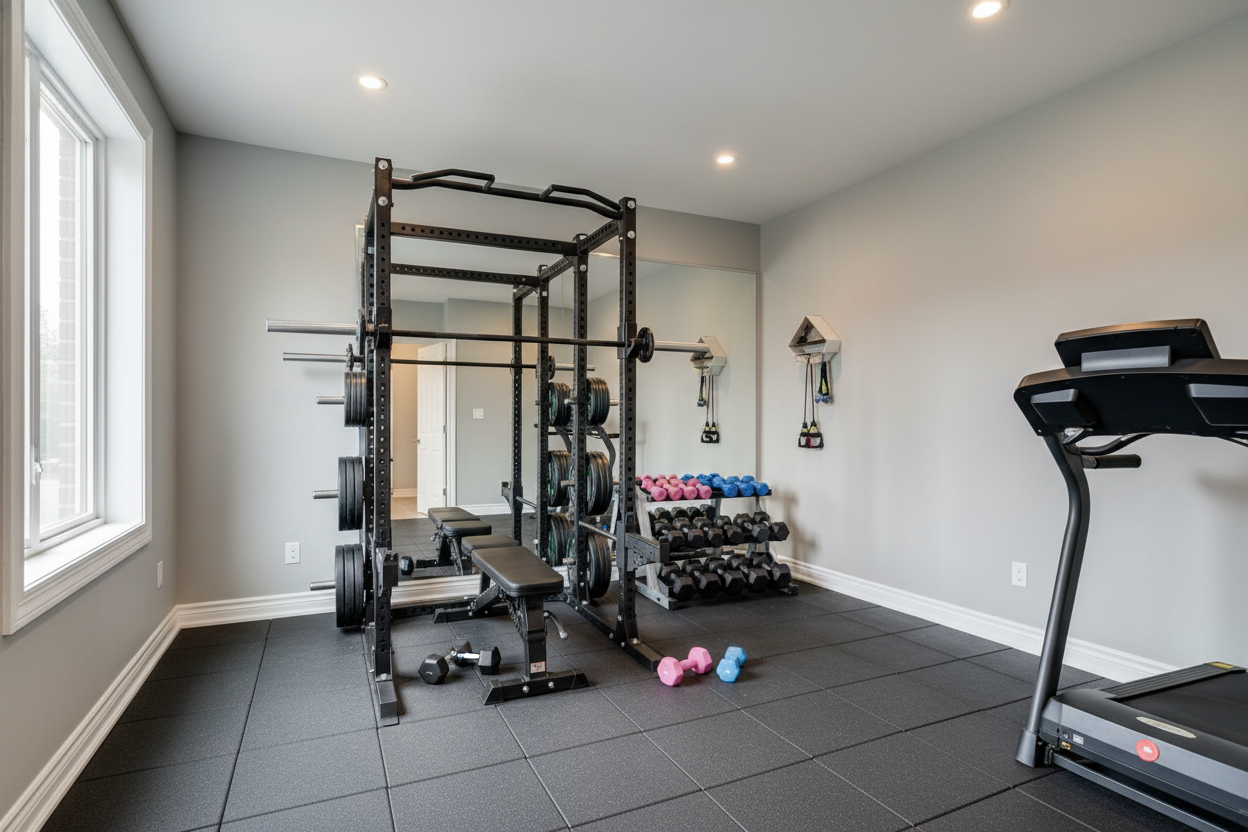
I remember standing in my spare bedroom—a 10x10 cube currently occupied by a mountain of laundry and a 'temporary' guest bed—and realizing I couldn't do another month at the local commercial gym. The commute was killing my motivation, and I was tired of waiting 15 minutes for a squat rack only to find the previous user left it covered in sweat and misplaced ego. I needed my own at home weight training set, but I didn't have a 3-car garage or a basement with 10-foot ceilings. I had a standard bedroom with carpet and neighbors who probably didn't want to hear 315 pounds hitting the floor at 6:00 AM.
Quick Takeaways
- Ditch the 'folding' gear; it’s usually 14-gauge steel garbage that wobbles under a 200-lb load.
- Invest in 3/4-inch horse stall mats to save your subfloor and your security deposit.
- Prioritize adjustable dumbbells over a full rack if you are working in under 100 square feet.
- A high-quality bench is the anchor of a small room gym—don't cheap out on the pivot points.
The All-in-One Compact Gear Trap
When you start searching for a weight lifting equipment set, the algorithm will immediately start feeding you ads for benches that fold into the size of a pizza box and 'all-in-one' machines that look like Transformers. Avoid them. Most of these space-saving miracles are built with thin-walled steel and plastic bushings that start squeaking after three workouts. If a bench is rated for a total capacity of 300 pounds, and you weigh 200 pounds, you only have 100 pounds of 'headroom' before you are testing the structural integrity of a Chinese-made bolt.
I’ve tested those 'as-seen-on-TV' sets. They feel like lifting on a lawn chair. When you're pressing heavy, the last thing you want is the backrest shifting half an inch to the left because the locking pin has too much play. A real setup needs to feel like a tank. You want 11-gauge or 12-gauge steel. In a 10x10 room, you don't have space for a massive footprint, but that doesn't mean you should sacrifice the thickness of the metal. Look for gear that uses a bolt-down or heavy-duty frame design, even if it doesn't fold. You can always stand a high-quality bench on its end to save space, but you can't fix a wobbly frame.
Protecting Your Floors (Before You Buy Iron)
The biggest mistake people make with a bedroom weight set is thinking a thin yoga mat or those interlocking foam tiles from the toy aisle will protect their floors. They won't. If you drop a 50-pound dumbbell on a foam tile, it will slice right through and leave a nice, permanent dent in your hardwood or crack the concrete subfloor underneath your carpet. I learned this the hard way in my first apartment when I tried to deadlift on 'high-density' foam. The landlord wasn't impressed by the crater I left in the bedroom.
If you're building a serious lifting space, you need 3/4-inch recycled rubber horse stall mats. They are heavy, they smell like a tire shop for the first two weeks, and they are virtually indestructible. They distribute the 'point load' of your equipment across the floor joists, which is crucial in a second-story bedroom. If you're worried about the weight of the gear itself, remember that a standard waterbed weighs more than a squat rack and a few hundred pounds of plates. The issue isn't the static weight; it's the impact. Double-up the mats in the area where you plan to keep your dumbbells to ensure you aren't vibrating the entire house every time you finish a set of rows.
The 3 Pieces You Actually Have Space For
In a 10x10 room, you have to be a minimalist. You can't fit a 6-post power rack and a cable crossover. You need to focus on the 'Big 3' of small-space lifting: a pair of adjustable dumbbells, a pull-up bar, and a heavy-duty adjustable weight bench. This trio allows you to hit every major muscle group without needing a dedicated storage closet for a full run of fixed dumbbells. I personally prefer the Ironmaster or PowerBlock style of dumbbells because they don't have the massive length issues that the cheaper dial-style weights have. When you're doing overhead presses in a room with an 8-foot ceiling, every inch of clearance matters.
The bench is your centerpiece. Since you won't have a rack to start, the bench is where you'll do your presses, rows, and split squats. When you're browsing for a sturdy weight bench, look at the footprint dimensions. You want something with a tripod design or a narrow front base so your feet don't kick the metal every time you set up for a bench press. A good bench should weigh at least 60-70 pounds. If it's lighter than that, it’s probably going to slide across your rubber mats when you're trying to do step-ups or incline work. I’ve spent years swapping gear, and I can tell you: a solid bench is the one thing you’ll never regret overspending on.
Should You Hunt for a Used Weight Lift for Sale?
Scouring Facebook Marketplace for a weight lift for sale is a rite of passage for home gym owners. You can find incredible deals on cast iron plates—usually around $0.50 to $0.70 per pound if you’re patient—but be careful with used benches and racks. People tend to leave their gear in damp garages, and rust can hide inside the tubing of a frame. If you see 'bubbling' paint, walk away. That’s internal oxidation that has finally eaten through to the surface.
If you find that your 10x10 room is becoming a dedicated shrine to gains and you’ve moved the bed out entirely, you might consider upgrading. If chest development is your main goal and you’re training solo without a spotter, a weight bench chest press machine with independent arms can be a lifesaver. It gives you the safety of a machine with the feel of a full gym weight set. It’s a bigger footprint than a standard bench, but in a dedicated lifting room, it’s the ultimate luxury for pushing to failure without worrying about dropping a barbell on your throat.
How to Keep Your Room From Becoming a Storage Closet
The death of a home gym is friction. If you have to move a desk, unroll a mat, and drag your dumbbells out from under the bed just to start your first set, you aren't going to do it. You need to layout your room so the gear is always 'live.' I keep my bench permanently centered on the mats with the dumbbells on a small stand nearby. This leaves just enough room on the sides for lateral raises and enough room behind the bench for rows.
Lighting also matters more than you think. Most bedrooms have a single, dim overhead light that makes the space feel like a cave. Throw in some cheap LED shop lights or a floor lamp. It changes the psychology of the room from 'sleeping area' to 'training zone.' When you finally pick a weight set for home that won't gather dust, you’re making a commitment to the space. Treat it like a professional facility, even if it is only 100 square feet. Keep it clean, keep the chalk off the carpet, and keep the weights organized. A cluttered gym leads to a cluttered workout.
Personal Experience: The Wobbly Bench Incident
Early in my lifting career, I bought a $90 'pro' bench from a big-box store. It looked great in the photos. Three weeks in, I was doing incline dumbbell presses with a pair of 60s. As I leaned back, the cheap pop-pin that held the backrest in place sheared off. I ended up flat on my back with 120 pounds of iron hovering dangerously over my face. I didn't get hurt, but I learned a valuable lesson: your life is worth more than the $150 you 'saved' by buying entry-level gear. Since then, I’ve only bought equipment that uses solid steel pins and 11-gauge frames. If it doesn't feel like it could survive a nuclear blast, I don't want it in my house.
FAQ
Is a 10x10 room really big enough for a gym?
Yes, but you have to be smart. You can fit a bench, adjustable dumbbells, and even a slim power rack if you don't mind the room feeling tight. The key is vertical storage—get your plates and bars off the floor and onto the walls or dedicated trees.
Will my neighbors hear me lifting?
If you use 3/4-inch rubber mats and avoid dropping your weights, the noise is minimal. For deadlifts, I recommend using 'silencer pads' or crash pads which are thick foam blocks that soak up almost 90% of the vibration and sound.
Should I get iron or rubber-coated plates?
In a bedroom, go with rubber-coated or urethane. Iron plates 'clank' together, which is a great sound in a garage but annoying for anyone else in the house. Rubber-coated plates are much quieter and won't rust if the room gets humid.
Share:
Why Good At Home Exercise Equipment Rarely Has 5-Star Reviews
Is a Rep Fitness Weight Bench Overkill for a Normal Home Gym?