
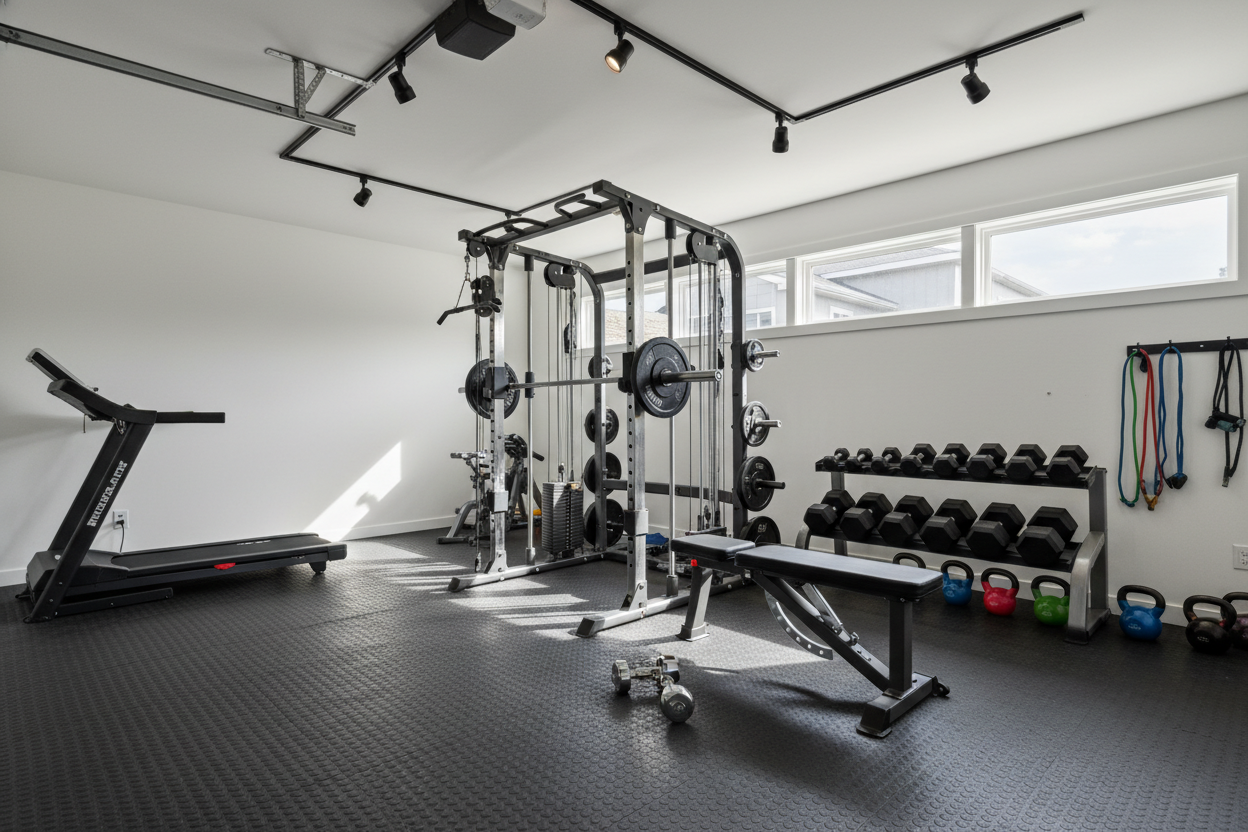
I remember staring at my garage floor, measuring the distance between my lawnmower and a stack of old tires, wondering how I was going to fit a power rack, a cable crossover, and a leg press in a single 10x10 space. Most of us start our home gym journey with a cheap bench and a dream, only to realize that real training requires real iron and a lot of floor space. That is when you start looking at a multifunctional smith machine as a potential savior.
Quick Takeaways
- Space Efficiency: You save roughly 30-40 square feet compared to buying individual units.
- Pulley Ratios: Most units use a 2:1 ratio, meaning 100 lbs feels like 50 lbs, which is better for isolation movements.
- The Compromise: The Smith bar carriage can sometimes limit your range of motion on free-weight barbell squats.
- Build Quality: Look for 11-gauge steel and aluminum pulleys if you want it to last more than two years of heavy use.
The 'Jack of All Trades' Gym Dilemma
The dream is simple: walk into your garage and have everything a commercial gym offers without the $60 monthly membership or the guy hogging the squat rack to do curls. But trying to cram a commercial footprint into a spare bedroom is a recipe for bruised shins. This is why the Smith machine home gym station has become the go-to for the space-starved lifter.
When you buy a hybrid unit, you are making a bet. You are betting that the manufacturer didn't cut corners on the steel thickness just to add a flashy landmine attachment. I have seen units that look like tanks in photos but wobble like a folding chair the second you try to do a 225-lb bench press. You need a base that weighs at least 300 lbs on its own before you even add the plates.
The real value is in the footprint. A standard power rack is 4x4 feet, but once you add a cable tower and a Smith machine, you are looking at three different stations. A multifunctional unit keeps that mess contained to one spot. Just make sure you have enough ceiling height; many of these rigs sit at 82 to 85 inches, which is a tight squeeze for a basement with low pipes.
Do the Cables Actually Feel Smooth?
Nothing kills a workout faster than a cable that hitches or stutters halfway through a rep. Most all-in-one machines use a 2:1 pulley ratio. This is actually a good thing for functional training and accessory work because it gives you more cable travel and finer weight increments. If you are doing lateral raises or face pulls, you want that smooth, consistent tension.
I always check the pulley material first. Nylon pulleys are fine for a year or two, but they eventually develop grooves. If you can find a Smith machine with cable crossover that utilizes aluminum pulleys and aircraft-grade cables, buy it. The difference in 'drag' is night and day. I have used machines where the friction was so bad I felt like I was fighting the machine more than the weight.
Also, look at the guide rods. They should be solid steel, not hollow tubes. If you keep them lubricated with a little silicone spray, a high-end hybrid unit can feel almost as smooth as the $5,000 Life Fitness towers at the local club. If the cables feel 'crunchy' out of the box, send it back.
Balancing Free Weights and the Track
One of the biggest gripes I hear is about the front uprights. A true multifunctional machine should have J-hooks on the front so you can still do free-weight squats and presses. However, some designs are so cramped that the Smith bar carriage gets in your way when you try to rack a traditional barbell. It is a massive pain in the neck if you have to strip the machine just to switch from a Smith press to a free-weight squat.
I usually recommend checking our complete Smith machine workout guide to see how to transition between these movements effectively. The best units have enough depth that the Smith bar can be locked out at the very top or bottom, completely out of the path of your free-weight bar. If the Smith bar is stuck right in your 'sweet spot' for benching, the machine is more of a hindrance than a help.
Don't ignore the knurling on the Smith bar either. Some manufacturers give you a bar as smooth as a PVC pipe, which is dangerous once your hands get sweaty. You want a moderate knurl that grips back without cheese-grating your palms.
Attachments You Will Actually Use (And What Collects Dust)
Manufacturers love to brag about '15-in-1' functionality. Let’s be real: you are going to use the pull-up bar, the dip handles, and maybe the landmine. The rest usually ends up in a corner. A full body multi training station shines when the attachments are easy to swap. If it takes five minutes of unscrewing bolts to put on the dip bars, you will never do dips.
The 'leg developer' attachments on these machines are often the weakest link. They usually use small foam rollers that dig into your shins. If you are serious about leg day, look for a unit that has a dedicated leg press plate attachment for the Smith bar. That is a game-changer for hypertrophy because it allows you to load heavy weight in a stabilized track without needing a separate $1,000 leg press machine.
I personally love a good landmine attachment. It’s the most versatile 5 pounds of steel you can own. T-bar rows, landmine presses, and rotations can all be done in the same footprint. If the machine doesn't include one, it’s a red flag that they aren't thinking about actual lifters.
The Final Verdict: Is It Worth the Floor Space?
If you have a three-car garage and a massive budget, buy individual pieces. There is no substitute for a standalone power rack and a dedicated functional trainer. But for the 90% of us living in the real world with limited space and a wife who doesn't want the house to look like a scrap yard, the multifunctional Smith machine is the smartest move you can make.
It comes down to your training style. If you are a competitive powerlifter trying to squat 700 lbs, you’ll outgrow the weight limits and the tolerances of a hybrid unit quickly. But if you are training for hypertrophy, general strength, or just trying to look better in a t-shirt, these machines provide 95% of the utility for 30% of the cost and space. Just don't cheap out on the pulleys, and make sure the frame is heavy enough to stay still when you're repping out.
FAQ
Is a Smith machine bar lighter than a regular barbell?
Usually, yes. A standard Olympic bar is 45 lbs, but a Smith bar is often counterbalanced or built lighter, sometimes weighing between 15 and 30 lbs. Always check the manufacturer's specs so you know your actual starting weight.
Can I perform pull-ups on these machines?
Almost every multifunctional unit includes a multi-grip pull-up bar. Just make sure the machine is weighted down with plates or bolted to the floor so it doesn't tip forward when you're doing weighted pull-ups or kips.
What is the difference between a 1:1 and 2:1 pulley ratio?
In a 1:1 ratio, 50 lbs of plates feels like 50 lbs of resistance. In a 2:1 ratio, 50 lbs feels like 25 lbs. The 2:1 ratio is preferred for home gyms because it allows for longer cable travel and smoother movement for exercises like cable crossovers.
Share:
The Hidden Reason Your Resistance Training Machine Feels So Awkward
Are Amazon Basic Adjustable Dumbbells Worth the Annoying Spin Locks?