
Confession: I Used to Be a Free Weight Snob
I spent a solid decade looking down my nose at anyone who spent more time on the leg press than in the squat rack. To me, if you weren't balancing a piece of steel on your back or pulling it off the floor, you weren't really training. I fell hard for the garage gym purist trap—the idea that barbells are the only path to 'real' strength and that working out with machines only was a shortcut for people who didn't want to do the hard work.
Then reality hit. A nasty lower back tweak during a heavy deadlift session left me unable to brace properly for weeks. I couldn't squat, I couldn't row, and I certainly couldn't overhead press. I had to swallow my pride and head to a commercial gym to use their selectorized circuit. I expected my gains to wither away. Instead, I got some of the best pumps of my life and actually added size to my quads and lats. It turns out, my muscles didn't care about my ego; they only cared about tension.
Quick Takeaways
- Your central nervous system cannot distinguish between a barbell and a cable stack.
- Machines allow for greater stability, which often leads to better muscular isolation.
- A machine-only routine is safer for training to failure without a spotter.
- Hypertrophy is driven by mechanical tension, not the 'cool factor' of the equipment.
Do Machine Weights Build Muscle as Well as Iron?
The short answer is yes. If you are wondering, 'do machines build muscle?' or 'can machines build muscle?', you need to understand how your body actually grows. Your muscle fibers respond to mechanical tension, metabolic stress, and muscle damage. When you use a chest press machine, your pectorals are contracting against resistance just as they would during a bench press. In many cases, do gym machines build muscle more efficiently? For some, yes, because you aren't wasting energy trying to keep a bar from wobbling.
People often ask: do machine weights build muscle as effectively as free weights? Research consistently shows that for hypertrophy (muscle growth), there is no significant difference. When you build muscle using machines, you are often able to push closer to true muscular failure. Think about it: if you're doing a set of 12 on the squat, your lungs or your lower back might give out before your quads do. On a hack squat or leg press, you can bury your quads into the floor until they literally cannot move another inch. That is the kind of stimulus that forces growth.
Are machines good for building muscle? Absolutely. The lack of a 'balance' requirement means you can focus entirely on the mind-muscle connection. Can weight machines build muscle? Look at any professional bodybuilder from the last 40 years. Most of them transitioned to a machine-heavy or machine-only approach as they got older and more muscular because it allowed them to move massive loads with less joint wear and tear. Do workout machines build muscle? Yes, provided you apply progressive overload and train with enough intensity.
Is It Bad to Only Use Machines at the Gym?
The most common argument against a machine-only approach is the 'stabilizer muscle' myth. The idea is that is it bad to only use machines at the gym because you'll develop 'fake' strength that doesn't translate to the real world. While it's true that machines take the balance out of the equation, the idea that your stabilizers just 'turn off' is an exaggeration. Your core still has to engage to keep your torso upright on a shoulder press machine, even if it's not working as hard as it would on a standing barbell press.
If your goal is to be a competitive powerlifter or a strongman, then yes, only using machines is a bad idea because those sports are specifically about moving an unstable object. But if your goal is to look better in a t-shirt or just stay healthy, machines are a godsend. They allow you to train around injuries and target specific weak points. For example, if your lats are lagging, a chest-supported row machine will hit them much harder than a barbell row where your lower back is the limiting factor. Isolation isn't a dirty word; it's a tool for precision.
How to Program a Brutal Machine-Only Routine
If you want to know how to build muscle with machines, you have to stop treating them like a warm-up. You need to approach a leg press with the same intensity you'd bring to a 405-lb squat. First, focus on your setup. Most people just sit down and start pushing. You need to adjust the seat height, the footplate angle, and the range of motion to match your specific limb lengths. If the machine feels awkward, it won't be effective.
Second, emphasize the eccentric (lowering) phase. Machines provide constant tension, so don't just let the weight stack slam back down. Control it for a 2-3 second count. Third, don't be afraid of high-rep sets and drop sets. Machines make it incredibly easy to strip weight and keep going, which is a fantastic way to accumulate the volume needed for growth. I’ve found that using a dedicated hip thrust machine is infinitely better than the barbell version. You don't have to spend ten minutes rolling a bar over your shins and padding it with a foam roller; you just strap in and destroy your glutes. Can you build muscle on machines? Only if you train with enough grit to make those last few reps look ugly.
The Home Gym Compromise: Bridging the Gap
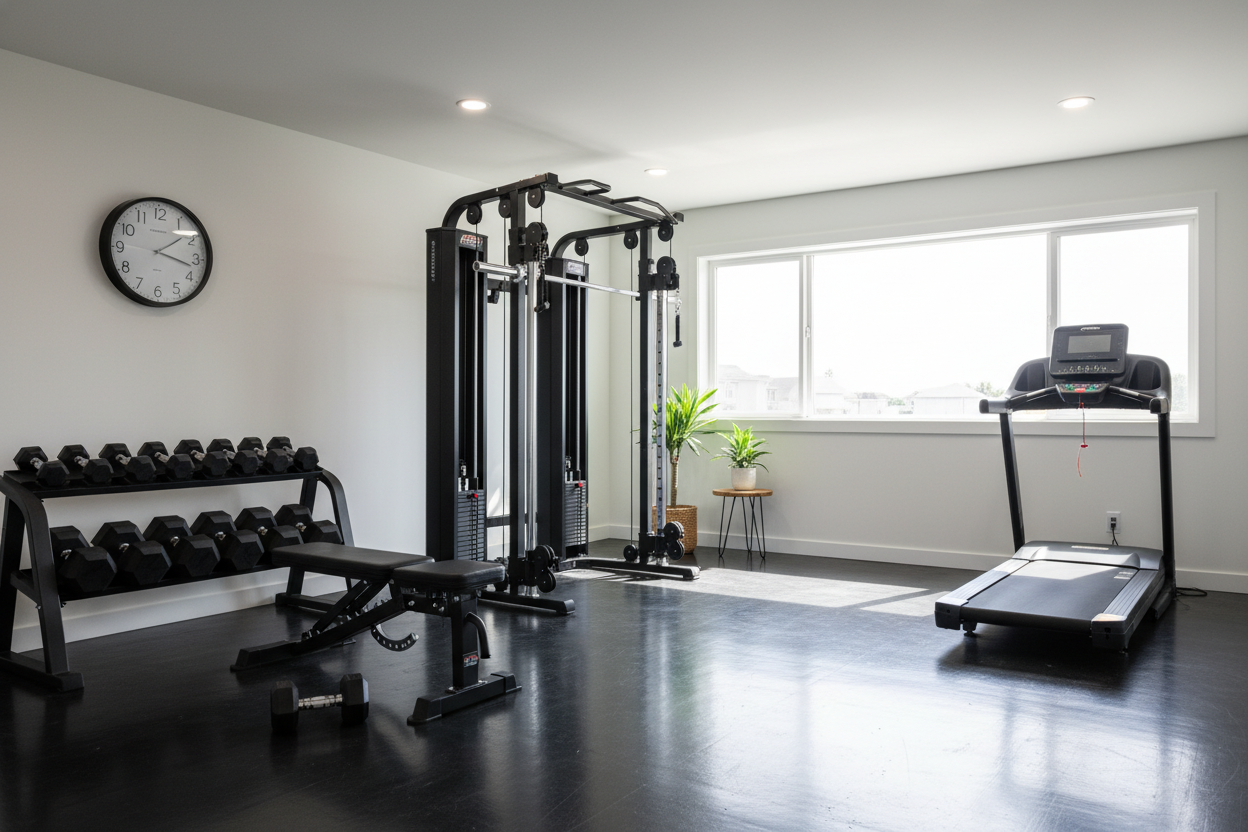
Most of us don't have the space for a 20-piece commercial circuit in our garage. If you're building a home gym, you have to be strategic. You don't need a different machine for every body part, but you do need a few key pieces that offer machine-like stability. This is where hybrid equipment comes in. You start with a sturdy weight bench that can handle at least 600 lbs of total load. If it feels flimsy, you won't feel confident pushing heavy sets.
To get that machine-level isolation in a small footprint, look for multi-functional pieces. A bench with a leg extension station is a massive win for home trainees. It allows you to do heavy compounds with a barbell but then immediately switch to a fixed-path isolation movement for your quads or hamstrings. This 'hybrid' approach gives you the best of both worlds: the raw power of free weights and the targeted fatigue of machines. It’s about being smart with your square footage—why buy a standalone leg extension machine when you can build it into your bench?
The Verdict: Stop Overthinking the Iron
At the end of the day, your body is a biological machine that responds to stress. Whether that stress comes from a piece of iron you're balancing or a weight stack on a pulley system is secondary to the effort you put in. I've seen guys with incredible physiques who have never touched a barbell, and I've seen 'purists' who spend years doing mediocre squats with zero progress. Stop worrying about whether machines are 'functional' enough. If they allow you to train hard, stay injury-free, and enjoy your time in the gym, they are the right tool for the job. Load the stack, pin it to the bottom, and get to work.
Personal Experience: The Leg Press Lesson
I once spent six months avoiding squats entirely because of a knee issue. I felt like a 'fake' lifter every time I sat on the leg press. But during those six months, I focused on deep, controlled reps and actually grew my quads by two inches. My mistake wasn't using the machine; my mistake was the ego that told me I was wasting my time. The downside of machines? They can be boring. You lose that 'warrior' feeling of a heavy bar on your back. But for pure results? The machines didn't let me down.
FAQ
Can you get ripped using only machines?
Getting 'ripped' is mostly a function of your diet and body fat percentage. You can absolutely build the underlying muscle mass using machines, then reveal it through a caloric deficit.
Do machines make you weaker in real life?
No. Strength is specific, but muscle mass is general. If you build 10 lbs of muscle on a chest press machine, your 'real world' pushing power will still increase significantly.
Are machines safer than free weights?
Generally, yes. Machines have a fixed path of motion and often include built-in safety stops, making them ideal for solo lifters who want to train to failure without a spotter.
Share:
Stuck at 30s? Why a 40-Pound Dumbbells Set of 2 Is the Fix
Stop Doing Jumping Jacks: How to Build Home Workouts That Work