
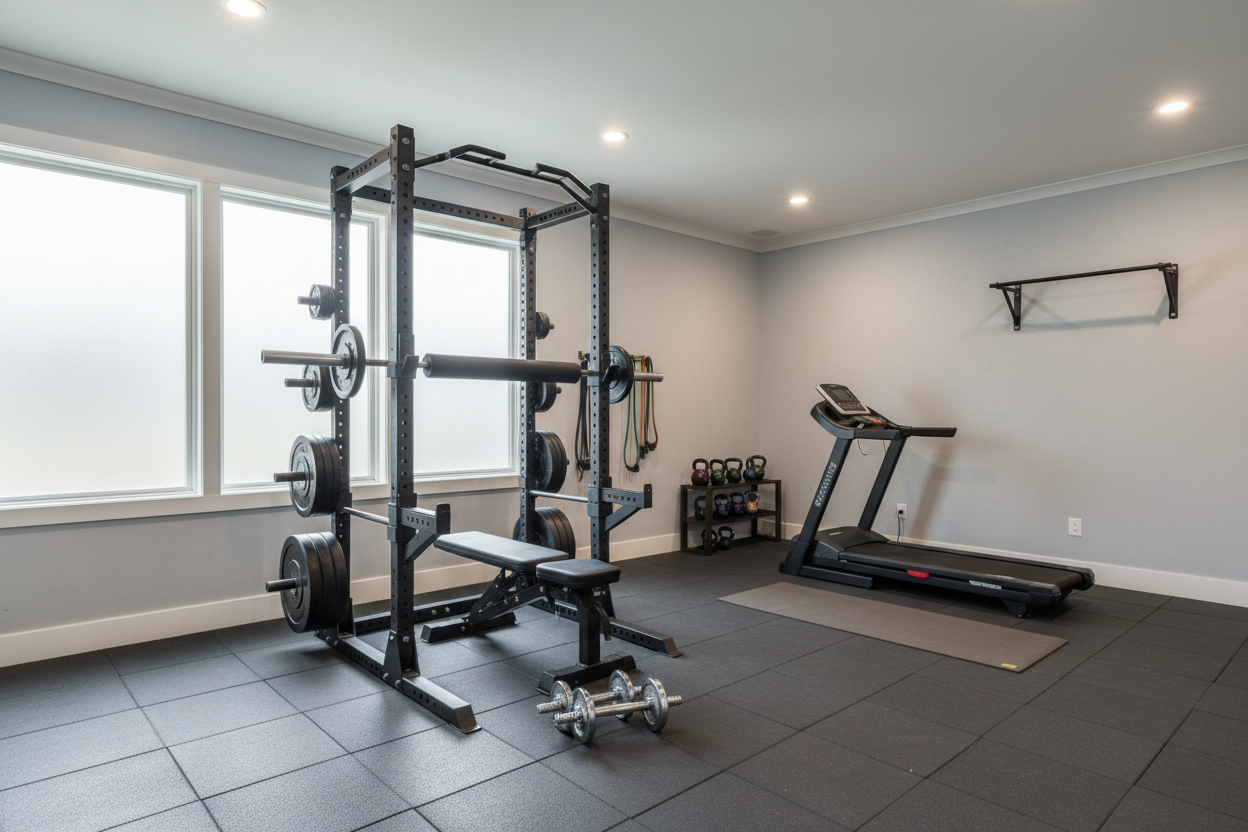
I remember staring at a $1,200 power rack and thinking, 'I have a circular saw and some structural screws, I can build that for fifty bucks.' Three weeks later, I was pinned under a pile of splintered Douglas fir and a 45-pound plate. My attempt at a gym setup at home was a total disaster that nearly cost me a trip to the ER.
We've all been there. You want to build a home gym, you see the prices of 11-gauge steel, and you head to the hardware store instead. But after years of testing, dropping weights, and failing reps, I’ve learned exactly where you can save a buck and where you’re literally risking your life. You can make a home gym that lasts, but you have to be smart about what you outsource to the professionals.
- DIY the Platform: Build your own deadlift platform with plywood and stall mats.
- Buy the Rack: Never trust wood for load-bearing overhead or squat movements.
- Skip Concrete Plates: They crumble, they're bulky, and they'll ruin your barbell.
- Prioritize Steel: Invest in a professional Home Gym setup for your primary lifting station.
The Allure of the Home Depot Hardware Trip
The 'Pinterest gym' is a dangerous drug. You see these homemade gym setup photos with stained wood and pipe fittings, and it looks rugged and rustic. You think you’re being a savvy diy home gyms architect. I spent $200 on 'heavy duty' galvanized pipe for a pull-up bar once. Between the fittings, the floor flanges, and the pipe itself, I was only $30 away from a commercial-grade wall-mounted bar.
The DIY version flexed like a wet noodle every time I did a weighted chin-up. The reality of making a home gym is that hardware store prices have caught up to fitness equipment prices. By the time you buy high-grade lumber and structural bolts, you haven't saved enough to justify the lack of a safety rating. Stop trying to build fitness equipment that requires a welding certificate when you only have a screwdriver.
Please Stop Building Wooden Squat Racks
If you're looking at how to build a homemade gym, the squat rack is usually the first thing people try to hack. Please, don't. Wood is an organic material that rots, splits, and warps. A 2x4 might hold a roof up, but it isn't designed to take the shock-load of a 300-lb barbell being slammed into it when you miss a lift. It's the most critical part of a full home gym set up.
When you buy a professional Home Gym rack, you're paying for 11-gauge or 14-gauge steel and precision-welded joints. These are tested for thousands of pounds of static weight. My wooden rack started swaying after two months of 400-lb squats because the screw holes started to widen. Your safety is worth more than the $200 you save. If you're serious about building your home gym, buy a steel rack with 1-inch or 5/8-inch hardware.
The DIY Projects That Actually Make Sense
I'm not saying you should buy everything. There are plenty of ways to make a gym at home without getting fleeced. You just have to pick the projects where 'overbuilt' is easy to achieve with basic tools and where a failure won't result in a hospital visit.
Deadlift Platforms and Plyo Boxes
This is where you win. A commercial deadlift platform can cost $600. You can build your own gym platform for about $150. All you need is four sheets of 4x8 plywood and two 3/4-inch rubber horse stall mats. Layer the plywood, screw it together, and top the sides with the rubber. It’s 8 feet wide, 8 feet deep, and can handle 600-lb pulls all day. Same goes for plyo boxes; a sheet of 3/4-inch plywood and some wood glue will give you a box that’s just as sturdy as the $150 versions online.
Concrete Weights (With a Major Catch)
If you want to make a home gym with no money, you’ll be tempted to pour concrete plates. They’re fine for a DIY sled or a cable machine counterweight. I’ve used them for weighted carries in the yard where I don't care if they chip. But never put them on a barbell. Concrete is abrasive. It will eat the finish off your bar and the sleeves will never be the same. Plus, they’re so thick that you can barely fit 225 lbs on a standard sleeve. Buy iron for the bar; pour concrete for the 'dirty' work.
Where to Spend the Cash You Just Saved
Since you saved $400 by building your own platform and boxes, put that money into things you can’t weld or saw yourself. Biomechanically complex gear is where the real gains are made. For example, trying to DIY a glute bridge setup usually involves a sketchy pile of mats and a bench that slides. Instead, look at a dedicated Hip Thrust Machine Glute Muscles Building Ht01. The pivot points and footplate angles are engineered to keep tension on the muscle, not your lower back.
If you're still unsure how to allocate your budget when you start home gym training, I've broken down Exactly How Id Build The Best Home Gym Under 2000 Today. It’s the roadmap I wish I had before I wasted a thousand dollars at the lumber yard. Spend your money on the steel that keeps you safe and the machines that provide the best resistance curves.
FAQ
Can I build a home gym in a small apartment?
Yes, but focus on vertical storage. A folding rack and adjustable dumbbells are your best friends. Skip the DIY projects here; you don't have the space for a wood shop anyway, and the noise from sawing plywood will get you evicted.
Are horse stall mats better than gym flooring?
Absolutely. They are 3/4-inch thick, indestructible, and cost about $50 for a 4x6 sheet. Most 'fitness' flooring is overpriced foam that compresses under heavy weight. Just be prepared for the 'new rubber' smell for a few weeks.
Is it cheaper to build or buy a gym?
It's cheaper to buy the essentials (rack, bar, plates) and DIY the accessories (platform, blocks, storage). Trying to DIY the essentials usually costs more in the long run when the wood fails or you have to buy a second bar because the first one rusted in your home gym setting.
Share:
I Calculated the Real Technogym Leg Press Starting Weight
I Sold My Racks and Kept Just a Barbell and Weight Set