
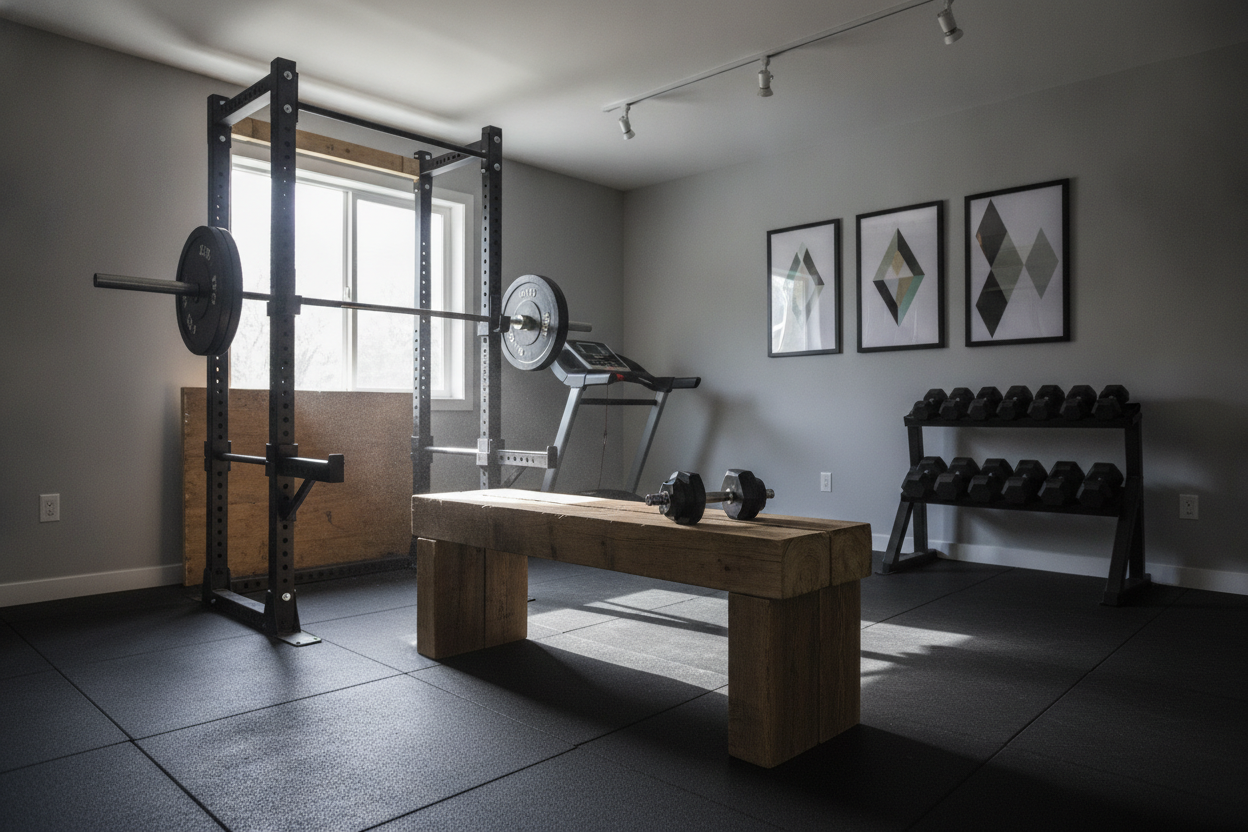
I remember the exact moment I decided to go down the rabbit hole of a weight bench diy project. My local commercial gym had just hiked their membership fees for the third time in two years, and I was tired of waiting twenty minutes for a rack. I figured I could build a workout bench in my garage over a weekend and save a few hundred bucks. I was wrong. I spent hours scrolling through Pinterest looking at diy wooden bench press plans, convinced that my local hardware store held the secrets to a cheap home gym.
- Wood prices have skyrocketed, making 'cheap' DIY builds a thing of the past.
- Lateral stability is nearly impossible to achieve with basic wood bench press plans.
- Upholstery work is a specialized skill; your homemade pad will likely be lumpy and sweat-soaked.
- Safety is non-negotiable when you have 200+ pounds hovering over your face.
The Romantic Trap of the Homemade Gym Bench
There is something undeniably satisfying about the idea of a diy home gym bench. You see those sped-up YouTube videos where a guy in a flannel shirt whips up a gym bench design in thirty minutes using scrap wood and a drill. It makes making your own weight bench look like a weekend hobby that pays for itself. I fell for it. I spent hours looking at wood weight bench plans and convincing myself that I could build a gym bench that would rival a commercial rack. The truth is, those tutorials often skip the part where the bench starts to wobble after three months of heavy use.
When you start searching for how to make bench at home, you're usually trying to solve a budget problem. But the false confidence that comes from a few successful woodworking projects doesn't translate well to the world of heavy iron. A bench isn't a coffee table; it's a piece of structural equipment that needs to support your body weight plus whatever you're pressing. If you're following a weight bench drawing you found on an obscure forum, you're essentially gambling your safety on a stranger's hobbyist engineering.
The True Cost Behind Those Wood Bench Press Plans
Let's talk about the receipts, because this is where the DIY dream usually dies. To build a workout bench that won't snap, you can't just use cheap pine 2x4s. You need pressure-treated 4x4s for the legs and high-quality plywood for the base. Then comes the diy weight bench pad. If you think a piece of carpet padding is enough, your spine will disagree by the second set. You need high-density rebond foam, which isn't cheap, and marine-grade vinyl so the sweat doesn't rot the wood from the inside out.
By the time I bought the heavy-duty lag bolts, the wood, the foam, the adhesive, and the vinyl, I had spent nearly $160. That doesn't even account for the eight hours of labor I put into the build. When you compare that to the cost of simply buying a reliable Weight Bench, the math just doesn't add up. A manufactured steel bench is engineered to handle specific weight capacities—usually 600 to 1,000 lbs—and it comes with a warranty. My homemade weight bench wood frame came with a prayer and a bottle of wood glue.
Why Plywood Can't Handle Heavy Dumbbells
The biomechanics of a bench press made of wood are fundamentally flawed for high-performance lifting. Wood is great for vertical loads, but it struggles with lateral stability. When you're grinding out a final rep and your body starts to shift, that bench needs to stay dead-still. Most diy bench press plans rely on screws and glue to hold the joints together. Under dynamic loads—like when you're racking a heavy bar—those joints experience shear force that can eventually strip the wood fibers.
I noticed the 'death creak' about two months into using my diy home gym bench. Every time I sat down with 50-lb dumbbells, the frame would groan. It lacked the rigidity of a welded weight bench. If you're serious about your training, you shouldn't be worrying about whether your equipment is going to split mid-set. A diy bench press seat that wobbles isn't just annoying; it ruins your force production because your CNS is too busy trying to keep you from falling over to focus on the lift.
The Structural Nightmare of DIY Incline Mechanisms
If building a flat bench is risky, trying to figure out how to make adjustable bench press angles is a nightmare. I've seen people try to build a wooden incline bench using door hinges or notched wood blocks. It is incredibly dangerous. A diy folding weight bench has so many failure points that it’s essentially a giant mousetrap for your fingers and your back. One slip of a wooden notch and you have a hundred pounds of steel crashing down on your chest.
Steel benches use laser-cut pop pins and reinforced pivot points for a reason. Trusting your spine to a homemade wooden hinge is foolish when you can get a properly engineered Adjustable Weight Bench Owb01. These units are tested for thousands of cycles. You can't replicate that kind of safety in a garage with a miter saw. Unless you know how to make a weight bench out of steel and have a professional-grade welder, you're better off sticking to factory-made gear for anything that isn't flat.
When to Build and When to Just Buy Steel
I’m not saying you should never pick up a tool. If you want to build a diy exercise table for light stretching or a diy homemade sit up bench for bodyweight core work, go for it. Those are low-risk projects where wood is a perfectly fine material. But for the big three lifts? You need steel. I eventually retired my wooden bench to the backyard to serve as a plant stand. It was a humbling lesson in why some things are worth paying for.
Before you commit to a diy workout bench with storage or some elaborate bench press bench diy setup, ask yourself if you're doing it to save money or for the 'craft.' If it's the former, you're better off checking the used market or buying a budget steel frame. You might even find yourself wondering, Is a Rep Fitness Weight Bench Overkill for a Normal Home Gym? For most people, the answer is no—the peace of mind is worth every penny. Build your own weight bench if you must, but don't be surprised when you end up buying a steel one six months later.
How much does it cost to build a DIY weight bench?
Depending on lumber prices, a sturdy DIY bench usually costs between $100 and $180 once you factor in quality wood, high-density foam, vinyl, and heavy-duty hardware. This is often more expensive than entry-level steel benches.
Is a wooden weight bench safe?
A wooden bench can be safe for light weights, but it lacks the lateral stability and shear strength of steel. Over time, wood joints can loosen or strip, leading to a catastrophic failure under heavy loads.
Can I make an adjustable bench out of wood?
It is not recommended. The adjustment mechanisms in a wooden incline bench are difficult to secure and prone to slipping. For adjustable benches, a welded steel frame is the only safe option.
What foam should I use for a DIY bench pad?
You should use high-density rebond foam (at least 2 inches thick). Standard craft foam or carpet padding will bottom out immediately, providing no support for your back during heavy lifts.
Share:
I Wasted $1,000 on Home Gym Equipment for Beginners. Learn from Me.
I Upgraded to a 5 75 Dumbbell Set (Here Is What Surprised Me)