
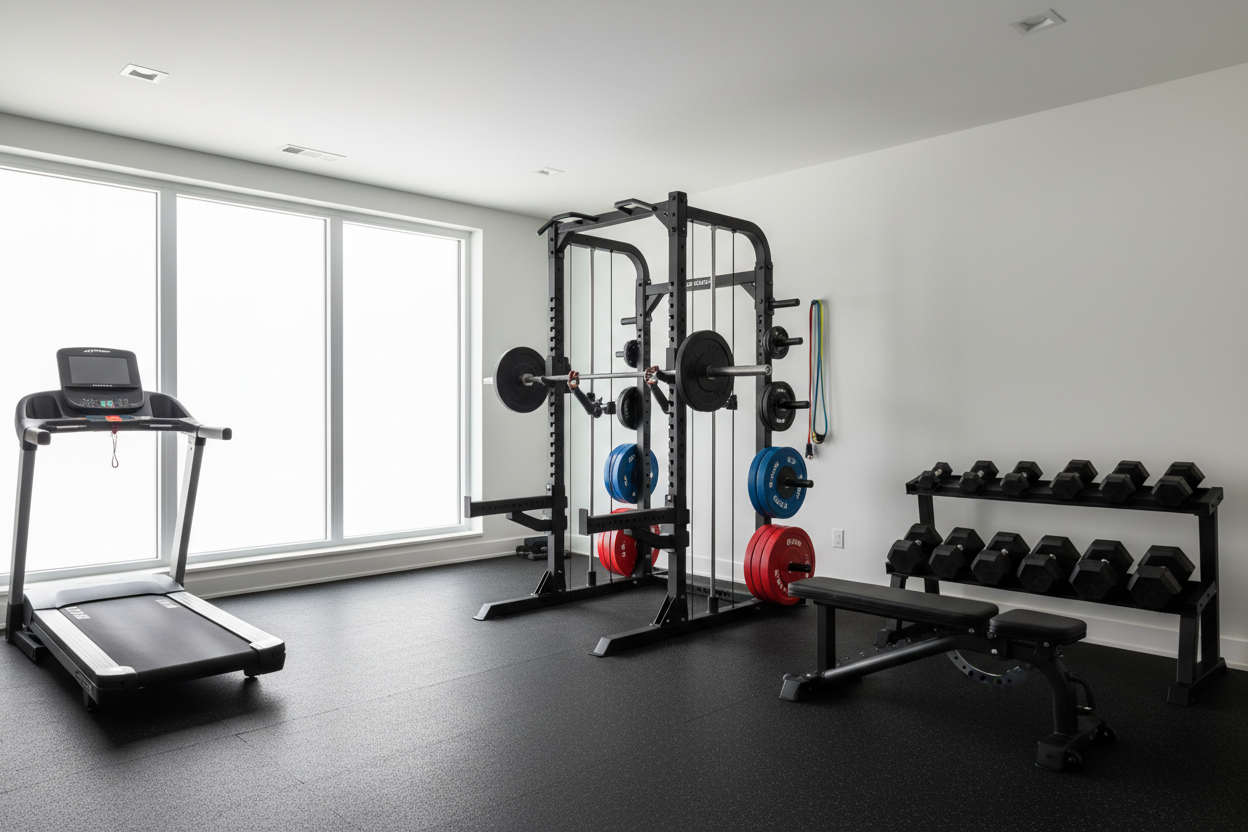
I remember the first time I loaded four plates on a Smith machine incline press. I felt like an absolute monster until I tried to replicate that number on a standard barbell and nearly pinned myself to the bench. It was a humbling reality check. The truth is, your ego is often being fed by a system of pulleys and counterweights designed to keep you safe, not to give you an accurate read on your raw strength. If you have ever wondered how much weight does a smith machine take off your actual lift, you are not alone—it is one of the most debated topics in the locker room.
Quick Takeaways
- Most commercial Smith machine bars have an effective starting weight of 15 to 25 pounds.
- Counterweights inside the frame are responsible for offsetting the actual 45-to-55-pound steel bar.
- Friction from the guide rods can actually add a small amount of resistance, especially on cheaper units.
- Consistency matters more than the conversion; log what you put on the bar and move on.
Why Your Fixed-Path Plate Math is Probably Wrong
When you unrack a standard Olympic barbell, you are holding exactly 45 pounds of steel. There is no magic involved. But the moment you step into a Smith machine, you are interacting with a complex mechanical system. The bar is attached to a carriage that slides on steel guide rods using linear bearings. In many cases, those carriages are also tethered to cables and hidden weights tucked inside the uprights.
This means the bar you are pressing isn't just a piece of steel—it is part of a machine. Because the path is fixed, you don't have to use your stabilizer muscles to keep the bar from drifting forward or backward. This mechanical assistance is the first reason your numbers feel inflated. You aren't just lifting the weight; the machine is doing the balancing for you, which significantly reduces the internal 'cost' of the lift.
Furthermore, the physics of a sliding carriage introduces friction. Depending on how well-lubricated the rods are, that friction can actually make the weight feel heavier during the concentric (pushing) phase and lighter during the eccentric (lowering) phase. It is a mechanical illusion that makes standard plate math almost impossible to translate to free weights with 100% accuracy.
The Counterweight Secret: How Much Weight Do Smith Machines Take Off?
The biggest factor in the 'missing weight' mystery is the counterbalance system. Most high-end modern Smith machine models use a pulley system with a weight hidden inside the frame that pulls upward on the bar. This is a safety feature. It ensures that if a user loses their grip, the bar doesn't come crashing down with the full force of gravity. It also makes the machine more accessible for rehab or accessory work where a 45-pound starting weight might be too heavy.
So, how much weight do smith machines take off exactly? In a typical commercial gym setting, the counterbalance is usually set to reduce the bar's effective weight to about 15 or 20 pounds. I have tested some high-end rigs where the bar felt like it weighed practically nothing—maybe 5 pounds at most. This is why you can smash a new PR on the Smith machine but struggle with the same weight on a power rack.
If you are trying to figure out how much does a smith machine take off your total load, look for a sticker on the frame. Most manufacturers will list the 'starting weight' or 'effective bar weight.' If it says 20 lbs, and you have two 45-lb plates on, you are lifting 110 lbs, not 135 lbs. It is a significant difference that can lead to some very confusing entries in your training log if you aren't paying attention.
Commercial Rigs vs. Garage Gym Setups
The discrepancy gets even wider when you compare a $5,000 Life Fitness rig to a budget unit you found on Amazon. When people ask how much does smith machine take off, the answer usually depends on the price tag. Cheap home units often lack a counterbalance system entirely. In those cases, you are lifting the full weight of the bar plus the weight of the steel carriage, which can actually be heavier than a standard 45-pound barbell.
When researching how much a Smith machine costs, you'll notice that the premium is often paid for the smoothness of the bearings and the quality of that counterbalance. A high-end home unit like the All In One Smith Machine With Cable Crossover S1 V4 is designed to mimic that commercial feel, providing a consistent, smooth glide that makes the starting weight feel predictable and manageable.
In contrast, a budget rack with plastic bushings instead of linear bearings will feel 'sticky.' That stickiness adds 'phantom weight' through friction. You might feel like you are lifting 50 pounds, but 10 of those pounds are just you fighting the poor construction of the machine. If you are serious about tracking progress, the consistency of a counterbalanced system is worth the extra investment.
So, How Many Pounds Does a Smith Machine Take Off Exactly?
If you want the hard numbers for your spreadsheet, here is the general rule of thumb: how many pounds does a smith machine take off is usually between 20 and 30 pounds. On a standard 45-pound bar, a well-calibrated counterbalance will leave you with an effective starting weight of about 15 to 25 pounds. This is the industry standard for most commercial gyms like Gold's or Planet Fitness.
However, you also have to account for the angle. Many Smith machines are set at a 7-to-10-degree slant. This isn't just for ergonomics; it changes the vertical force required to move the bar. Because you aren't pushing perfectly vertically, a small percentage of the weight is supported by the guide rods themselves. It is basic trigonometry—the steeper the angle, the 'lighter' the weight feels compared to a vertical path.
Don't forget the 'friction tax' either. Even the smoothest bearings have a coefficient of friction. In my experience, friction usually adds about 3-5% to the perceived weight on the way up. So, while the counterbalance takes weight off, the friction adds a tiny bit back. It’s a wash in most cases, but it’s why the Smith machine will never feel exactly like a free-weight barbell.
My Personal Experience: The Chin-Check Incident
I learned about Smith machine counterweights the hard way. I was testing a new commercial-grade unit for a local studio. I was used to my old, un-counterbalanced garage rack where the bar was a beastly 55 pounds of solid steel and friction. I walked up to this new, shiny machine, unhooked the bar with one hand to check the height, and because it was counterbalanced to 15 pounds, it practically flew upward.
I nearly clocked myself in the jaw because I expected a heavy resistance that simply wasn't there. It taught me two things: always test the 'empty' bar weight before you start loading plates, and never assume two machines are built the same. Now, whenever I train at a new spot, I do a few 'air reps' just to see where the tension kicks in. It saves my ego and my face.
Stop Stressing and Just Log the Plates
At the end of the day, trying to calculate the exact conversion to a free-weight bench press is a waste of mental energy. The Smith machine is its own tool with its own benefits—mainly the ability to train to absolute failure without a spotter. If you put two plates on the machine this week and three plates next month, you got stronger. That is the only metric that actually matters for hypertrophy.
Treat the fixed-path rig as a secondary movement. Use it for high-volume chest presses, behind-the-neck presses, or Bulgarian split squats where stability is the bottleneck. Log the plates, note the machine you used, and focus on progressive overload. Whether the bar weighs 15 pounds or 45 pounds doesn't change the fact that more plates equals more growth.
FAQ
Do all Smith machines have counterweights?
No. Most commercial-grade machines do, but many entry-level home gym models are 'counter-weightless,' meaning you are lifting the actual weight of the bar and the sliding carriage.
How can I find out the starting weight of my machine?
Check the frame for a manufacturer's label. If it isn't there, you can use a luggage scale or a bathroom scale to get a rough estimate by weighing the bar at its lowest point.
Is 225 lbs on a Smith machine the same as 225 lbs on a barbell?
Usually no. Because of the counterbalance and the lack of stabilizer muscle involvement, 225 lbs on a Smith machine is generally 'easier' and won't translate directly to a 225-lb free-weight bench press.
Share:
Exactly What Does Smith Machine Squat Work? (And What Does It Ignore?)
I Sold 80% of My Gym Equipment in Home Storage. Here's What I Kept.