
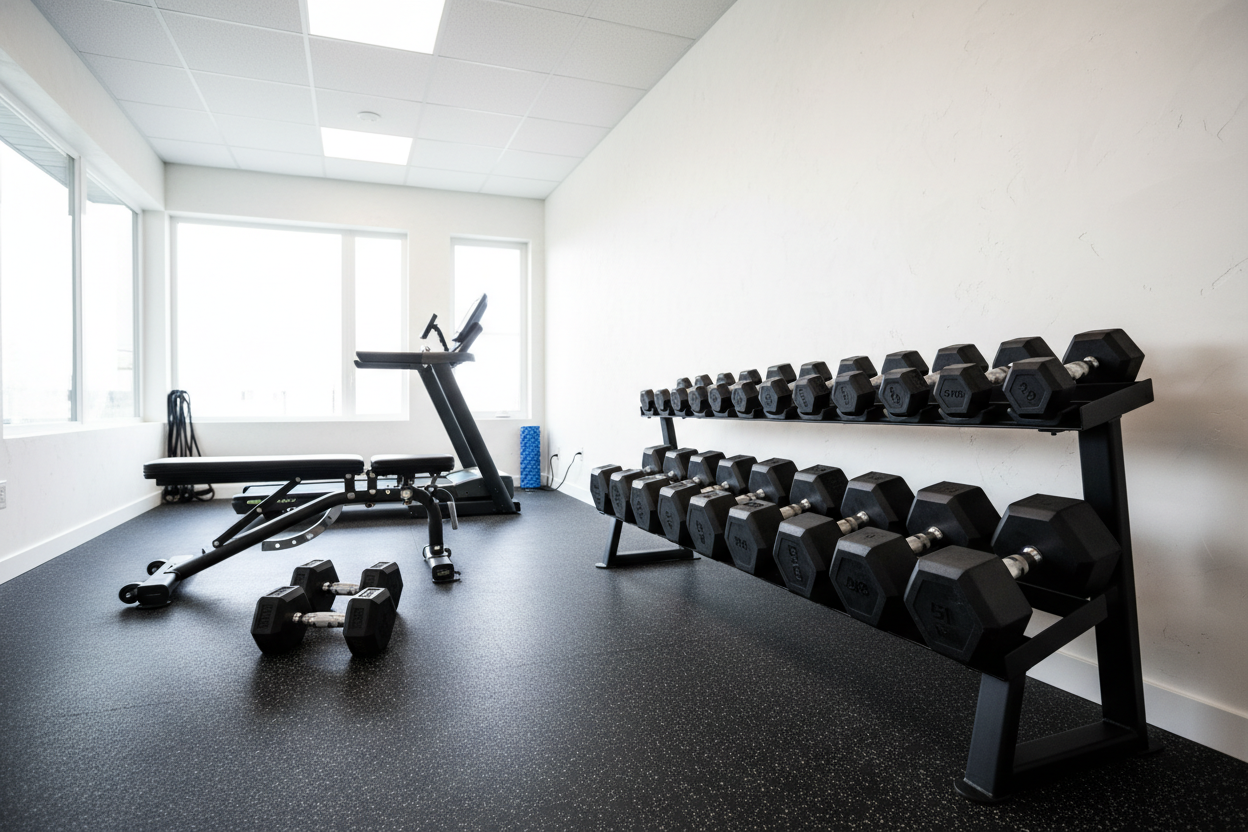
I remember the day my 'budget' gym setup finally broke me. I was scouring Facebook Marketplace for a pair of 35s to bridge the gap between my 30s and 45s, only to realize I’d already spent enough on individual pairs to buy a brand new dumbbells full set twice over. It is a classic trap: you think you are saving money by only buying what you need 'right now,' but you are actually paying a convenience tax that adds up to a mortgage payment.
Quick Takeaways
- Piecemeal buying often costs 30% more due to individual shipping and retail markups.
- Mismatched brands lead to inconsistent handle diameters and knurling.
- 5-pound increments are non-negotiable for progress on isolation lifts.
- Fixed racks win on durability, while adjustables win on footprint.
The Trap of Buying Just One More Pair
Buying single pairs of dumbbells is a slow financial bleed. Every time you hit 'order' on a single pair, you are getting crushed by shipping fees. Shipping 50 lbs of iron is not cheap, and retailers bake those costs into the individual price tag. By the time you have pieced together a 5-50lb run over two years, you have likely spent hundreds more than if you had just bought the rack on day one.
Then there is the 'Frankenstein' gym effect. One pair has a 28mm handle, the next is 32mm, and the knurling on your 40s feels like a cheese grater while the 45s are smooth as glass. This is not just about aesthetics; it ruins your grip consistency. When you are pushing for a PR, the last thing you want is your left hand feeling a different texture than your right because you bought them six months apart from different factories.
The Exact Moment You Should Buy a Dumbbells Full Set
There is a specific point where 'just one more pair' stops working. If your training has evolved into hypertrophy work or metabolic conditioning, you need speed. Trying to run a drop set on lateral raises when you have to walk across the garage to grab a different brand of weight is a flow-killer. Your heart rate drops, your pump fades, and the workout loses its edge.
Once you start shopping for a complete rack, you realize the value isn't just in the iron—it is in the efficiency. If your training involves EMOMs or rapid-fire supersets, you cannot afford to be hunting for the other 25-lb dumbbell that rolled under your lawnmower. A full set of dumbbells organized on a rack turns a chaotic garage into a high-performance training space.
Why a full set of dumbbells fixes those nasty weight jumps
Most lifters who buy piecemeal skip the 'boring' weights to save cash. They go 10, 20, 30, 40. But skipping crucial 5-pound increments is the fastest way to stall your progress on isolation moves. You would never add 20 lbs to a barbell curl overnight, yet people expect to jump from 20lb to 30lb dumbbells without hitting a wall. That is a 50% increase in load. A complete set gives you the 12.5, 17.5, and 22.5-lb increments that keep your progress linear and your joints happy.
The Great Debate: Dial-Up Weights vs. A Fixed Iron Rack
If you are working out in a 6x8 ft corner of a spare bedroom, space-saving adjustable blocks are the obvious choice. They pack a whole rack's worth of weight into a tiny footprint. For many, the ability to tuck 50 lbs under a bed is the only way a home gym even happens. They are great for slow, controlled movements where you aren't tossing the weights around.
However, if you have the floor space in a garage, nothing beats a classic rubber hex layout. You can drop them, they don't rattle, and there are no plastic pins or dials to snap. I have seen too many adjustable mechanisms fail after a heavy set of shoulder presses. A fixed rack is bulletproof. It is the kind of gear that survives a move, a flood, and a decade of abuse without missing a beat.
When Should You Stop Buying Hand Weights Entirely?
Eventually, you will hit a ceiling. For most of us, that is when the 100-lb dumbbells start feeling light for Kroc rows or goblet squats. At that point, buying 110s or 120s becomes a game of diminishing returns. That is the signal that you should be transitioning to heavy barbell training.
Once you are pulling 400 lbs off the floor, a 110-lb dumbbell is just an expensive, space-consuming paperweight. Use that budget for a high-quality Olympic bar and some bumper plates. Use the dumbbells for what they are best at: isolation, unilateral work, and high-volume finishers.
Personal Experience: The 35-lb Gap
I spent three years building a 'franken-set' of random weights. My 35s were actually 33.8 lbs when I finally put them on a scale, and the handles were so thick I couldn't get a decent wrap on them. The day I finally upgraded to a matching 5-75lb set was the day my training actually became consistent. I wasn't overthinking which pair 'felt' heavier that day; I just grabbed the next one on the rack and worked. The mental friction it removed was worth every penny of the shipping cost.
FAQ
Is a full set worth it for beginners?
Not yet. Buy two or three versatile pairs (like 15s, 25s, and 40s) first. Once you have proven to yourself that you will actually use them three days a week for six months, then invest in the full run.
Rubber hex or urethane?
Rubber hex is the best value for 90% of home gym owners. Urethane is beautiful and lasts forever in a commercial setting, but it usually costs twice as much. Save that money for a better bench.
Do I really need a rack?
Yes. Weights on the floor are a trip hazard and they make your gym look like a junk pile. A two-tier rack keeps the weights at a safe height for your lower back when you are picking up the heavy stuff.
Share:
The Real Problem With Every Seated Exercise Machine I've Tried
I Quit LA Fitness: The 4 Machines Gym Vets Actually Miss