
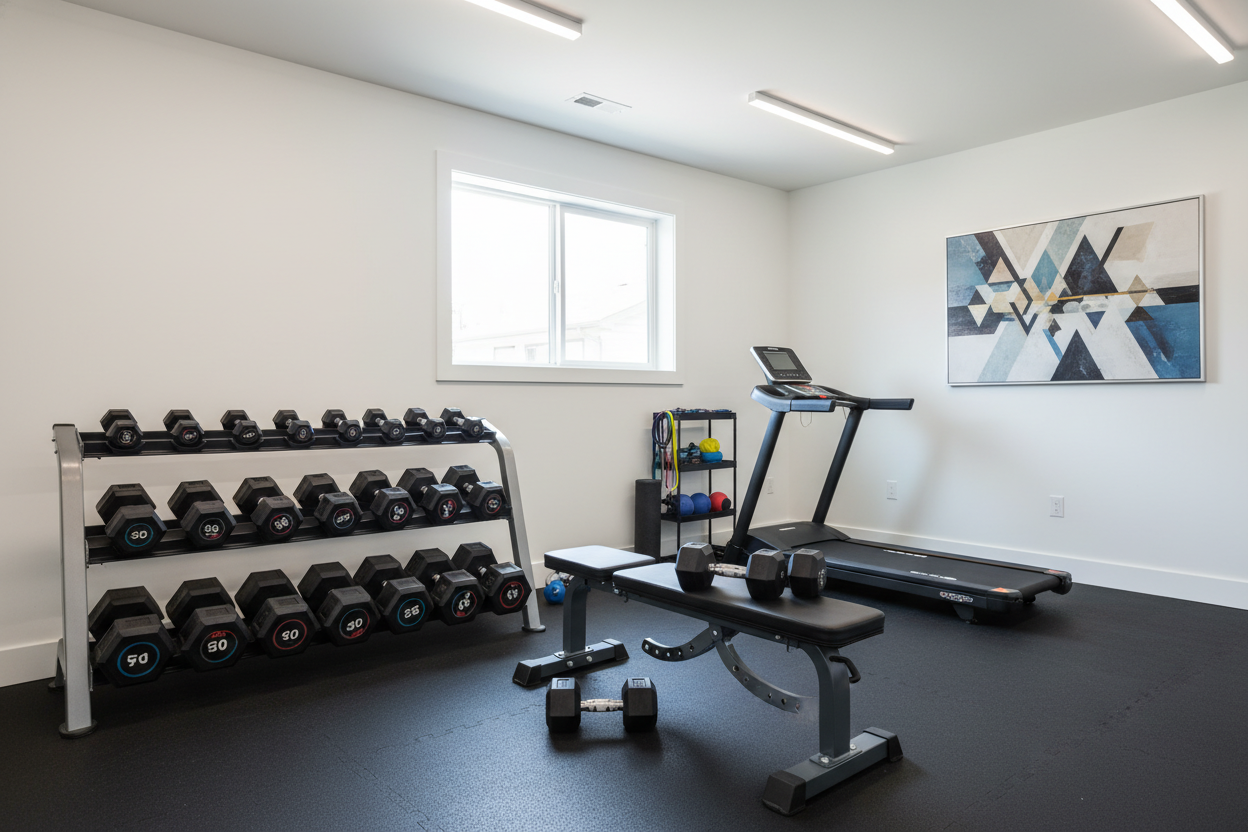
I remember looking at my rack of 5-25s and feeling like a beast until I tried to hit a heavy set of chest presses. I eventually bought a massive pair of 90-lb adjustables thinking I would grow into them, but they spent a year gathering dust while I struggled to bridge the gap. Adding a dedicated dumbbell set 30-50 lbs was the moment my home training actually started to produce results.
- The 30-50 lb range is the Goldilocks zone for 8-12 rep hypertrophy.
- Fixed hex weights are better for fast transitions and resting on your knees during presses.
- A 5-pair rack (30, 35, 40, 45, 50) takes up less than 4 square feet of floor space.
- You will use these weights for roughly 70% of your accessory and volume movements.
The 'No Man's Land' of Home Gym Weights
Most of us start with a 5-25 lb rack from a big box store. It is affordable and it gets the job done for lateral raises and curls. But eventually, you hit a wall where the 25s feel like air, but the 80s you bought on sale feel like trying to bench press a small refrigerator.
This 30-50 pound dumbbell set range is the bridge. It is often neglected because it isn't heavy enough for ego lifting, but it is too heavy for beginners. In reality, this is where you stop just moving and start actually building muscle.
If you jump from 25s straight to 60s, your form will trash itself. You need those 5-pound increments to keep the progressive overload linear without snapping a rotator cuff.
Why the 30 to 50 Lb Range Is Your True Hypertrophy Zone
Muscle growth happens when you can control a weight through a full range of motion for enough volume. For the average lifter, a 30 50 lb dumbbell set is the sweet spot for high-rep incline presses, deep goblet squats, and single-arm rows.
I have found that why a 50 lbs dumbbell set covers 90% of lifts for most people. Unless you are a competitive powerlifter, 50s are plenty for punishing Bulgarian split squats or high-volume shoulder work.
When you have 35s and 45s available, you don't have to guess. Moving from 30s to 35s on a dumbbell flye is a massive win for your chest development that you just can't replicate by jumping ten pounds at a time.
Fixed Rubber Hex vs. Adjustables for Mid-Range Lifts
I own a pair of adjustable dumbbells, and they have their place. But for the 30-50 lb range, they are clunky. When you are setting up for a heavy flat press, you want to be able to rest the weight on your thighs comfortably.
A dedicated rubber hex dumbbell set has a flat, stable face. Dial-based adjustables often have plastic pins or sharp edges that dig into your quads. It is a small detail until you are trying to kick up 50s for a max set.
Fixed weights also allow for faster supersets. You aren't fumbling with a dial while your heart rate is 160. You just drop the 40s and grab the 30s. That speed keeps the intensity high, which is the whole point of hypertrophy training.
How Much Space Does a 5-Pair Mid-Weight Rack Actually Take?
Space is the biggest lie told in the home gym world. You don't need a massive commercial rack for dumbbells 30 50. A standard two-tier rack for these five pairs is usually about 32 inches wide and 20 inches deep.
That is a smaller footprint than a standard treadmill or even a stationary bike. If you can fit a single piece of cardio equipment, you can fit this dumbbell set 30 50. I keep mine tucked in a corner next to my power rack, and it has never felt crowded.
My Go-To Garage Routine With Just the 30s Through 50s
If I am short on time, I grab my 30-50 lb rack and run this circuit. It hits everything and leaves me wrecked in thirty minutes.
- Bulgarian Split Squats: 3 sets of 10 (45s)
- Single-arm Rows: 4 sets of 12 (50s)
- Dumbbell Floor Press: 3 sets of 15 (40s or 45s)
- Goblet Squats: 3 sets of 20 (50s)
- Lateral Raises: 3 sets to failure (30s)
I once bought a bargain set of 40s that had handles so thin they felt like holding a pencil. My grip failed before my chest did. Don't cheap out on the handle diameter; look for that 28mm to 32mm sweet spot.
Investing in reliable dumbbells in this specific weight bracket changed my consistency. I stopped skipping accessory work because the weights were finally the right size for the movement.
Is 50 lbs enough for leg day?
For most lifters, yes. If you do single-leg work like lunges or split squats, holding a pair of 50s is a 100-lb load on one leg. That will build massive quads without crushing your spine.
Should I get 30-50 lb sets in 5-lb or 10-lb increments?
Get the 5-lb increments. A 30-50 lb dumbbell set that skips the 35s and 45s is a trap. That 10-lb jump is way too big for upper body movements like overhead presses.
Why rubber hex instead of iron?
Rubber hex is quieter and won't chip the paint on your rack or scratch your floor. Plus, the hex shape means they won't roll away when you set them down between sets.
Share:
Why I Finally Made Room for a Slide Squat Machine
Joint Pain? The Real Benefits of Smith Machine Training