
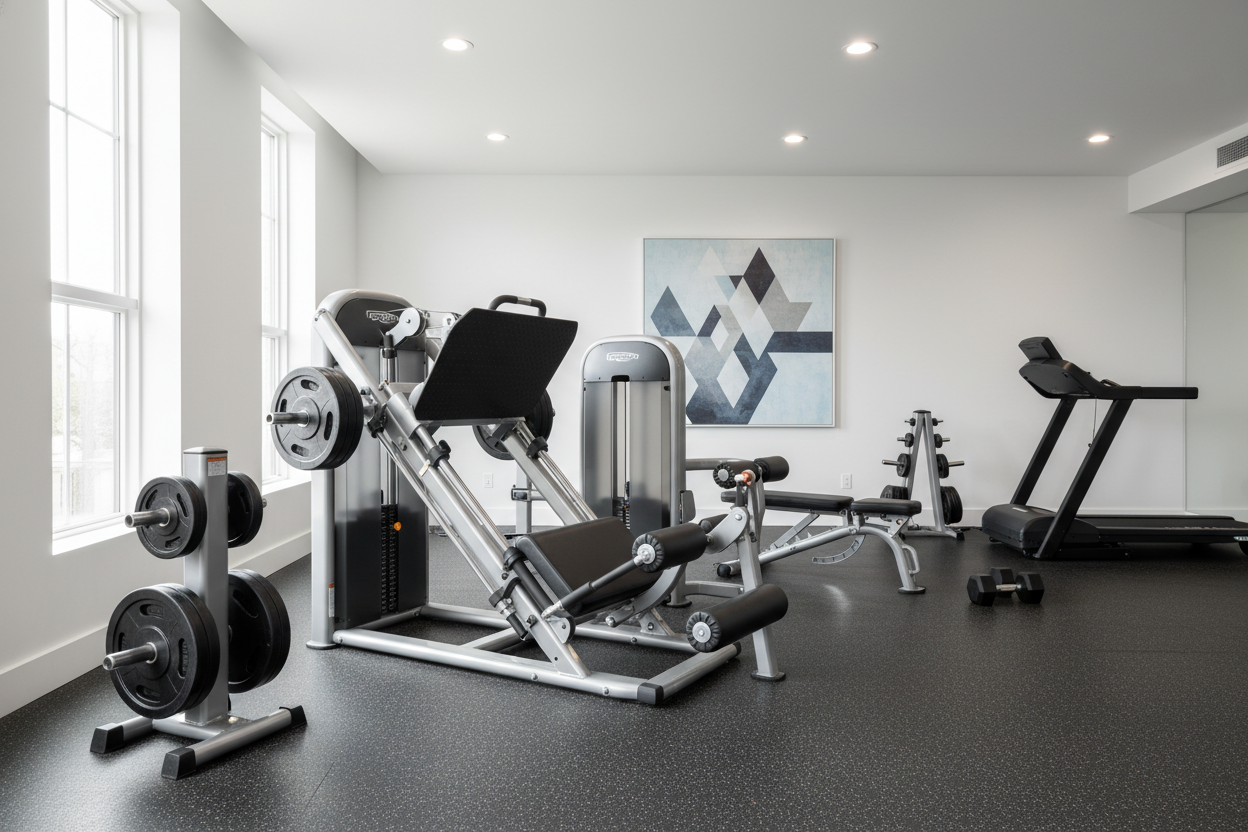
I remember the day I finally cancelled my commercial gym membership. I felt like a free man, ready to conquer the world with a power rack and a barbell in my garage. I told myself that machines were for people who didn't want to work hard. Then came the first real leg day. Halfway through my third set of high-rep squats, my lower back was screaming, my lungs were on fire, but my quads were barely awake. I realized that lower body machines at the gym provided something my barbell couldn't: pure, unadulterated stability.
- Stability equals more muscle fiber recruitment in the target area without balance being the bottleneck.
- Isolation machines allow you to train to failure without fearing a crushed spine or a pinned neck.
- Commercial hack squats and leg presses are the gold standard for quad hypertrophy for a reason.
- You can replicate these movements at home with the right attachments and creative setups.
The Brutal Reality of Garage Leg Days
Barbells are great for building general strength, but they are systemic fatigue monsters. When you're squatting heavy, your core, upper back, and nervous system often give out long before your legs do. It's a frustrating ceiling to hit when your goal is bigger wheels, not just a higher powerlifting total. I spent months trying to compensate with more volume, but all I got was a cranky SI joint and a plateau that wouldn't budge.
In those first few months of training alone, I Missed the Weight Machines at the Gym more than I cared to admit. I missed being able to sit down, pin a heavy weight, and just grind until my legs turned to jelly. I had to stop being a barbell purist and start looking at the biomechanics of what I was missing. Isolation isn't a dirty word; it's a tool for growth that most home lifters ignore until their progress stalls out.
If I Still Commuted: What Machines to Use at the Gym for Legs
If I were still paying a monthly fee and fighting for a parking spot, I’d spend 80% of my time on three specific leg weight machines at the gym. First is the 45-degree Leg Press. It lets you load hundreds of pounds and move them through a massive range of motion without the shearing forces on your spine that a back squat creates. You can manipulate your foot placement—high, low, wide, or narrow—to hit different parts of the quad or glutes in a way a barbell simply won't allow.
Next is the Hack Squat. This is arguably the best leg muscle exercise machine ever invented. Because your back is fixed against a pad at an angle, you can drive your knees forward and get deep into the kind of knee flexion that builds that elusive 'teardrop' quad muscle. It removes the need for core stabilization, meaning 100% of your effort goes into pushing the platform.
Finally, the Seated Leg Curl. Unlike the lying version, the seated position keeps your hips flexed, which puts the hamstrings in a stretched state. This leads to better 'stretch-mediated hypertrophy.' If you're wondering what machines to use at the gym for legs to get that thick, 3D look from the side, the seated leg curl is non-negotiable. It’s the one machine I still haven't found a perfect 1:1 replacement for in a standard rack setup.
Anatomy of a Good Leg Muscle Exercise Machine
Not all machines are built the same. A cheap unit feels jerky because the pulleys are plastic and the bearings are non-existent. A high-quality commercial unit uses a cam system—that's the oval-shaped wheel the cable or belt wraps around. A well-designed cam changes the resistance profile to match your muscle's natural strength curve, making the weight feel heavier where you're strongest and slightly lighter where you're weakest. This keeps constant tension on the muscle throughout the entire rep.
You also want to look for adjustable footplates and seat angles. If a machine forces you into a specific path that makes your knees click or your hips pinch, it’s a liability. Proper back support should feel firm and contoured, not like you're leaning against a piece of plywood covered in thin vinyl. When I test equipment, I’m looking for linear bearings that glide like silk. If there's any 'stiction'—that jerky feeling when you try to start the movement—it’s going to ruin your mind-muscle connection.
How to Replicate Leg Weight Machines at the Gym Without Leaving Home
You don't need a 5,000-square-foot facility to get a pro-level leg pump. The trick is finding multi-functional gear that mimics the fixed-path feel. For isolation, adding a leg extension curl station to your existing bench is the most space-efficient move you can make. It gives you that focused burn for the quads and hamstrings that you just can't get with lunges or RDLs. It’s about 1/10th the size of a commercial unit but provides 90% of the benefit.
If you're missing the heavy, stable drive of a leg press or hack squat, look at a Smith machine home gym station. By leaning your back against the bar or using it for 'Hatfield' style squats where you hold the frame for balance, you get the stability of a commercial hack squat. It removes the balance requirement, letting you focus entirely on the leg drive. I’ve used mine to push my quads to absolute failure without ever worrying about dumping a bar or missing a rep. You can also perform 'sissy squats' inside a Smith machine to mimic the extreme quad isolation of a specialized machine.
The 'Commercial Machine' Leg Workout You Can Do in a Garage
To get that machine-style stimulus at home, you have to change your mindset. We aren't training for a powerlifting meet here; we're training for muscle. Start with Smith Machine Squats—place your feet about 6 inches in front of the bar, keep your torso vertical, and use a slow 3-second eccentric. Do 3 sets of 12 reps.
Follow that with a leg extension curl station superset. Do 15 reps of extensions immediately followed by 15 reps of leg curls with no rest. The goal is to keep the tension constant. Finish the session with Bulgarian Split Squats, but hold onto your power rack with one hand for balance. By removing the balance component, you turn a functional movement into a pure hypertrophy tool. It mimics the guided feel of a machine while using the equipment you already have. My legs haven't stopped growing since I stopped worrying about 'functional' and started focusing on stability.
Can I build big legs with only a barbell?
You can build strength, but for maximum size, you eventually need isolation. Machines allow you to bypass the fatigue of your lower back and grip, letting you push your quads and hamstrings to their actual physiological limits.
Are gym machines safer than free weights?
They aren't inherently safer, but they are more stable. This makes them better for training to absolute muscular failure, as you don't have to worry about a heavy barbell falling on you if your legs give out mid-rep.
What's the best home alternative to a Leg Press?
A Smith machine is the closest thing. By placing your feet forward and keeping your torso upright, you replicate the mechanics of a leg press while staying in a vertical plane. It's the ultimate hack for home gym owners.
Share:
Your Barbell-Only Routine Is Missing the Best Machine Exercises
Counterbalanced vs Angled: Making Sense of Smith Machine Types