
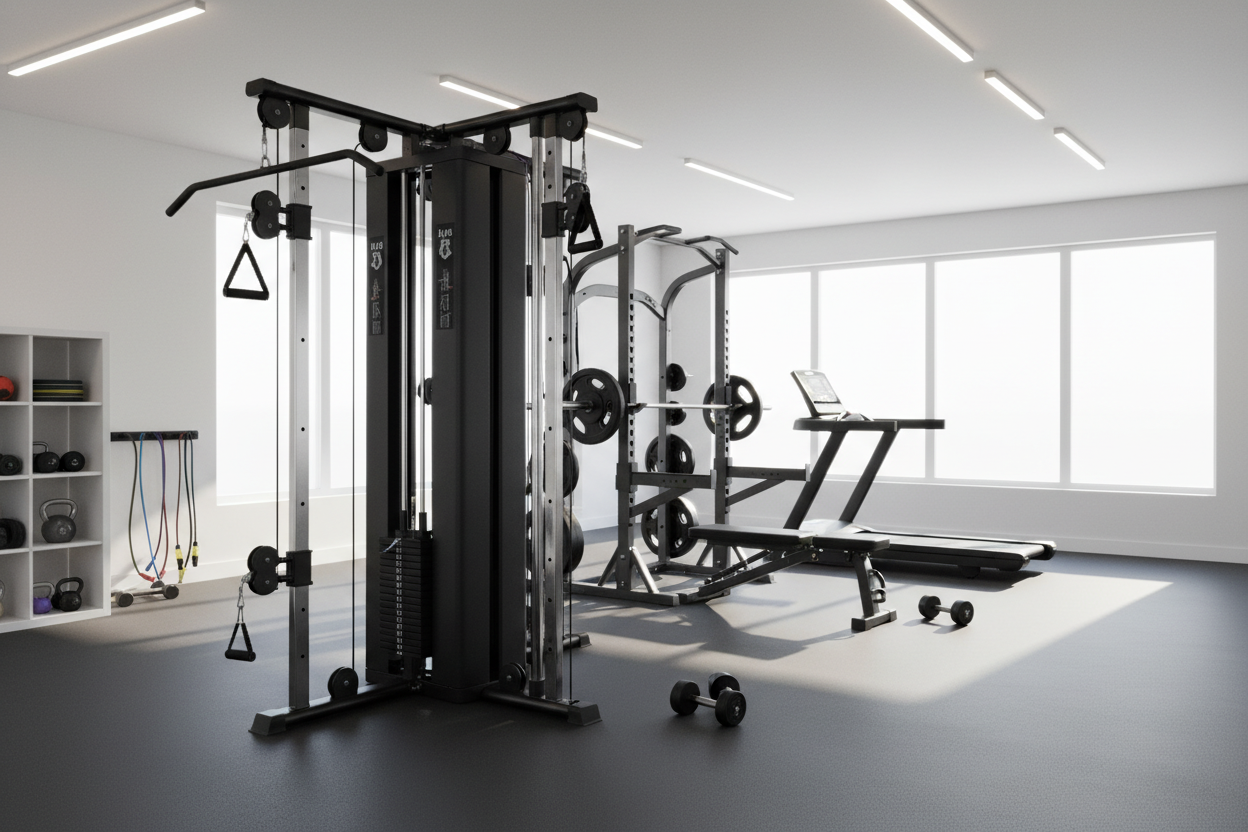
I remember my first day in a real commercial gym. It was a humid Tuesday, and I spent twenty minutes pretending to check my phone because I didn't know which lever to pull. I didn't want to look like a tourist, but I was definitely lost in a sea of steel and cables. Learning exercise machine names isn't just about sounding smart; it's about actually getting your workout done without a panic attack.
Quick Takeaways
- Most machines are named after the movement they perform (e.g., Press, Curl, Pulldown).
- 'Selectorized' means it has a weight stack with a pin; 'Plate-loaded' means you bring your own iron.
- The diagrams on the side of the frame are your best friend—they show the target muscle in red.
- Don't overthink the jargon; if you know the muscle you want to hit, the machine name usually follows.
The Day I Asked Gym Staff for the 'Squat Frame Thing'
About ten years ago, I walked up to a floor trainer at a big-box gym and asked where the 'squat frame thing' was. He looked at me like I had two heads and pointed toward the Power Racks. I felt like an absolute idiot. But here's the thing: nobody is born knowing the difference between a Half Rack and a Monolift. We all start as the person pointing at a piece of equipment and hoping someone understands.
Understanding the actual names of exercise machines is a massive confidence booster. It’s the difference between walking into the weight room with a plan and wandering around aimlessly until you settle for the treadmill out of pure social anxiety. When you know that the 'squat frame' is actually a Power Rack, you can look up tutorials, follow a program like 5/3/1, and actually track your progress. If you can't name it, you can't claim it.
Beyond the ego, accuracy matters for your logbook. Writing down 'leg thing' doesn't help you next week when you're trying to remember if you did the Leg Press or the Hack Squat. Those are two very different animals with different loading capacities. One might let you move 500 pounds, while the other will humble you with 200. Precision in terminology leads to precision in training.
Upper Body Gear: Stop Calling It the 'Chest Pusher'
I see it every day: people calling the Chest Press a 'chest pusher.' While technically accurate, you'll have a hard time finding that in a workout app. The staple of any upper body day is the Chest Press machine. These come in three flavors: flat, incline, and decline. Usually, they are selectorized, meaning you just move a pin to select your weight. If you're looking for something that feels more like a barbell, look for the plate-loaded versions where you manually slide 45-lb plates onto the horns.
Then you have the Lat Pulldown. This is the tall station with a long bar and a seat with knee pads. It’s the king of back builders. If the bar is missing, don't panic; most gyms keep a variety of attachments nearby. You might see a 'Pec Deck,' which is that machine where you sit upright and bring two pads together like you're giving a giant invisible bear a hug. It’s also often used in reverse—sit facing the machine to hit your rear delts.
Terminology for the smaller muscles gets even more cluttered. You don't need to overcomplicate the small stuff. If you're tired of being confused by every different pulley system, you can stop googling arm exercise machine names and just focus on the 'Bicep Curl' and 'Tricep Extension' stations. They do exactly what they say on the tin. Most modern gyms have a dedicated row of these isolation units, usually grouped together by muscle group. Look for the 'Preacher Curl' if you want that classic angled bench for your arms.
Lower Body Basics (So You Don't Wander Aimlessly)
The leg floor is usually the most intimidating part of the gym. It's full of heavy iron and machines that look like medieval torture devices. The big one is the Leg Press. You sit low and push a heavy sled away from you at a 45-degree angle. It's a quad-builder, but it's also where people tend to ego-lift. Don't be that person. Keep your back flat and don't lock your knees.
Right next to it, you’ll likely find the Hack Squat. In this one, you’re standing up, but your back is against a padded sled that slides on rails. It’s a brutal quad isolator. I spent years decoding exercise machine names for legs because, to the untrained eye, a Leg Extension and a Seated Leg Curl look almost identical. Here is the trick: if you are pushing your shins up to straighten your legs, it's an Extension. If you are pulling your heels down toward your glutes, it's a Curl.
Don't forget the 'Calf Raise' machines. These come in seated and standing varieties. The seated version hits the soleus (the lower part of the calf), while the standing version hits the meatier gastrocnemius. If you see a machine that looks like a weird wide-seated chair where you push your knees outward, that's the Abductor machine. If you're squeezing your knees together, it's the Adductor. Think 'Add' for adding your legs together. It’s a simple mnemonic that saves you from a lot of awkward stares.
The Cardio Section: Moving Beyond the Treadmill
The cardio deck is usually a sea of screens and plastic, but there are distinct gym instruments names you should know. Everyone knows the Treadmill, but have you tried the 'Stair Climber'? It’s essentially an infinite escalator. It’s one of the most effective ways to burn calories, but it’s also a mental battle. Most people call it a 'StairMaster,' which is actually a brand name, much like Kleenex is to tissues.
Then you have the Elliptical. It’s that low-impact machine that mimics a running motion without the joint-jarring impact. If you see something that looks like a bike but you're sitting back with a full backrest, that’s a 'Recumbent Bike.' If you’re sitting upright like a traditional cyclist, it’s an 'Upright Bike.' If you want a real challenge, look for a reliable exercise bike with a giant fan on the front—that's an Air Bike (or Assault Bike), and it will ruin your day in the best way possible.
Lastly, don't overlook the Rower (or Ergometer). It’s a full-body cardio machine that requires a bit of technique. You’ll see a handle attached to a chain or strap. It’s not just an arm workout; about 60% of the power should come from your legs. If you see a machine that looks like a vertical treadmill for your hands, that’s an 'Arm Ergometer'—great for cardio if you have a lower-body injury.
The 'Do It All' Racks and Stations
The center of gravity in most gyms is the 'Functional Trainer.' This is the big unit with two adjustable cable columns. You can move the pulleys up and down to do everything from chest flies to cable rows. It’s the most versatile piece of equipment in the building. If the two columns are spaced far apart, it’s often called a 'Cable Crossover' station, specifically designed for chest work.
Then there is the Smith machine home gym station. This is a barbell that is fixed into a set of vertical steel tracks. Purists love to hate on it because it removes the need for stabilization, but it’s an incredible tool for hypertrophy. Because the bar path is fixed, you can focus entirely on the muscle contraction without worrying about the bar tipping over. It’s also much safer for solo lifting because you can 'hook' the bar into the frame at any point by just flicking your wrists.
Finally, we have the Power Rack (or Power Cage). This is the four-post steel box where people do squats and bench presses. It’s designed with safety pins—long metal bars that catch the barbell if you fail a rep. If it only has two posts, it’s a Squat Stand or a Half Rack. These take up less space but offer a bit less safety if you’re lifting heavy enough to bend the earth's crust.
A Cheat Code for Remembering Gym Instruments Names
If you get overwhelmed, stop trying to memorize the manufacturer's labels. Life Fitness, Matrix, and Hammer Strength all have different branding, but the movements are the same. Categorize everything by the movement pattern. Is it a 'Vertical Pull' (Lat Pulldown), a 'Horizontal Push' (Chest Press), or a 'Knee Extension' (Leg Extension)? If you think in terms of movement, the name usually reveals itself.
I once spent ten minutes trying to find a 'T-Bar Row' machine because a YouTube video told me to. I walked past it three times because I was looking for a sign. Eventually, I realized it was just a bar stuck in a pivot on the floor. I felt dumb, but it taught me a lesson: look at the mechanics, not the marketing. Most machines have a little sticker with a diagram showing you exactly which muscle is being worked. If you're ever in doubt, just look at the red highlight on the little silver man on the sticker. That’s your ultimate cheat code.
Personal Experience: The Leg Press Disaster
Early in my training, I loaded up a 45-degree Leg Press with way more weight than I could handle. I didn't know the name of the safety handles—I just called them 'the clicky things.' I forgot to rotate them out before I started the rep. I descended, the safety caught the weight with a deafening *bang* that echoed through the whole gym, and I sat there pinned under the sled, red-faced and humbled. I didn't get hurt, but I learned that knowing the names of the machine's components is just as vital as knowing the machine itself. Learn where the 'Safety Pins,' 'Adjustment Knobs,' and 'Weight Selectors' are before you start moving heavy loads.
FAQ
What is the difference between a Power Rack and a Smith Machine?
A Power Rack uses a completely free barbell that you have to balance yourself. A Smith Machine has the barbell fixed to steel tracks, so it can only move up and down in a straight line. The Smith Machine is easier to use solo, while the Power Rack builds more stability.
Why are there so many names for the same machine?
Marketing. One brand calls it a 'Low Row,' another calls it a 'Seated Cable Row.' They do the same thing. Focus on the muscle it targets rather than the brand name on the frame.
Are cable machines better than plate-loaded machines?
Neither is 'better.' Cables provide constant tension throughout the whole movement, which is great for muscle growth. Plate-loaded machines usually allow you to lift heavier weights and feel more like using free weights.
Share:
Your Smith Machine Bench Press Conversion Math Is Probably Wrong
I Added a Powerlifting Machine to My Garage Gym (And My Total Jumped)