
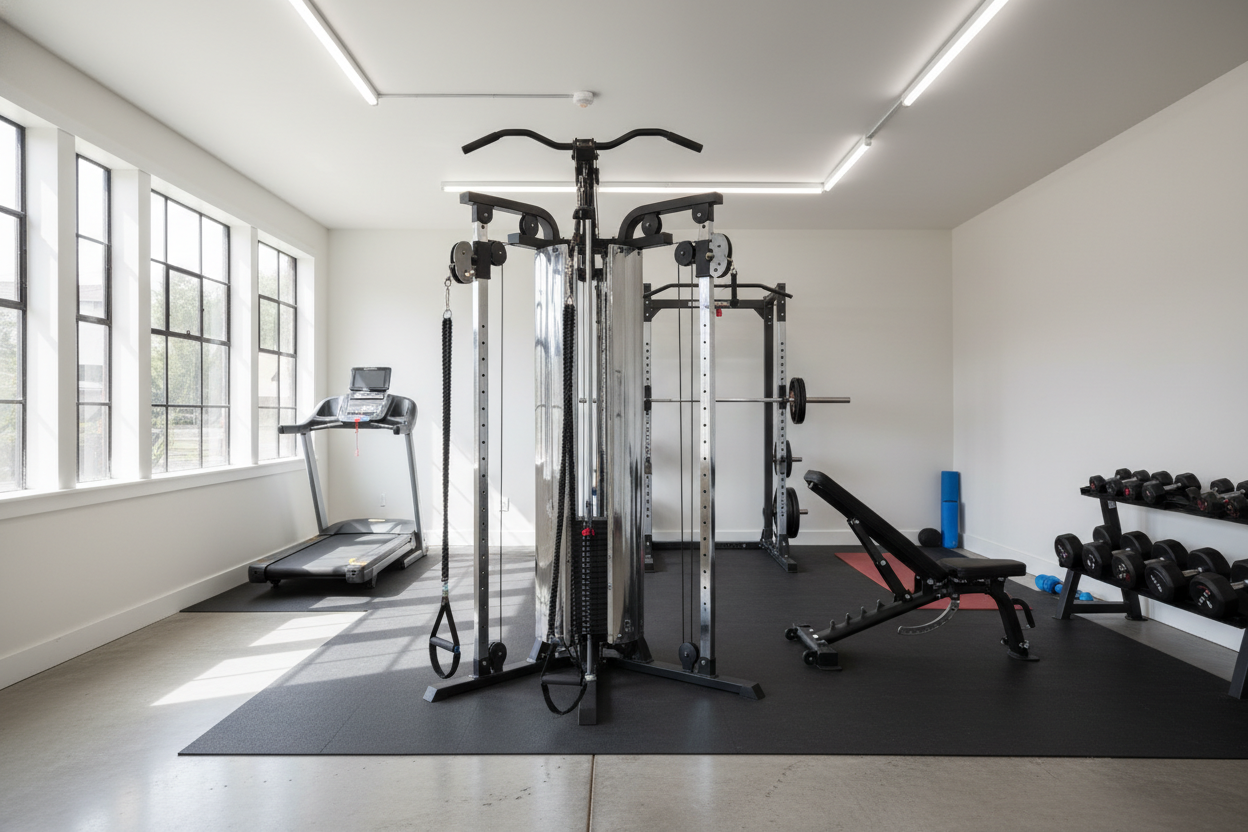
I remember the first time I dragged a budget lat pulldown into my garage. I expected the silky glide of the professional rigs at my old commercial spot. Instead, it felt like I was dragging a bag of wet cement over a gravel driveway. Most workout machines built for the residential market are designed to look impressive in a 2D thumbnail, but they fail the 'feel' test the second you load a heavy plate. If you have ever abandoned a training session because your gear felt clunky, it is probably the hardware, not your motivation.
Quick Takeaways
- Plastic bushings are the enemy of smooth movement; always look for sealed ball bearings.
- Aluminum pulleys outlast and outperform nylon versions, preventing cable drag and fraying.
- Weight stacks offer more consistent resistance than plate-loaded machines due to better balance.
- The leverage curve matters; if a rep feels 'dead' at the top, the machine’s geometry is flawed.
The 'Commercial Feel' Isn't Magic (It's Just Bearings)
When you are building a home gym, you quickly realize that 'smoothness' is a technical spec, not a vibe. Commercial gyms spend five figures on single-station units because they use high-end linear bearings. Most budget gym exercise machines use plastic bushings—essentially a plastic sleeve that slides over a metal rod. The moment you add a little bit of weight, that plastic compresses and creates friction. That is the 'sand' you feel during your set.
I have tested machines where the friction was so bad it felt like I was losing 20% of the resistance on the eccentric phase. That is a disaster for muscle growth. You want your gym machines to disappear under the load so you can focus on the muscle, not the stutter of the carriage. If a manufacturer does not explicitly list 'sealed bearings' or 'linear bearings' in the specs, assume they are using cheap bushings. It is the single biggest difference between a piece of equipment you'll use for a decade and a clothes rack for your laundry.
Don't be fooled by a thick frame either. A machine can be made of 11-gauge steel, but if the pivot points are just a bolt through a hole, it will feel like garbage. Look for grease nipples on pivot points; that is a sign the designer actually cares about longevity and friction reduction.
Weight Stacks vs. Plate-Loaded: The Honest Truth
There is a massive price gap between a selectorized workout machine and a plate-loaded one. A weight stack is convenient, but it also provides a more centered center of gravity. When you slide plates onto a machine home setup, you are often adding weight to one side of a pivot or a carriage. If the tolerances aren't perfect, that weight causes the carriage to tilt slightly, increasing friction against the guide rods.
I finally bought gym machines with selectorized stacks for my own space because I was tired of the 'plate-loaded dance.' Loading 45s for every set of leg presses is a workout in itself, but more importantly, the stacks are usually balanced better. If you go the plate-loaded route to save money, you have to be twice as picky about the guide rods. They need to be solid steel and chrome-plated, not just powder-coated pipe.
Another factor is the 'jump' in weight. Cheap stacks often have 20-lb increments, which is useless for isolation moves. If you are buying a stack, check if it comes with add-on weights or 10-lb plates. A gym workout machine that forces you to jump from 40 lbs to 60 lbs on a lateral raise is a machine that will eventually cause an injury.
Pulleys and Cables: Where Good Rigs Go Bad
Pulleys are the most underrated component of any cable-based gym exercise machines. Most home units ship with nylon pulleys. Over time, the steel cable saws into the nylon, creating a groove that adds massive drag. Even worse, nylon pulleys tend to warp under high heat or heavy tension. If you want that buttery feel, you need to upgrade to aluminum pulleys. They don't flex, and they keep the cable perfectly centered.
The cable itself matters too. Most people look at the '2,000-lb test' rating and think they are safe. That rating is for the breaking point, not the smoothness. You want a 7x19 strand cable with a thin, hard nylon coating. If the coating is too thick or gummy, it will stick to the pulleys. I have seen 1/4-inch cables that felt like rubber bands because the core was low-quality steel. When you pull, the cable stretches before the weight moves. That lag ruins your mind-muscle connection.
Check the pulley diameter as well. A small 3-inch pulley forces the cable to bend at a sharp angle, which increases wear and friction. A 4.5-inch or 5-inch pulley is the gold standard for a smooth gym workout machine. It allows the cable to roll with minimal resistance, which is exactly what you pay for in a high-end club.
The Leverage Curve Problem You Didn't Notice
Have you ever used a leg extension where the weight feels like 100 lbs at the start but feels like nothing at the top? That is a bad leverage curve. The pivot point is poorly placed, meaning the resistance doesn't match your body’s natural strength. A well-designed workout machine uses a cam—that kidney-shaped wheel—to adjust the tension throughout the movement. As you get stronger in the range of motion, the cam increases the leverage of the weight to keep the tension consistent.
This is especially critical for lower body movements. For example, a dedicated hip thrust machine needs a very specific pivot point to ensure the glutes are under tension at the peak contraction without the weight crashing down at the bottom. If the geometry is off by even an inch, the machine becomes a glorified footrest.
When shopping, look at the 'cam' where the cable attaches. If it is just a perfectly round circle, the resistance will stay the same, which often feels 'wrong' because our muscles are naturally weaker at the start of a lift. A variable resistance cam is the hallmark of a pro-grade machine home enthusiasts should look for.
How to Spot a Survivor Before You Buy
Buying a workout machine online is a minefield of photoshopped images. To find a machine that survives daily abuse, you have to look at the hardware. Zoom in on the bolts. Are they tiny Grade 5 zinc bolts, or are they beefy Grade 8 hardware? Check the guide rods—are they hollow tubes or solid cold-rolled steel? Solid steel rods add weight and stability that hollow tubes can't match.
If you are looking for a smooth Smith machine, the linear bearings are the only thing that matters. If the description doesn't mention 'linear ball bearings,' it's likely using plastic sliders that will bind up the moment you try to press more than 135 lbs. Also, check the footprint. A machine that weighs only 150 lbs total is going to wobble when you are halfway through a heavy set of rows.
Ignore marketing buzzwords like 'pro-style' or 'industrial grade.' Look for the gauge of the steel (11 is better than 14) and the warranty on the cables and pulleys. A company that only warranties cables for 90 days knows their parts are going to fail. A five-year warranty on wear items is a sign you've found a winner.
Personal Experience: The $300 Mistake
Early in my training career, I bought a 'complete home gym' for $300 from a big-box store. On paper, it did everything: chest press, lat pulldown, leg extension. In reality, it did nothing well. The cables were so stretchy that I had to move the handle six inches before the weight stack even budged. The seat wobbled so much I felt like I was training on a boat. I ended up selling it for $50 on Craigslist just to get the floor space back. Now, I’d rather have one high-quality functional trainer than five cheap single-station machines. Quality isn't just about luxury; it’s about whether you’ll actually want to use the gear six months from now.
FAQ
Can I make a cheap machine feel smoother?
You can try using 100% silicone spray on the guide rods. Never use WD-40; it attracts dust and turns into a sticky paste. However, if the machine uses plastic bushings, there is a limit to how much spray can help.
Why are aluminum pulleys better than nylon?
Aluminum doesn't compress or warp under load. It keeps the cable in a precise track, which reduces friction and prevents the 'jerky' feeling you get when a cable rubs against the side of a plastic pulley.
What steel gauge should I look for?
11-gauge steel is the standard for commercial gear. 14-gauge is common for home use. If you are a heavy lifter, stick to 11-gauge for anything that involves a pivot point or a cable system to ensure the frame doesn't flex under load.
Share:
I Ruined Two Garage Home Gyms Before Getting It Right
The Only Gym Machine for Upper Body Worth Its Footprint