
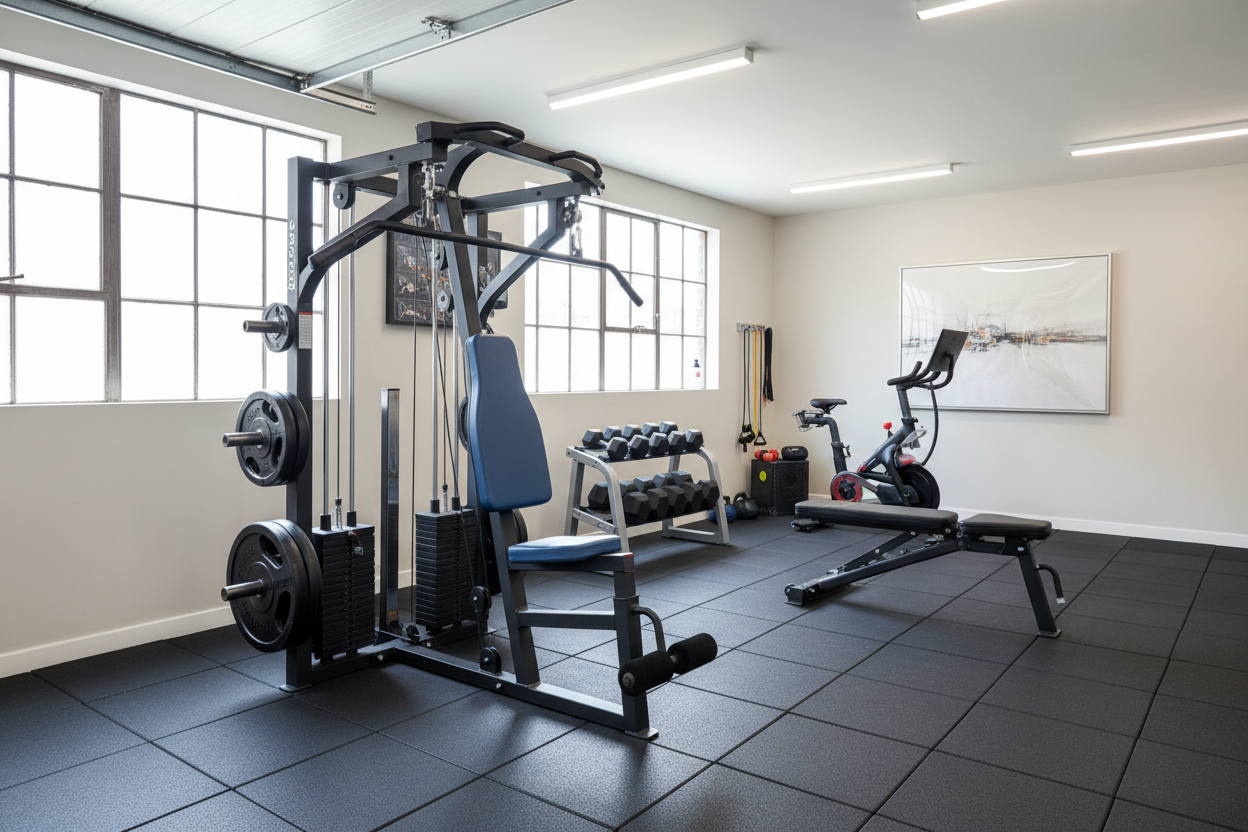
It is 5:30 AM. You are staring at a 225-pound barbell in your garage, and the only other living soul in the house is a sleeping toddler. You know you have four reps in the tank, but that fifth one? That is the one where you might end up doing the 'roll of shame' across your ribs. I have been there more times than I care to admit. It is the silent progress killer for every solo lifter: the fear of getting pinned. This is exactly why I finally caved and looked into a high-quality assisted weight machine.
For years, I told myself that machines were for people who did not want to work hard. I was wrong. After testing dozens of pieces of gear, from budget racks to commercial-grade leverage systems, I realized that an assisted weight lifting machine is not a crutch—it is a safety net that allows you to actually train with the intensity required for hypertrophy without needing a neighbor to stand over you.
- Eliminates the 'fear factor' of heavy solo sets.
- Allows for true muscular failure without safety risks.
- Provides a fixed path to target specific muscle groups.
- Saves your floor from the damage of dropped bails.
- Perfect for high-volume accessory work after heavy compounds.
The Fear of Getting Pinned in an Empty Garage
There is a specific kind of psychological wall you hit when training alone. You are on your third set of bench press, your triceps are screaming, and your brain starts doing math. 'If I fail this next rep, can I reach the safeties? Are they set at the right height? Will I wake up the whole neighborhood when I drop this?' That split-second of doubt is enough to make you rack the bar early. You just left the most effective rep of the set on the table because you did not have a spotter.
I spent two years holding back on my top sets. My progress stalled because I was essentially training at an RPE 7 when I should have been hitting an RPE 10. The garage gym lifestyle is great for convenience, but it is brutal for intensity if you are constantly worried about a 100-pound iron plate crushing your windpipe. It is not just about the physical danger; it is the mental energy you waste managing that risk instead of focusing on the contraction.
When you use an assisted weight machine, that mental load vanishes. You can grind out a rep for five seconds, shaking like a leaf, knowing that if you fail, the machine simply stops. You do not have to worry about the bar tilting or the plates sliding off because you missed the hook. That peace of mind is worth more than any fancy knurling on a boutique barbell. It changed the way I approach my heavy days entirely.
Swallowing My Ego: Enter the Assisted Weight Lifting Machine
Let's talk about the 'ego' problem. We have all seen the memes about Smith machines and leverage rigs. The 'hardcore' crowd will tell you that if you are not using free weights, you are not really lifting. I used to be that guy. Then I looked at the physiques of the guys who have been training for thirty years without a major injury. Most of them use machines to supplement their heavy barbell work. Why? Because an assisted weight lifting machine allows you to isolate a muscle without your stabilizers giving out first.
If your goal is pure muscle growth, you need to put the target muscle under tension for as long as possible. On a free-weight bench press, your shoulders, wrists, and upper back are all working overtime just to keep the bar straight. On a leverage machine, that stability is built-in. This means I can take my chest to absolute, shivering failure without my front delts taking over because I am getting tired. It is a tool for advanced lifters, not just a starting point for beginners.
I have found that these machines are particularly useful for rehab and 'high-mileage' joints. My left shoulder has been a mess since high school football. Heavy dumbbell presses often aggravate it because of the micro-adjustments needed to balance the weight. A fixed-path assisted weight lifting machine keeps the movement pattern consistent every single time. It allows me to load up the weight and feel the pump without the sharp, stabbing pain that usually follows a heavy session. Swallowing my ego and moving away from 100% free weights was the best thing I ever did for my longevity in this sport.
How I Actually Program Fixed-Path Equipment
My training split is pretty simple: I start with one big, heavy free-weight movement while I am fresh. Then, I move to the machines to finish the job. For chest day, that means I might start with a heavy barbell incline press. But once I have done my heavy sets of 5, I am done with the barbell. I move over to something like the Weight Bench Chest Press Machine Independent Arms Z1 Pro. This is where the real growth happens.
The Z1 Pro is a beast because it features independent arms. Most cheap machines move on a single pivot point, which means your stronger side will always compensate for your weaker side. With independent arms, you can't hide. If your left side is lagging, that handle is going to move slower. I use this for high-volume sets, usually in the 10-15 rep range. Because I don't have to worry about balancing the weight, I can use techniques like rest-pause or drop sets that would be suicidal with a barbell.
I also love using fixed-path gear for converging movements. A standard barbell moves in a straight line, but your chest muscles actually function better when your hands move toward each other at the top of the press. A good assisted weight machine mimics this natural arc. I'll often finish a workout with 'isometronics'—holding the weight at the point of maximum tension for 10 seconds at the end of a set. Try doing that with a pair of 90-pound dumbbells without a spotter. It is not happening. The machine allows for a level of intensity that free weights simply cannot match in a solo environment.
Do You Still Need Traditional Free Weights?
Do not get it twisted: I am not telling you to sell your dumbbells on Craigslist. Free weights are still the king for building overall athleticism and core stability. But you have to be smart about how you pair them. I still use my Adjustable Weight Bench Owb01 for about 60% of my workout. It is the foundation of the gym. I'll do my heavy rows and my overhead presses on the bench, then I'll slide it right into the machine rig for the assisted work.
The key is versatility. The Owb01 is great because it has a small footprint but can handle 1,000 lbs. When I am switching from free weight flies to machine presses, I need a bench that is easy to move and locks into position securely. You do not want a bench that wobbles when you are trying to push a PR on a leverage machine. The synergy between a solid bench and an assisted rig is what makes a home gym feel like a pro facility.
If you are tight on budget, start with the bench and a set of weights. But as soon as you hit a plateau, or as soon as you find yourself 'sandbagging' your sets because you are scared of the weight, that is when you add the machine. I usually position my bench so I can transition from dumbbell work to the machine in under thirty seconds. This keeps the heart rate up and the intensity high. You are building a system, not just buying random pieces of metal.
Is It Worth the Floor Space in a Home Gym?
This is the big question. Most of us are working with a two-car garage or a spare bedroom. A dedicated assisted weight machine usually takes up about a 4x5 foot footprint. That is a lot of real estate. You have to ask yourself: will I use this every week? In my experience, if you buy a cheap, flimsy one from a big-box store, it will become a clothes rack. But if you invest in a solid piece of gear, it becomes the centerpiece of your training.
To save space, look for machines that integrate with your existing setup. I recommend browsing a dedicated Weight Bench collection to see which benches are designed to fit within a rack or a leverage system. Some machines allow you to perform squats, rows, and presses all in one footprint. If you can replace three different machines with one high-quality assisted rig, the floor space argument goes out the window.
In my current 400-square-foot setup, my leverage machine is the most used item besides my rack. Yes, it took up the spot where I used to keep my cardio bike, but my chest and shoulders have grown more in the last six months than they did in the previous two years. If you are serious about solo training, you have to prioritize tools that allow you to work harder. The floor space is a small price to pay for the ability to train safely at 100% intensity.
Is an assisted weight machine better than a Smith machine?
It depends on the design. Most 'assisted' leverage machines use a circular pivot which feels more natural for pressing. Smith machines move in a strictly vertical or slightly angled straight line. For chest work, I prefer leverage machines; for squats and lunges, a Smith machine is often superior.
Can I build as much muscle with machines as with free weights?
Absolutely. Your muscles do not have eyes; they only know tension and fatigue. If you can create more tension and reach a deeper level of fatigue safely on a machine, you will grow. Many pro bodybuilders rely heavily on machines to minimize injury risk while maximizing volume.
How do I know if a machine will fit in my low-ceiling basement?
Always check the 'max height' spec, but also check the 'arm travel' height. Some machines are only 75 inches tall when sitting still, but the arms might swing up to 85 inches during a shoulder press. Measure your ceiling twice before ordering.
Do these machines require a lot of maintenance?
Not really. If it is a plate-loaded leverage machine, you just need to keep the pivot points greased once a year. If it is a cable-based assisted machine, you will need to check the cables for fraying. Generally, they are much lower maintenance than a treadmill or stationary bike.
Share:
Which Brands of Exercise Equipment Actually Survive 5 Years?
The Only 4 Triceps Workout Machine Names You Need to Know