
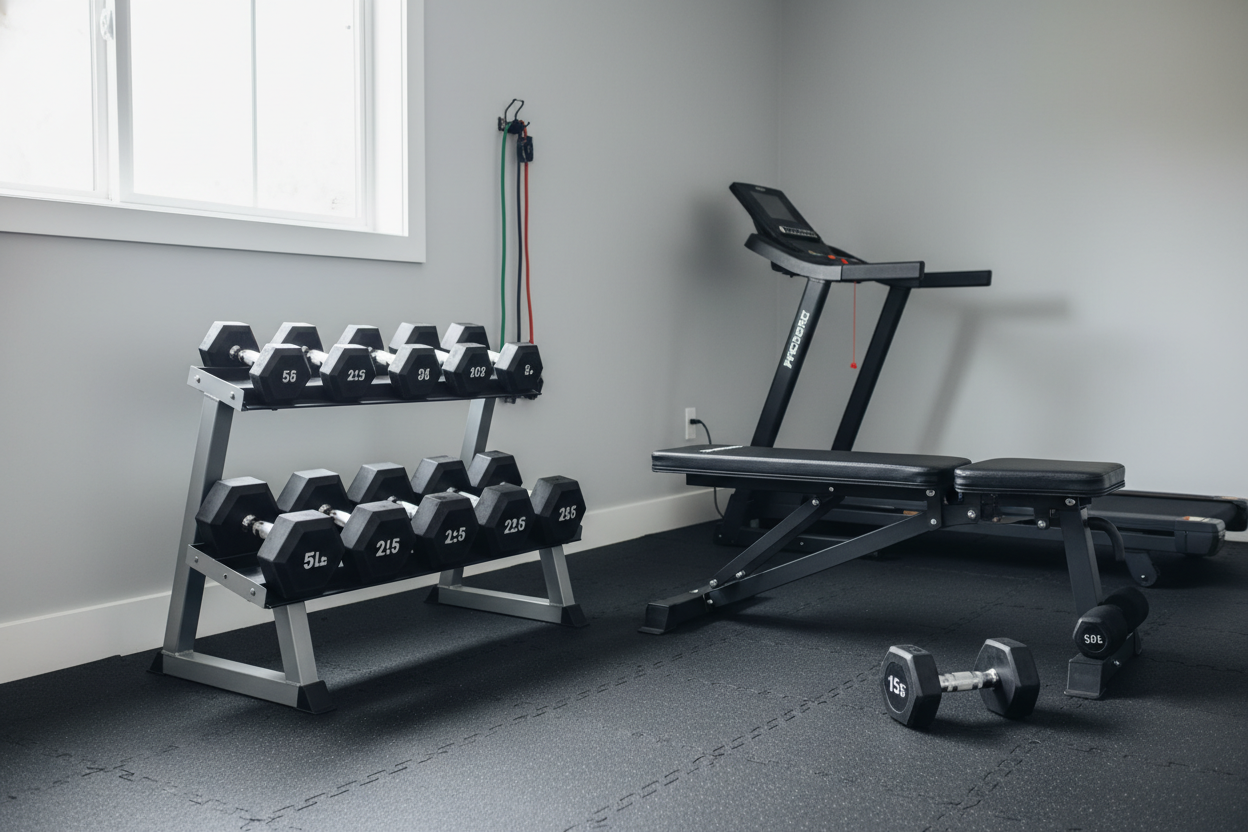
I remember my first pair of hand weights for home. They were those bright purple, neoprene-coated things I bought from a big-box store during a New Year's resolution phase. I thought they’d be the foundation of a new physique, but after exactly three workouts, I realized a 5-pound dumbbell doesn't do much for anything other than maybe a high-rep lateral raise. Now, one of them holds my office door open when the AC is out, and the other is lost somewhere in the crawlspace.
Quick Takeaways
- Avoid 'toning' kits; buy individual pairs or adjustables that offer room to grow.
- Hex-shaped heads are mandatory for home use unless you enjoy chasing weights across the floor.
- Knurled steel handles provide better grip than slippery plastic or cheap neoprene.
- Prioritize versatility over aesthetic colors—your muscles don't care if the weight is teal or grey.
The Neoprene Graveyard: Why We Buy Junk
We’ve all been there. You’re scrolling through Amazon at midnight, feeling a bit soft around the edges, and you see a 'complete set' of home hand weights for sixty bucks. They look friendly. They’re colorful. They promise a 'total body transformation.' But here is the reality: those light, vinyl-coated handheld weights are designed for marketing, not for long-term progress. Most people buy a dumbbell hand weight that is far too light to elicit any real muscle adaptation. If you can do 30 reps without breaking a sweat, you aren't training; you're just moving.
The 'Neoprene Graveyard' is real. It’s that corner of the living room where 2lb, 5lb, and 8lb weights go to die. These kits usually skip the weights you actually need—like 15s, 25s, and 35s—because those are expensive to ship. By the time you realize you need more resistance, you've already spent a hundred dollars on a collection of plastic-coated pebbles. If you want hand weights for exercise that actually work, you have to stop thinking about 'toning' and start thinking about loading.
What Actually Matters When Picking Handheld Weights
When you're holding hand held dumbbells for forty minutes, the interface between your palm and the weight is everything. Most cheap hand weight with handle designs use a smooth, thick plastic grip. The second your palms get even slightly damp, that weight becomes a projectile. I’ve seen more than one drywall hole caused by a slippery 5lb weight flying out of a hand during a overhead press.
Look for a handle with real texture. If you can find a rubber hex dumbbell with a chromed, knurled handle, buy it. The knurling—that diamond-patterned etching—is there for a reason. It creates friction without requiring a death grip. Also, pay attention to the head shape. Round dumbbells are great for commercial racks, but in a home gym with a slightly uneven garage floor, they are a nightmare. A hex-shaped head stays exactly where you put it, which is crucial when you're doing floor-to-overhead movements or renegade rows.
Fixed Hex vs. Adjustables: The Space Showdown
The biggest hurdle for home lifters isn't motivation; it's square footage. If you buy a full run of fixed weights hand held from 5 to 50 pounds, you're looking at a massive footprint. You’ll need a three-tier rack that’s at least four feet wide. For most of us, that’s just not realistic. This is where high-quality adjustable dumbbells earn their keep. A single pair of PowerBlocks or Ironmasters can replace 16 pairs of individual weights while occupying about two square feet of floor space.
I’ve tested nearly every adjustable on the market. While some feel a bit clunky compared to a fixed dumbbell hand weight, the trade-off is worth it. You can jump from a 10lb weight for curls to a 50lb weight for rows in about five seconds. Plus, a solid home setup doesn't need 50 pairs of dumbbells to get you commercial-level results. Investing in one heavy-duty adjustable set is almost always cheaper and more efficient than buying individual pairs as you get stronger.
How to Actually Grow With Dumbbells in Hand
Once you have the right dumbbells in hand, the magic isn't in the equipment—it's in the execution. If you’re limited to lighter hand weights for home, you have to get creative with your intensity. Stop counting to ten and stopping. Instead, focus on time-under-tension. Try a 4-second eccentric (lowering) phase on every rep. I promise that 15lb dumbbell will feel like a 40lb weight by the time you hit rep eight.
Unilateral work is another secret weapon. Doing a single-arm overhead press forces your core to stabilize the load, making a lighter weight feel significantly more challenging. You don't need a 100lb barbell to get a massive stimulus. By using weights hand held in staggered stances or with paused repetitions, you can build serious muscle without turning your spare bedroom into a commercial powerlifting gym. It’s about making the weight feel heavier, not just searching for the biggest number on the side of the bell.
The Blueprint for Buying Hand Weights for Exercise
If you’re starting from scratch, don't buy a pre-packaged set. They are almost always padded with weights you'll never use. Instead, buy 'the gaps.' For most people, a pair of 10lb, 20lb, and 35lb dumbbells will cover 90% of your needs for the first six months. If you’re focusing on accessory work or yoga-style flows, a single pair of 5lb handheld weights is fine, but don't make them the centerpiece of your gym.
The bottom line? Buy for the person you want to become, not the person you are today. If you only buy weights that feel 'comfortable' right now, you’re essentially planning to plateau. Get the hand weight with handle knurling that feels a bit aggressive. Get the weight that's five pounds heavier than you think you can handle. That’s how you actually see a change in the mirror.
My Honest Mistake
Years ago, I bought a set of those sand-filled plastic dumbbells because they were on clearance. I thought I was being smart. A month later, the plastic seam on the 20lb weight split during a set of swings, and I ended up with a gallon of fine black sand in my carpet. It took three vacuum sessions to get it out, and the weight was useless. Since then, I only buy solid cast iron or high-quality rubber-encased steel. The extra twenty bucks is a small price to pay for equipment that doesn't explode in your living room.
Frequently Asked Questions
Is neoprene or rubber better for home use?
Rubber hex dumbbells are superior. Neoprene tends to peel and absorb sweat over time, which makes them smell. Rubber is more durable and the handles are usually better designed for actual lifting.
Should I buy one heavy weight or two light ones?
Always buy pairs first. While you can do a lot with a single heavy weight, having a matched set of hand weights for home allows for a much wider range of traditional strength movements like bench presses and squats.
How do I know if my weights are too light?
If you can maintain perfect form for more than 15 reps, it's time to move up. For muscle growth, you generally want to be struggling by the 8th to 12th rep.
Share:
Stop Wasting Time on the Arm Workout Machines Planet Fitness Promotes
I Tested a $200 Muscle Tone Machine So You Don't Have To