
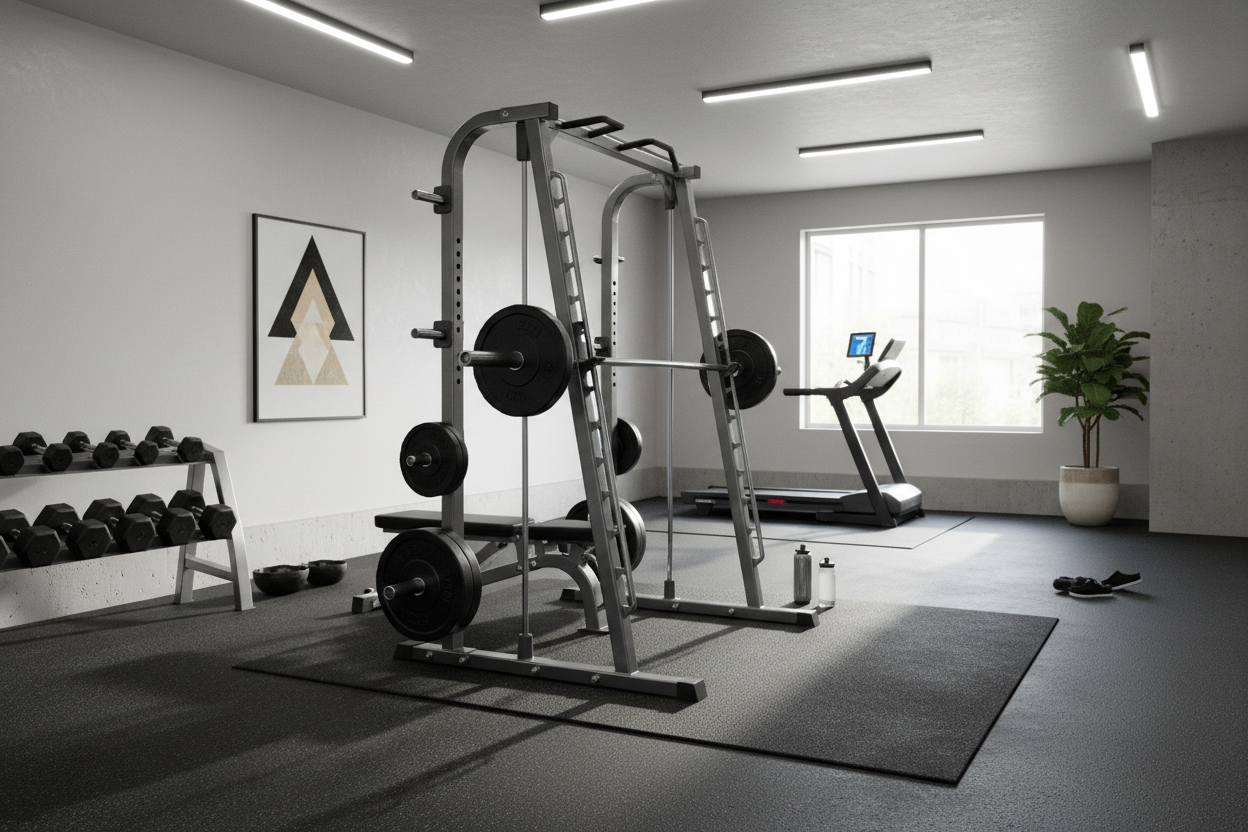
I remember the first time I stood in front of a commercial-grade Smith machine at a big box gym. I spent five minutes just staring at the slanted rails, trying to calculate the physics like a nervous engineering student before I even touched the bar. If you’ve ever felt like your angled smith machine squat was trying to fold you like a lawn chair, you aren't crazy—you're probably just facing the wrong way.
- Face the direction that allows the bar to travel toward your back on the way down.
- The slant is designed to mimic the natural J-curve of a barbell back squat.
- Facing 'backward' isn't illegal, but it requires a specific foot setup to avoid knee pain.
- Most machines have a 7 to 11-degree pitch for ergonomic reasons.
The Great Slanted Track Debate (Why Are We So Confused?)
Most people assume a Smith machine is just a vertical rod. Then they see an angled smith machine and panic. These tracks usually sit at a 7 or 11-degree incline. Manufacturers aren't doing this to mess with you; they're trying to solve the 'straight line' problem of a standard Smith, which feels stiff because your body doesn't actually move in a perfect vertical line during a squat.
When you use a slanted squat machine, you have to account for that horizontal shift. If you ignore it, you’ll feel a weird pressure in your lower back or a sharp pinch in your knees. The goal is to align your body's center of gravity with the machine's fixed path so the friction of the bearings doesn't become your enemy.
The Definitive Answer: Which Way to Face on a Smith Machine
Logic time. When you do a free-weight squat, your hips move back and the bar travels in a slight arc, not a laser-straight line. To get that same feel, you need to know which way to face on smith machine. Stand so that as you drop into the hole, the bar moves slightly toward your heels. This keeps the weight over your mid-foot and prevents the machine from pushing your chest into your knees.
When you stop hating the smith machine squat and dial in this alignment, you'll realize it's actually one of the best ways to load your legs without your lower back giving out first. This specific smith machine squat direction allows your hips to hinge naturally. If the bar is moving away from you as you go down, you’re essentially fighting the machine's momentum, which is a fast track to a lumbar strain.
What Happens If You Face the Other Way?
If you face the opposite way—where the bar travels forward as you descend—you’re basically asking for a bad time. In a standard stance, this slanted smith machine squat variation creates massive shearing force on the patellar tendon. Your knees shoot forward, your heels want to lift, and the bar path fights your natural mechanics. It feels like the machine is trying to dump you on your face.
I see people do this all the time because they want to face the mirror. Don't do that. Your joints don't care about your reflection. Facing the wrong way on an angled smith machine squat forces your shins into an aggressive forward angle that most people's ankles simply can't handle. Unless you have the mobility of an Olympic weightlifter, you'll end up rounding your back to compensate.
Turning the 'Wrong' Way Into a Brutal Hack Squat
However, you can use that 'wrong' direction to your advantage if you're smart about it. By walking your feet about 12-18 inches in front of the bar, you can turn a slanted smith machine into a makeshift hack squat. This shifts the load entirely to the quads and saves your lower back because you can lean your weight into the bar.
I’ve used this hack squat on smith machine setup in my own garage when I didn't have the floor space for a dedicated 400-pound leg press. It’s brutal, but you have to commit to that forward foot placement. If you try to stand directly under the bar while facing this way, you'll feel it in your ACL immediately. Move those feet forward and turn it into a quad-isolation masterclass.
Foot Placement is Everything (Don't Blame the Machine)
Don't blame the machine if your feet are glued under the bar like a statue. For a proper squat on angled smith machine, your feet should usually be slightly ahead of the bar path, even when facing the 'correct' way. Experiment with a shoulder-width stance and toes flared about 15 degrees. This gives your hips room to open up at the bottom of the movement.
The biggest mistake is trying to mimic a high-bar Olympic squat with your heels directly under the rails. Because the smith machine squat angle is fixed, you have more stability, so use it. Lean back slightly into the bar. You want to feel stable, not like you're relying on the friction of the bearings to keep you from toppling over. If you feel like you're falling forward, move your feet out another two inches.
Straight vs. Angled: Does It Actually Matter for Your Home Gym?
If you’re currently investing in a smith machine for your home gym, the angle vs. straight debate is real. A straight vertical track is actually better for overhead presses and benching because it doesn't force an unnatural horizontal shift. But for pure lower body hypertrophy, I prefer the 7-degree slant. It just feels more 'human' for squats and lunges.
I spent three years doing these backwards because 'bro-science' told me facing the mirror was the only way. My knees sounded like a bag of potato chips every time I walked up stairs. The day I flipped around and learned how to squat on angled smith machine properly, the joint pain vanished. I realized I was fighting the machine instead of working with the gravity it was trying to simulate.
FAQ
Can I bench on an angled Smith machine?
Yes, but face the direction where the bar moves toward your face as you press up. This mimics the natural J-curve of a bench press and keeps your shoulders in a safer position.
Which way to face for lunges?
Generally, you want to face the same way as a squat—so the bar moves back toward your 'back' leg as you drop. This keeps your front shin more vertical and hits the glutes harder.
Is the Smith machine 'cheating'?
No. It's a tool for stability. It lets you take your quads to absolute failure without worrying about falling over or dumping a barbell in your garage. It's not cheating; it's targeted destruction.
Share:
Cables vs. Smith: Which Exercise Machine Best Fits a Garage Gym?
Why That Neat Little Dumbbell Set and Case Will Drive You Crazy