
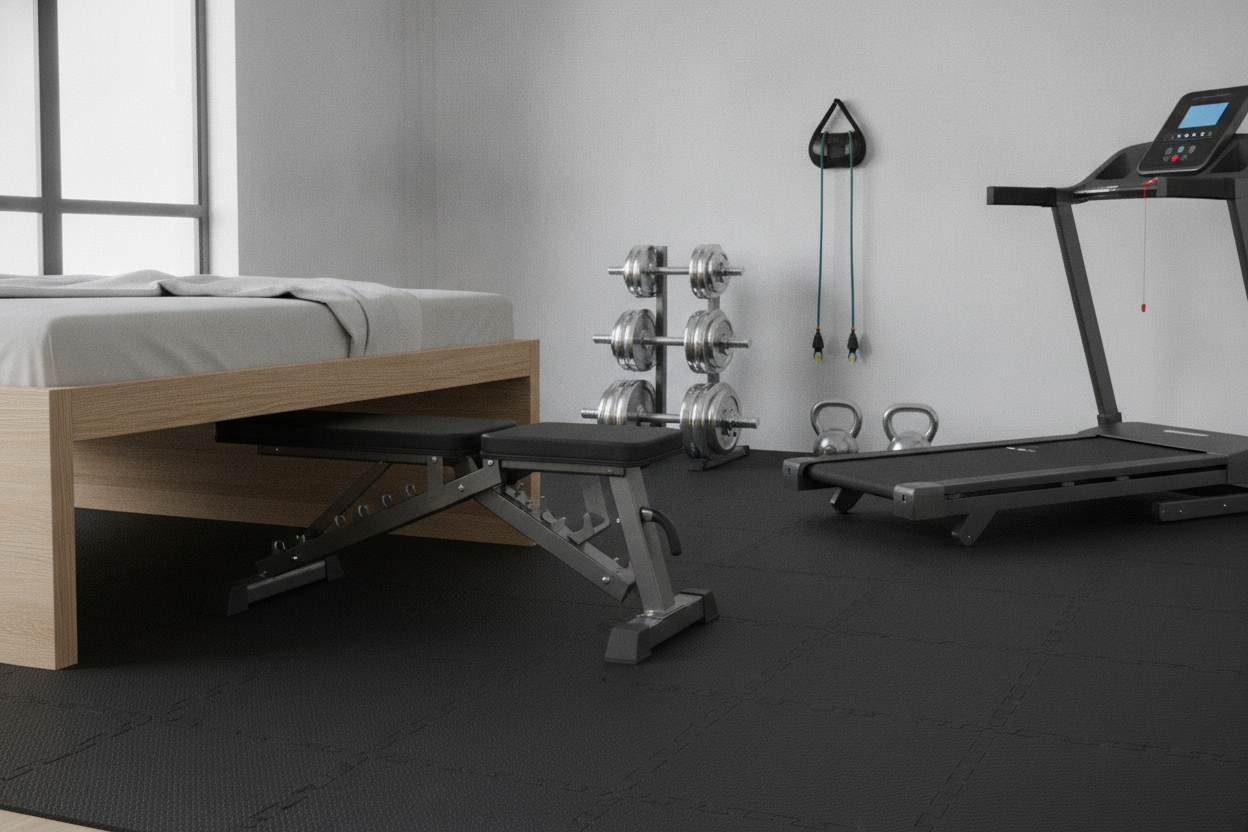
I remember my first studio apartment in Chicago. I had exactly 12 square feet of floor space that wasn't taken up by a mattress or a desk. I bought a cheap collapsible weight bench under bed hoping to keep my bench press gains without losing my security deposit. Halfway through a set of 85-pound dumbbell presses, the hinge groaned in a way that made me rethink my life choices.
Most people buy these benches for convenience, but they forget that a bench's primary job is to be a rock. If it folds, it has a weakness. I've tested dozens of these 'stowable' options, and while some are engineering marvels, others are just waiting to fold up while you're mid-set.
- Look for steel locking pins, not just friction knobs.
- Check the 'folded height' carefully—most beds have less than 7 inches of clearance.
- Static weight ratings are marketing fluff; look for 'dynamic' stability.
- If the bench weighs less than 30 lbs, it’s probably a toy.
The Physics of Folding Flat (Why Most Benches Suck)
To make an under bed weight bench truly flat, manufacturers have to cut the main frame. Every cut is a potential failure point. If you're looking at a foldable weight bench under bed, you need to inspect the gussets around the hinges. Without reinforced locking pins, you're basically balancing on a giant hinge.
A quality collapsible design uses a 'double-locking' mechanism. This means a primary pin holds the weight, and a secondary bolt keeps the frame from swaying. If your bench only relies on a single thin bolt to keep the legs from collapsing, you're essentially trusting your spine to a $2 piece of hardware.
Weight Capacity Lies on Compact Benches
You see '600lb capacity' and think you're safe. That's usually a static rating—meaning it can hold that weight if the weight is perfectly still. The second you start a chest fly or a heavy row, that number drops. When comparing a folding model to a standard Weight Bench, you'll notice the fixed ones have welded joints for a reason. Welds don't wiggle; bolts do.
I’ve seen benches advertised with massive weight limits that would literally tip over if you sat on the edge too quickly. Look for a wide tripod or H-frame base. If the feet are narrow, no amount of steel thickness will save you from a lateral tip. If you weigh 200 lbs and you're pressing 50-lb dumbbells, you need a bench rated for at least 500 lbs just to feel secure.
What Actually Matters When Measuring Your Space
Don't trust the 'folded dimensions' on the box. They often omit the caster wheels or the adjustment knob that sticks out like a sore thumb. Measure from the floor to the lowest rail of your bed frame. If you have 6 inches of clearance and the bench says 6.5 inches, don't 'hope for the best.' You'll end up with a permanent piece of furniture in your living room.
Also, consider the length. A bench that fits under a Queen bed might stick out from under a Twin. I once bought a bench that fit perfectly under the bed, but I forgot I had to actually drag it out to use it. If you don't have the 'pull-out' clearance, the stowable feature is useless.
The 'Wobble Test' You Need to Do Before Lifting
Before you even pick up a weight, sit on the bench and shake your hips. If it feels like a bowl of Jello, tighten the pivot bolts. Check the pop-pins; they should click into place with a definitive 'thwack.' If the lateral sway is more than half an inch, it's not a gym tool—it's a liability.
I always tell people to check the gap between the seat and the backrest. On cheap folding benches, this gap can be two or three inches wide. Not only is it uncomfortable, but it also means the two halves of the bench aren't working together to distribute your weight. A tight, minimal gap is a sign of better manufacturing tolerances.
When to Ditch the Folding Frame for Good
Eventually, you'll hit a point where you're moving enough weight that a hinge just isn't safe. Once you start hitting 225 lbs on the bar or 80-lb dumbbells, the flex in a collapsible frame becomes distracting. When you finally have the room, upgrade to a dedicated Adjustable Weight Bench Owb01. It’s the difference between lifting on a rock and lifting on a trampoline.
If you're still in that apartment phase, stick to the heavy-duty folding models with thick 11 or 12-gauge steel. It’ll cost more, but it’s cheaper than a trip to the ER because your 'space-saver' decided to fold while you were under it.
How often should I tighten the bolts on a folding bench?
Every month. The vibration from moving it and the stress of lifting causes bolts to back out. Keep a 17mm wrench handy.
Can I do step-ups on a collapsible bench?
I wouldn't. Most folding benches have a weight distribution problem. If you put all your weight on one end, the other end might kick up or the hinge could buckle under the concentrated load.
Is the padding different on stowaway benches?
Usually, yes. To save on thickness, they use cheaper, softer foam. Look for high-density foam that doesn't bottom out when you poke it with your thumb. If you can feel the wood through the vinyl, skip it.
Share:
How to Actually Use the Rowing Machine Planet Fitness Keeps on the Floor
Can One Small Home Gym Machine Really Replace a Full Gym?