
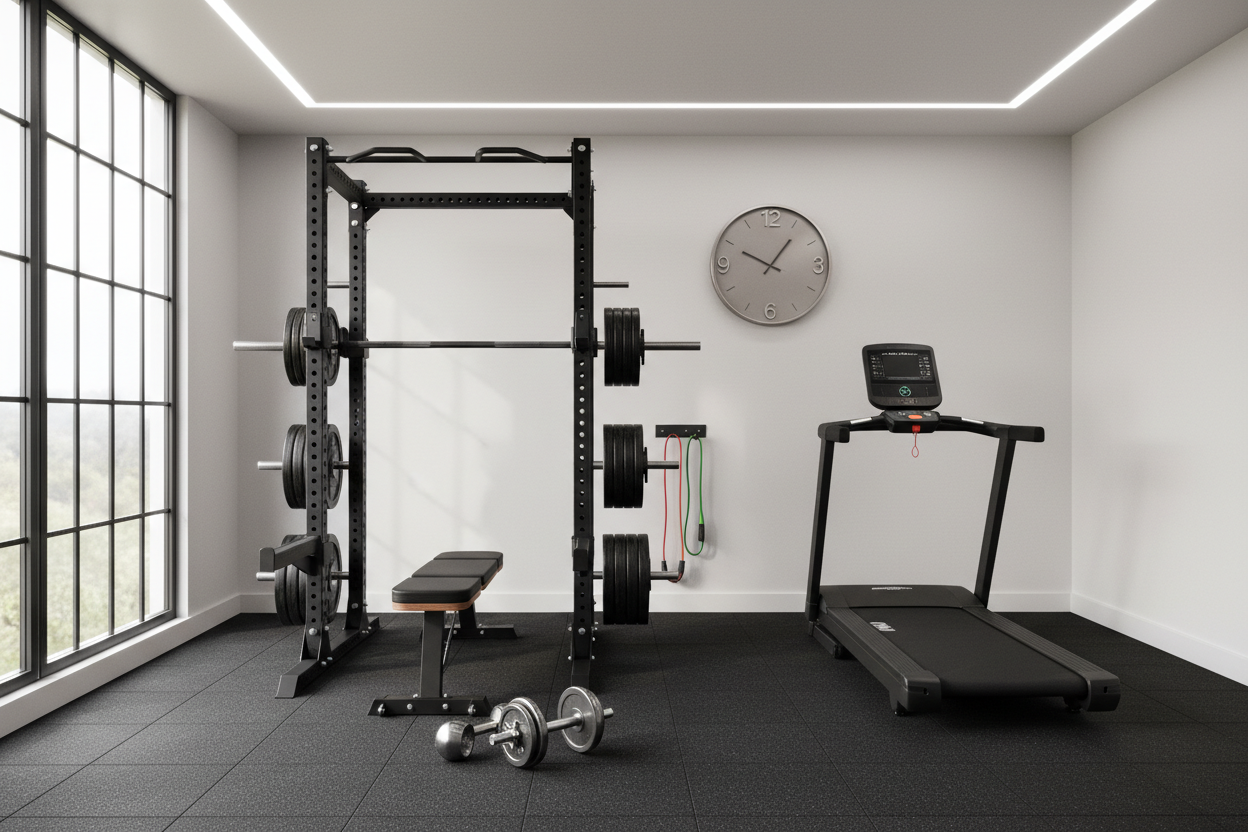
I remember the first time I walked into a high-end commercial facility and saw that row of selectorized pieces. There is something incredibly satisfying about pinning 150 lbs on an ab machine with weights and just crunching away until your midsection is on fire. It feels productive, it looks serious, and it makes you think you are building a bulletproof core.
But then I started building my own garage gym. When you are working with limited square footage, every single purchase has to earn its keep. I quickly realized that buying a dedicated abs machine with weights is one of the fastest ways to waste a thousand dollars and twenty square feet of floor space. You can get better results with gear you likely already own.
Quick Takeaways
- Dedicated weighted ab machines have a terrible footprint-to-utility ratio for home gyms.
- Cable crunches provide the exact same resistance curve as high-end selectorized machines.
- An adjustable bench and a single heavy plate can create more mechanical tension than most weighted ab machines.
- Fixed-track movements like Smith machine crunches offer superior stability for heavy loading without the bulk of a standalone unit.
The Commercial Gym Illusion
Commercial gyms love weighted ab machines because they are 'user-friendly' for people who don't want to learn how to brace. They have the space to fill, so a massive piece of iron that only does one thing isn't a problem for them. In a 200-square-foot garage, that same machine is a liability.
The temptation to buy an abs weight machine usually comes from the desire for 'isolation.' We think that if we are locked into a seat, we can target the rectus abdominis better. The truth? Your core doesn't care if the weight comes from a fancy cam system or a simple cable pulley. Tension is tension.
Why Dedicated Core Machines Ruin Home Gyms
Most standalone abs machine with weights units have a footprint of roughly 4 feet by 3 feet. That might not sound like much until you realize that is the same space required for a power rack extension or a dedicated dumbbell storage rack. For a muscle group that can be crushed with a $20 ab roller or a cable attachment, the math just doesn't add up.
Beyond the space, these machines are often built with fixed pivot points that might not actually match your spine's natural curvature. I have seen more people tweak their lower backs trying to force themselves into a machine's 'ideal' path than I have seen people build six-packs on them.
Hack 1: The Heavy Cable Crunch
If you have a functional trainer or a lat pulldown, you already own the best abs weight machine on the market. Grab a heavy-duty rope attachment, set the pulley to the top, and kneel down. The secret here is anchoring your hips. If your butt is moving back and forth, you are using your hip flexors, not your abs.
Keep your hips locked and focus on bringing your elbows toward your knees. Because it is a cable, the tension is constant throughout the entire range of motion. Unlike a cheap home-grade ab machine with weights, a commercial cable stack is smooth and allows for micro-loading with fractional plates when you hit a plateau.
Hack 2: The Fixed-Track Core Crusher
If you want the stability of a machine without the dedicated footprint, look at your rack. You can actually perform a weighted Smith machine ab workout that mimics the 'fixed path' feel of a pro-grade selectorized unit. By using the fixed bar, you remove the stability requirement, allowing you to move significantly more weight.
I like to set the bar at a height where I can perform a seated crunch against it. It forces the core to handle the entire load without the bar drifting forward or back. It is the closest you will get to a $3,000 Cybex machine using gear you use for squats and presses.
Hack 3: The Decline Bench Overload
This is my personal favorite for raw hypertrophy. Grab an adjustable weight bench and set it to a steep 30-degree decline. Instead of doing high-rep bodyweight sit-ups, hold a 45-lb plate or a heavy dumbbell against your upper chest. This creates massive mechanical tension at the long-lever position.
The decline angle changes the strength curve, making the 'top' of the movement much harder than a flat crunch. You don't need a 200-lb weight stack when gravity and a 50-lb dumbbell are working against you at a 30-degree angle. Plus, when you are done, you can just use the bench for presses.
When Should You Actually Buy One?
I will concede there are two scenarios where a dedicated abs weight machine makes sense. First, if you are a professional bodybuilder with a 2,000-square-foot warehouse gym and money is no object. Second, if you are dealing with a specific lower back injury where you need the chest pad of a machine to offload your erectors entirely.
For the rest of us? Take that $800 you were going to spend on a single-purpose machine and buy a better barbell or more plates. Your gym—and your core—will be better for it.
My Experience With The 'Space Trap'
I once bought a used Hammer Strength ab crunch machine for $250. I thought I scored a deal. Within three weeks, I realized I hated moving it every time I wanted to park the lawnmower. It eventually became a very expensive rack for my gym towels and extra lifting belts. I sold it six months later for $100 just to get my floor space back. Now, I stick to cable crunches and weighted declines, and my core has never been stronger.
FAQ
Are weighted ab machines better than bodyweight exercises?
For building muscle size (hypertrophy), yes. You need to apply the principle of progressive overload just like you do for your chest or legs. Bodyweight crunches eventually stop being a challenge.
Can I use a resistance band instead of weights?
You can, but bands have an ascending resistance curve—it gets harder as you stretch them. An abs weight machine or cable provides more consistent tension, which is generally better for isolation.
How often should I train abs with weights?
Treat them like any other muscle. 2-3 times a week with 48 hours of rest in between is the sweet spot for most people training for strength and aesthetics.
Share:
I Added a Powerlifting Machine to My Garage Gym (And My Total Jumped)
Why the Best At Home Fitness Machines Don't Fold Up