
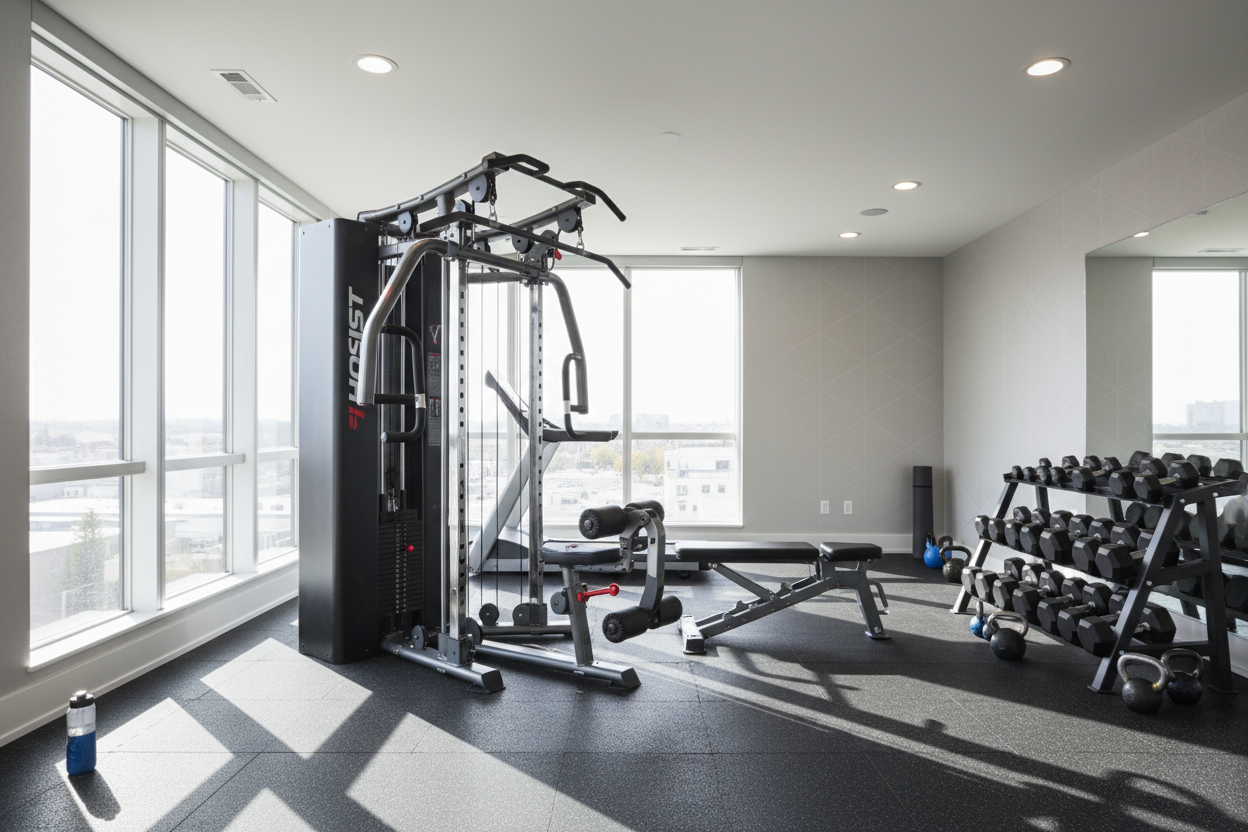
I am the guy who usually thinks a power rack and a pile of rusty iron is the peak of human engineering. But after watching my neighbor drop several thousand dollars on a hoist v3 and seeing it sit there looking like a piece of modern art, I had to know. Is this thing a real training tool, or just a shiny ornament for people who use their treadmills as coat racks?
- Articulating arms provide a surprisingly natural range of motion that mimics dumbbells.
- Small footprint makes it ideal for tight garage corners or finished basements.
- The 150-lb weight stack (upgradable to 200-lb) might feel light for advanced powerlifters.
- Build quality is top-tier with silent pulleys and thick upholstery.
Why I Finally Tested This Suburban Status Symbol
The hoist v3 home gym has a reputation. In the lifting community, it is often seen as the 'safe' choice for people who want to look like they lift without the risk of dropping a barbell on their neck. It is the kind of machine you see in high-end hotel gyms or $2 million suburban basements.
When you are building a premium home gym, the sheer number of options is paralyzing. I decided to spend 30 days with the V3, trading my usual barbell routine for selectorized stacks and cables. I wanted to see if the engineering justified the premium price tag or if I was just paying for the Hoist logo.
The 3D Articulating Press Arm: Gimmick or Game Changer?
The standout feature of the hoist v3 weight machine is the patented 3D articulating press arm. Most home gyms use a fixed pivot point. You push, and the machine dictates where your hands go. It is rigid, often uncomfortable, and ignores the fact that your joints do not move in perfect straight lines.
The V3 arms move in, out, up, and down simultaneously. When I first grabbed the handles, it felt weirdly loose. But as soon as I started a set of incline presses, I got it. The handles naturally converged at the top of the movement, exactly like a pair of 50-pound dumbbells would. It is the closest I have felt a machine get to free-weight mechanics.
How the Cables Feel During Heavy Chest Days
Smoothness is where cheap machines die. If there is a hitch in the pulley or the cable catches, your mind-muscle connection is gone. The Hoist V3 uses high-grade internal cables that feel like they are gliding on ice. Even when I pinned the whole stack, there was no 'stutter' at the start of the rep.
Compared to a dedicated chest press machine independent arms setup, the V3 holds its own. The resistance profile is consistent. You do not get that annoying drop-off in tension at the peak of the contraction that you see on lower-end cable towers. It kept my pecs under fire the entire time.
Where the V3 Actually Falls Short for Serious Lifters
It is not all sunshine and perfect pumps. If you are a 300-pound squatter, you are going to max out the leg extension and the press arm pretty quickly. The standard 150-lb stack is fine for isolation work, but for compound movements, it feels a bit light. You can upgrade to the 200-lb stack, but even then, it is not a replacement for a 500-lb deadlift.
Then there is the footprint. While it is marketed as a compact gym for home setups, that only applies to the base unit. If you decide to add the optional leg press attachment, you are going to need a lot more floor space. It also lacks the raw versatility of a rack where you can do pull-ups, dips, and landmine work without switching pins.
Does It Make Sense Over a Traditional Rack and Cables?
This is the real debate. For the price of a V3, you could buy a world-class power rack, a high-end barbell, and a few hundred pounds of plates. So why buy the Hoist? Convenience. I found myself finishing my workouts 15 minutes faster because I was not loading plates or moving safety bars. You pull a pin and you go.
If you are training for a powerlifting meet, stick to the rack. But if you are a busy professional who wants a high-quality pump without the clutter of fifteen different pairs of dumbbells, the V3 makes a lot of sense. It is quiet, it is safe, and it actually feels good on the joints.
Final Verdict: Who Should Actually Buy the V3?
I went into this test expecting to hate the V3 for being 'too soft.' I was wrong. The articulating arms are the real deal, providing a level of freedom you just do not get on a standard Smith machine or a cheap cable gym. It is built like a tank and will likely outlast your house.
If you have the budget and want the best home gym weight setup that does not require a pile of loose plates, this is it. It is for the person who values their time and their joint health over their max squat number. Just make sure you spring for the 200-lb stack upgrade—you will thank me later.
FAQ
Is the Hoist V3 hard to assemble?
Yes. Do not try this alone unless you have a full day and a lot of patience. There are dozens of pulleys and cables. Pay for the professional installation if it is offered; it is worth the avoided headache.
Can you do leg curls on the V3?
Yes, it has a built-in leg extension and standing leg curl station. The transition is fast, though the range of motion for the curl might feel a bit short if you have very long legs.
How much ceiling height do I need?
The machine stands about 83 inches tall. You want at least 7 feet of clearance to be safe, especially if you are using the lat pulldown bar and do not want to be banging it against the drywall.
Share:
I Tested Every Weight Bench Attachment (Only 2 Are Worth It)
How to Survive Working Out at Planet Fitness If You Lift Heavy