
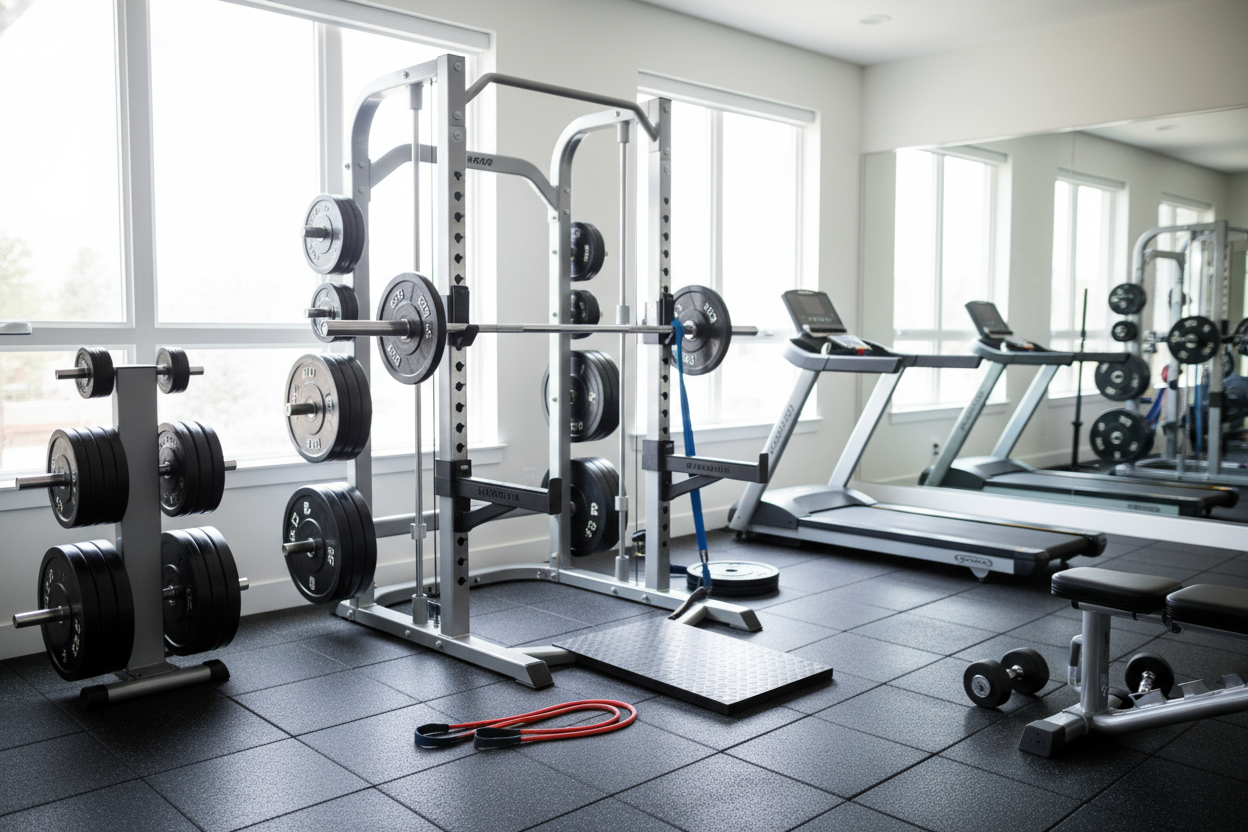
I used to be a total barbell snob. I thought if you weren't bracing for dear life under a free-moving bar while your ankles wobbled, you weren't really training. Then I looked in the mirror and realized my quads were massive, my lower back was constantly fried, and my glutes were basically non-existent. I was working hard, but I wasn't working the right things. That’s when I stopped listening to the purists and started looking for the best glute exercises on smith machine to actually fix my posterior chain.
- Stability Equals Growth: Removing the balance requirement lets you push to true failure.
- Foot Position is Everything: Stepping forward shifts the load from quads to glutes.
- Vertical Shins: This is the secret sauce for glute recruitment on a fixed track.
- Safety First: You can safely hit heavy sets alone in your garage without a spotter.
Why Your Glutes Actually Prefer a Fixed Bar Path
When you're doing a free-weight squat, a massive chunk of your neurological output goes toward not falling over. Your stabilizers are screaming, your core is bracing, and your brain is busy calculating your center of gravity. That’s great for 'functional' fitness, but it sucks for targeted hypertrophy. If your goal is to grow your glutes, you want to be able to push the muscle to its absolute limit without your balance giving out first.
This is where the biomechanics of a fixed path come into play. On a Smith machine, the bar moves on a track. Because the machine handles the stability, you can produce more force. Think of it like a leg press vs. a barbell squat; you can always move more weight on the press because you’re locked in. Adding a home gym Smith machine to my garage setup completely changes your leg day intensity because it allows you to sit into the movement in ways that would be physically impossible with a free bar. You are essentially turning a compound movement into a high-stability isolation-adjacent powerhouse. This is how to use smith machine for glutes effectively: stop worrying about the bar and start worrying about the squeeze.
How to Target Glutes on Smith Machine (It's All in the Feet)
The biggest mistake I see in every commercial gym is people using the Smith machine exactly like a power rack. If you put your feet directly under the bar, the mechanics of the fixed track will drive your knees forward. That is a one-way ticket to Quad Town. To understand how to target glutes on smith machine, you have to master the forward foot placement. By moving your feet 12 to 18 inches in front of the bar, you create a vertical shin angle at the bottom of the rep.
A vertical shin means less knee flexion and more hip flexion. More hip flexion means the glutes are being stretched under load. When you descend, you aren't just dropping down; you are sitting back. It feels more like a hack squat or a box squat. This shift in center of gravity, made possible by the machine’s support, forces the glutes to become the primary driver to get you back to the top. If you don't feel a massive stretch in your glute-ham tie-in, your feet aren't far enough forward.
The Big Three: My Picks for the Best Smith Machine Glute Exercises
Forget the weird 'donkey kick' variations you see influencers doing while hanging off the side of the machine. We are here for heavy, high-tension movements that actually build tissue. If it looks like a circus act, skip it. These three movements are the best smith machine glute exercises because they allow for progressive overload and maximum mechanical tension.
1. The Glute Focused Squat on Smith Machine
This isn't your standard back squat. To perform a glute focused squat on smith machine, set the bar at shoulder height and take a stance that is slightly wider than shoulder-width. Point your toes out about 30 degrees. Now, here is the key: walk your feet forward until you feel like you'd fall over if the bar wasn't holding you up.
As you descend, think about reaching your butt back toward an imaginary chair far behind you. Go as deep as your hip mobility allows—ideally past parallel—to get that deep glute stretch. Because the bar path is fixed, you can stay more upright in your torso while your hips do all the work. This is how to squat on smith machine for glutes without letting your quads take over the entire set. I usually aim for 3 sets of 8-12 reps here, focusing on a 3-second eccentric.
2. The Heavy Smith Machine Hip Thrust
I’ll say it: the Smith machine is objectively better for hip thrusts than a barbell. There, I said it. You don't have to worry about the bar rolling down your shins or crushing your pelvis unevenly. You can lock the bar, slide under it, and focus entirely on the peak contraction. If you've ever felt like Why Your Hip Thrust on Smith Machine Feels Awkward (And How to Fix It), it usually comes down to bench height, but the Smith machine removes half the variables for you.
Set the bar height so it sits right in the crease of your hips when you're seated on the floor. Use a thick pad—don't be a hero. Drive through your heels and explode up, pausing for a full two seconds at the top. The Smith machine allows you to go much heavier than you'd think, and because you don't have to balance the bar, you can really grind out those last few 'ugly' reps that actually spark growth.
3. Deficit Reverse Lunges
This is the most underrated movement in the book. By standing on a 45lb plate or a small platform, you increase the range of motion. When you step back into a lunge on the Smith machine, that deficit allows your back knee to drop lower than the floor level of your front foot. This creates a massive, skin-splitting stretch on the lead leg’s glute. It is easily one of the best smith machine glute exercises for targeting that lower glute area. The stability of the machine means you won't be wobbling side-to-side, so you can actually load this heavy—something that's terrifying to do with a free barbell.
Building a Complete Booty Workout Smith Machine Routine
You don't need twenty exercises. You need four or five done with high intensity and perfect form. A solid booty workout smith machine routine should start with your heaviest compound movement and move toward higher-rep finishers. Here is how I’d structure a dedicated session:
- Glute-Focused Squats: 3 sets of 8-10 reps (RPE 8). Focus on the 'sit back' phase.
- Hip Thrusts: 4 sets of 12 reps with a 2-second pause at the top.
- Deficit Reverse Lunges: 3 sets of 12 reps per leg.
- Good Mornings (Smith Version): 3 sets of 15 reps, focusing on the hinge.
Rest about 90 to 120 seconds between sets. You need your ATP to recover so you can move real weight. If you're looking for more ways to round out your leg day, Stop Wobbly Lunges: 5 Brutal Glute Exercises on Smith Machine offers some great accessory ideas to plug into this framework. Remember, the goal is progressive overload. If you did 135lbs last week, try for 140lbs or an extra rep this week.
Is a Dedicated Home Rig Worth It for Leg Day?
If you're training in a garage gym like I am, safety is the biggest hurdle. I love heavy squats, but I don't love the idea of being pinned under a 300lb bar at 6 AM with no one around to help. Investing in a high-quality unit like the Full Body Multi Training Station Smith Machine DM01 is a total shift in how you train. It’s stable, the tracking is smooth as silk, and the safety catches are reliable. Having a machine that lets you go to absolute failure on lunges and squats without the fear of a trip to the ER is worth every penny. For glute growth specifically, the ability to manipulate your foot placement without losing your balance is the difference between mediocre results and a physique that actually looks like you lift.
My Personal Experience
I once tried to max out my hip thrust with a free barbell in my cramped garage. I didn't have enough room to properly stabilize, the bar tilted, and I ended up dumping 315lbs onto my concrete floor, narrow-missed my toes, and cracked a plate. It was a wake-up call. Switching to the Smith machine didn't just make my workouts safer; it made them more effective. I stopped 'surviving' my sets and started 'feeling' them. The downside? Smith machines take up a footprint. You need to clear a 7x7 area to really use it comfortably, but if you have the space, your glutes will thank you.
FAQ
Can you really build glutes on a Smith machine?
Absolutely. Muscle doesn't have eyes; it only knows tension and load. The Smith machine provides both in a high-stability environment, which is often better for hypertrophy than free weights.
Why do I only feel Smith squats in my quads?
Your feet are likely too close to the bar path. Walk them forward 12-15 inches. This forces your hips to hinge more than your knees, shifting the work to the posterior chain.
Is the Smith machine bad for your knees?
Only if you use poor form. By stepping your feet forward, you actually reduce the shear force on your knees compared to a traditional squat where the knees often travel far past the toes.
Share:
Why Your Power Rack Isn't the Best Equipment for Muscle Building
I Tracked Down the Exact LA Fitness Smith Machine for My Garage