
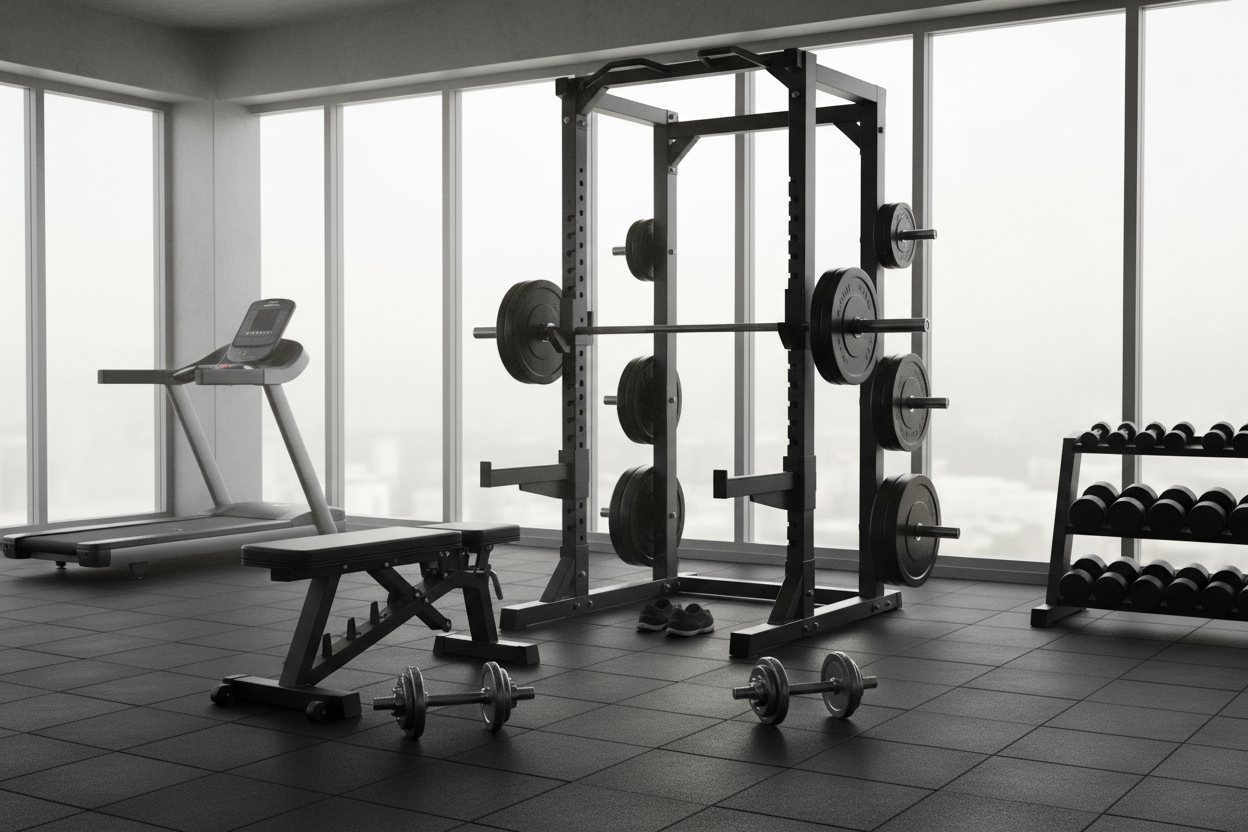
I remember staring at my power rack, bored to tears with the same old back squats. My knees were cranky, and my progress had stalled harder than a rusted-out pulley on a cheap cable crossover. I started playing with every smith machine squat variation I could think of just to stop my brain from rotting. It turns out, that fixed track isn't a crutch; it's a tool for surgical precision on your quads and glutes.
- Fixed paths allow for foot placements that would tip you over with a barbell.
- Front squats on the rack save your wrists from the 'rack position' torture.
- The 'Sissy' variation is a quad destroyer that doesn't require a dedicated bench.
- Safety stops mean you can push to absolute failure without a spotter.
Why I Stopped Doing Just One Type of Fixed-Path Squat
I used to be a barbell elitist. I thought if it wasn't a free-standing 45-lb bar, it didn't count. Then I realized my ego was growing faster than my legs. It's easy to fall into the trap of doing the exact same stance every leg day because it's 'comfortable.' But comfort is where gains go to die. By switching up the types of squats on smith machine, I could lean back, shift my center of gravity, and actually feel my muscles working instead of just surviving the rep.
Utilizing the fixed track to alter your mechanics can break through hypertrophy plateaus that a standard barbell simply can't touch. If you have a Smith machine in your garage, you're sitting on a goldmine of isolation work. You aren't fighting for balance, which means 100% of your neural drive goes into moving the weight. Most home units use a 1-inch or 2-inch guide rod system; as long as you keep those rods lubed with silicone spray, the movement is butter-smooth, allowing for a mind-muscle connection you just can't get when you're worried about tipping over.
The Front Squat: Saving Your Wrists and Torching Quads
Barbell front squats are a nightmare for anyone with tight lats or bad wrists. I've seen guys try to use straps or the 'zombie' grip, but it always feels sketchy once the weight climbs over 225 lbs. On the Smith, you just cross your arms, let the bar sit on your delts, and drive. Because the bar can't move forward or back, you stay perfectly upright. This is huge if you have a long torso and tend to 'good morning' your squats.
This upright torso is the secret sauce. It shifts massive tension directly to the quads without the lower back taking over. I've found that I can get much deeper in the hole with a Smith front squat because the machine handles the stability. No more gasping for air because the bar is crushing your windpipe while you try to balance. Plus, if the bar doesn't have center knurling, it won't even chew up your collarbones while you're at it.
The Sissy Squat Hack: Deep Knee Flexion Without the Fear
This is a highly advanced, quad-isolating move that usually requires a specialized bench. Not anymore. Walk your feet out about 12 inches, lean your torso back so your body forms a straight line from knees to head, and allow your knees to travel far over your toes as you descend. You're essentially leaning into the bar, trusting the track to hold you. It feels unnatural at first, but the pump in your lower quads is undeniable.
It mimics a hack squat on Smith machine setup but with even more brutal emphasis on the teardrop. You must set your safety stops about two inches below your lowest point. I once tried these without setting the pins and folded like a lawn chair when my quads gave out. The machine stayed put, but my dignity didn't. Keep the weight light at first—even just the weight of the bar (which is often counterbalanced to 15-25 lbs) is enough to start.
The Sumo Stance: Waking Up Stubborn Adductors
My adductors were always my weak link. Going wide on a Smith machine feels more stable than a free-weight sumo squat because you aren't fighting to balance the bar laterally. Take a wide stance, flare your toes out at a 45-degree angle, and focus on pushing your knees out as you descend. The fixed path makes this much safer for the hips, especially if your machine has a slight 7-degree angle, which mimics the body's natural path of motion.
You can sit 'back' into the movement more aggressively than you could with a barbell. I like to use this as a secondary movement after my heavy sets to really flush the inner thighs with blood. It’s also a great way to hit the glutes from a different angle without needing a dedicated hip thrust station. If your Smith bar is thicker—say 30mm or 32mm—it actually feels better on the upper traps during these wide-set reps.
The Split Stance: A Bulgarian Nightmare
The Bulgarian Split Squat is a 'nightmare' because of the balance, not just the pain. The Smith machine removes the balance variable. You can load this heavy—I'm talking 200+ lbs—and just focus on driving through that front heel. It’s a hybrid between a lunge and a squat that lets you hit unilateral failure safely. Stagger your feet on the fixed track, and keep your front foot far enough forward that your knee doesn't scream.
Since you don't have to worry about wobbling left or right, you can focus entirely on the mind-muscle connection. I've pushed these to absolute failure where I literally couldn't stand up, and I just clicked the bar into the nearest notch with a flick of the wrist. You can't do that with a barbell without risking a trip to the ER or dumping plates all over your floor mats.
How to Program These Types of Squats on Smith Machine
Don't just do all of these at once or your legs will be useless for a week. Pick one as your primary or secondary move for a 4-6 week block. I usually go for higher reps (12-15) on the Smith to maximize the pump and metabolic stress. If you're running a standard split, swap your secondary leg move for one of these variations to keep the stimulus fresh.
Eventually, you might find you've reached the limit of what a fixed-bar setup can provide for your goals. If you're consistently maxing out the rack and want that commercial-grade feel with a dedicated carriage, it might be time to upgrade to a 3 in 1 hack squat leg press combo machine. But until then, keep tweaking your stance and tempo. The gains are in the details, not just the weight on the bar.
Is a Smith machine squat 'easier' than a barbell squat?
It's not easier; it's different. You'll likely lift less weight on some variations because you're removing momentum and stabilizing muscles. It’s harder on the target muscle and significantly easier on the joints.
Where should I put my feet?
For most quad-dominant moves, place your feet 3-6 inches in front of the bar. For glute focus, go even further out. Experiment with an empty bar first to find where your hips feel most powerful.
Can I do these every day?
Hard no. These variations put a lot of stress on the connective tissue around the knee because of the deep flexion. Stick to 1-2 times per week and listen to your body.
Share:
Is the Rogue Fitness Smith Machine Actually Worth the Price Tag?
The Brutal Truth About Buying a Machine for Leg Press at Home